AI in game development is no longer a futuristic concept, now this definition is a present reality reshaping how teams build, test, and scale games, especially for fast prototyping. Tools once seen as experimental are now deeply entwined with modern workflows. But despite all the hype, one truth stands out:
AI is not replacing game developers, but it’s transforming how they work, collaborate, and create.
And 2025 marks a turning point. AI tools are becoming faster, better trained, and more deeply integrated into production pipelines. But there’s something even more interesting beneath the surface. Let’s explore with GIANTY!
How Game Developers Respond to AI in Game Development
Positive in Using AI Tools
According to the Unity Gaming Report 2025, it shows a clear majority of developers now embrace AI tools:
- 79% of developers are positive about AI in game development
- Only 5% remain apprehensive
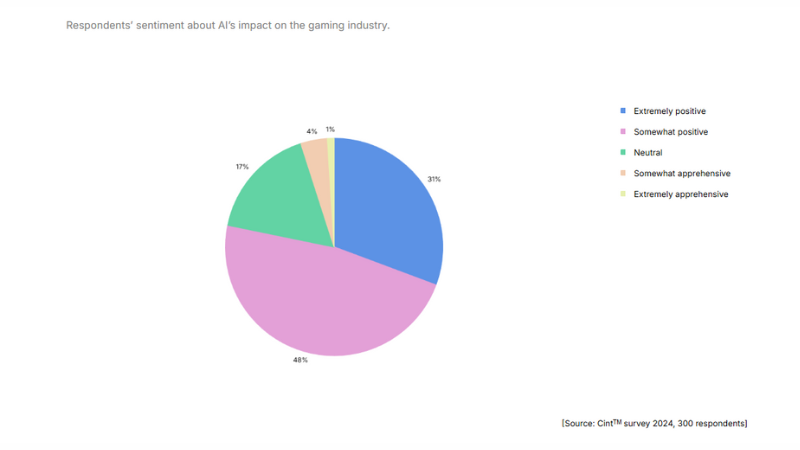
These numbers confirm that AI has become normalized in production workflows. Developers recognize that AI:
- Speeds up routine tasks
- Improves iteration cycles
- Helps maintain production velocity
- Supports experimentation without heavy costs
Efficiency is everything in game development. New AI tools can help teams do more with less, but researching and testing them can drain time and momentum. And despite the hype, AI hasn’t become the creative solution to every problem; most developers use it selectively, treating it as one tool in an already crowded toolbox.
These numbers confirm that AI has become normalized in production workflows. Developers recognize that AI:
- Speeds up routine tasks
- Improves iteration cycles
- Helps maintain production velocity
- Supports experimentation without heavy costs
Efficiency is everything in game development. New AI tools can help teams do more with less, but researching and testing them can drain time and momentum. And despite the hype, AI hasn’t become the creative solution to every problem; most developers use it selectively, treating it as one tool in an already crowded toolbox.
Challenge in Adapting AI in Game Development
Comparing this year’s Unity survey with last year’s reveals an unexpected insight: AI adoption rates have barely changed, but AI use cases have evolved dramatically. Developers are picking up use of AI in game development at roughly the same pace, but what has changed is:
- Tools have become faster, better trained, and more predictable
- Developers have improved at prompting AI and guiding generative models
- AI usage has become a daily habit, not an experiment
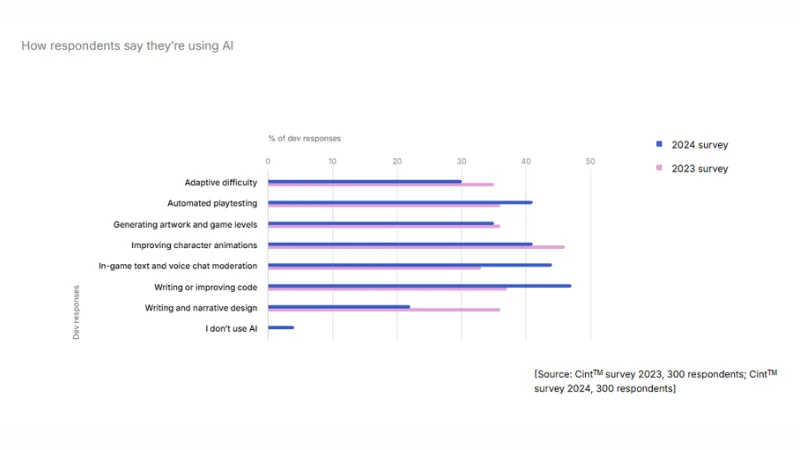
However, two parts of the report are particularly striking: First, a decline in creative AI in game development use cases.
There are slight downturns in AI usage for:
- Adaptive difficulty
- Generating artwork and game levels
- Writing and narrative design
This could mean:
- Developers tested these areas last year
- Found limitations or inconsistencies
- Realized AI output still requires strong editorial oversight
- Chose to keep creative decisions primarily human-driven
And the second part is a rise in support-focused AI use cases. On the other hand, adoption increased for:
- Automated playtesting
- In game text and voice chat moderation
- Writing or improving code
These rising categories indicate that AI is currently most effective as a support tool, strengthening pipelines rather than replacing creative teams.
In short, AI in game development is stabilizing in the areas where it adds the most value, like automation, analysis, and scale.
AI Will Evolve from Helper to “Co-Developer”
The role of AI in game development is shifting from a passive assistant to an active co-creator. AI won’t and shouldn’t replace developers. But it will drastically improve what small and mid-sized teams can achieve. Below are some aspects of game development that can be impacted by AI:
Asset Generation
AI-assisted asset creation is becoming one of the most practical applications of AI in game development. Instead of producing every element manually, generative AI can assist with creating game assets:
- Environment concepts
- Textures and materials
- UI elements
- VFX ideas
- Character prototypes
- Pixel art variations
- Rapid visual iterations
One of GIANTY’s latest internal AI tools is the AI Pixel Tool, an AI-assisted art workflow tool designed specifically for our game development teams. This tool streamlines early-stage visual prototyping by generating consistent pixel-style mockups based on design intent, gameplay context, and asset requirements. Instead of waiting for a full art pass during the prototype phase, developers can now create reliable placeholder visuals in the fastest time. See how it works here.
NPCs Will Become Lifelike, Emotional, and Context-Aware
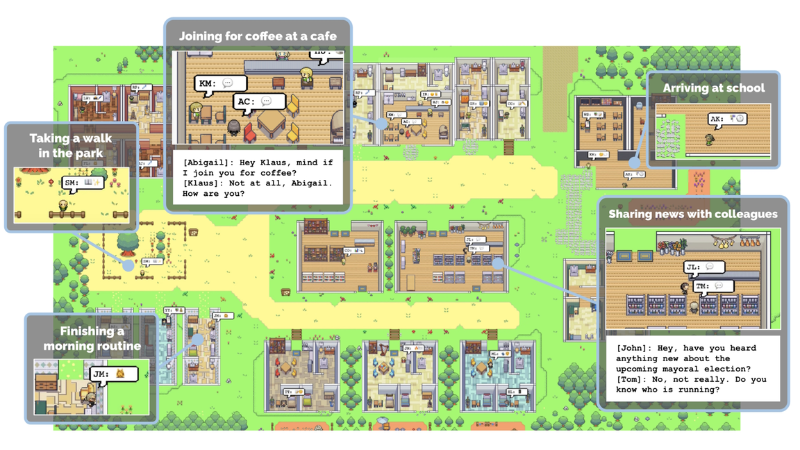
One of the most transformative uses of AI in game development is next-generation NPC behavior.
AI-driven NPCs can:
- Respond dynamically to player actions
- Generate contextual dialogue in real time
- Display emotional states and adaptive animations
- Build memory of past interactions
- Collaborate with other NPCs through agent-based logic
Beside that, with AI-driven personalization, games shift from static experiences to adaptive journeys with hyper-personalized storytelling.
Greater Safety
AI enhances safety both in-game and in online environments:
- Automated moderation for player communication
- Behavior detection for toxic or harmful interactions
- Real-time filtering and dynamic response
- Early detection of exploits or abnormal activity
- Stress-testing and automated edge-case simulations
AI shifts safety systems from reactive to predictive.
Game Design
AI is reshaping core design workflows:
- Generating multiple level variants
- Simulating player behavior
- Identifying balance issues early
- Assisting with mission logic and pacing
- Validating difficulty curves
- Helping designers iterate faster with less manual setup
AI won’t replace game designers but it will extend their strategic and creative reach.
What studios must prepare for AI in Game Development
AI-ready pipelines
To fully leverage AI, studios need:
- Modular pipelines with open APIs
- Toolchains that integrate genAI + procedural systems
- Clean codebases optimized for automation
- Testing/build automation powered by AI agents
GIANTY already applied this into our game prototype, only 2 devs in 30 days. Basically. we don’t rely on AI to create a full asset at once. Instead, we break ideas into parts, use AI for drafts, and let developers artists bring them to life. The main purpose of applying AI in our pipeline is to boost up the speed, make it easier for game devs at first stage to propose their idea without an artist needed. See how we build it.
Rapid Prototyping Will Be Dominant
In the AI era, success belongs to studios that:
- Prototype fast
- Test fast
- Kill bad ideas fast
- Scale winning ideas efficiently
AI drastically reduces the cost of iteration. Studios that cling to heavy, linear production will fall behind.
The Future Team is Humans and AI Working Together
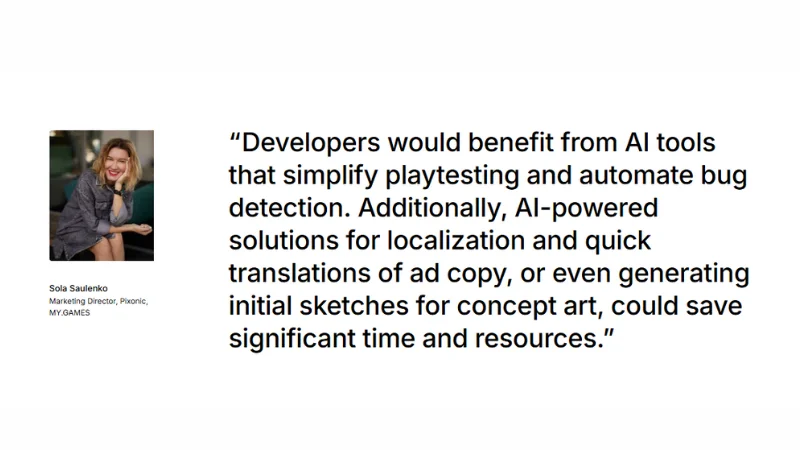
Future-ready developers will build hybrid skillsets:
- Designers who simulate player behavior with AI
- Artists who iterate visual ideas using AI pipelines
- Programmers who guide LLM-based coding assistants
- QA testers who deploy AI agents to catch edge cases
Final Thoughts
GIANTY believes the strongest studios will be those that embrace hybrid workflows: human creativity combined with AI acceleration. Our mindset at GIANTY is simple: AI is a multiplier not a replacement.
We are already integrating: AI-powered rapid prototyping, AI art & pixel pipelines, AI animation, AI-assisted coding,… This gives studios the velocity of large teams without the overhead.
And because AI tools are maturing rapidly, the advantage will go to the studios that adopt early. If you’re exploring AI in your next game whether for prototyping, gameplay systems, or AI-driven NPCs, our team is ready to collaborate. Reach out to GIANTY for your next AI in Game Development plan!
Interested in AI in game development? Don’t let the latest in AI-powered game development pass you by. Subscribe to the GIANTY Newsletter to get more insights from the GIANTY team on automation, prototyping, and the future of game creation.
FAQs
- How popular is AI in game development today?
Developers use AI for asset generation, automated playtesting, code assistance, and in-game moderation. According to the Unity Gaming Report 2025, AI is most effective in support-focused workflows that reduce repetitive tasks and accelerate production.
- Can AI in game development replace game developers?
No. AI supports production but does not replace human creativity, direction, or quality control. Developers remain essential for narrative, art, gameplay design, and ensuring the final vision stays consistent.
- What types of game assets can AI generate?
AI can assist with environments, textures, characters, UI elements, VFX ideas, and pixel-art variations. These tools help teams iterate faster and explore more visual directions without increasing workload.
- How does AI in Game development improve playtesting and QA?
AI agents can stress-test systems, detect bugs, simulate player behavior, and identify balance issues much earlier. This reduces QA time and leads to more stable builds before launch.
- What do studios need to adopt AI in game development pipelines successfully?
Studios need an AI-ready pipeline that supports modern workflows. This includes modular tools, open APIs, clean codebases for LLM integration, automated testing, and clear art direction guidelines. For studios without in-house AI expertise, partnering with a team experienced in AI for game development such as GIANTY – provides a faster, safer, and more reliable path to adoption.