“Can this speed up our concept phase with AI?”
“Can we prototype skins faster with AI?”
“Can we reduce iteration costs with AI?”
“Have you noticed,” someone said during a production meeting earlier this year, “that every studio conversation somehow ends up talking about Generative AI?”
The momentum is real, like we mentioned before about how AI is transforming game development workflows at scale in Google Cloud’s 2025 global study. Generative AI is no longer optional – it’s part of the conversation.
But the reality is more nuanced than the hype.
Can Generative AI truly reshape game asset production? Or simply redefine the role of human artists?
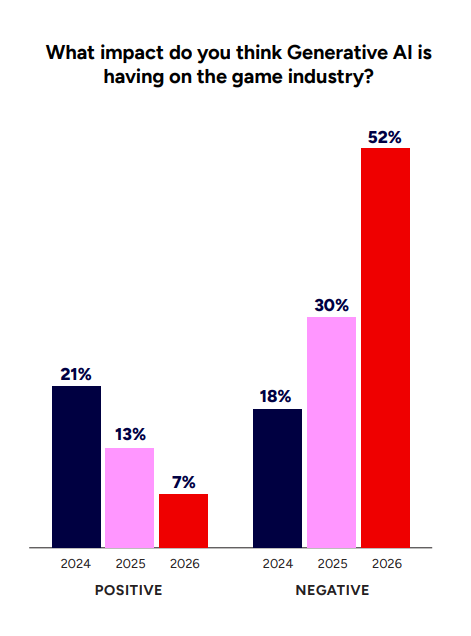
In 2026, industry sentiment reveals growing tension. According to the GDC 2026 State of the Game Industry report, nearly half of professionals believe Generative AI could negatively impact the industry.
In this post, GIANTY will explore with you how Generative AI is changing game asset production and why it hasn’t (yet) transformed it the way many predicted.
The Traditional Game Asset Production Pipeline We All Know
Before we evaluate how Generative AI is reshaping Game Asset Production, in most studios, whether indie, AA, or AAA, asset production follows a structured multi-stage process. For a typical character or environment asset, the workflow often includes:
- Concept ideation
- Sketching and mood exploration
- Internal feedback and revisions
- Final concept approval
- 2D illustration or 3D modeling
- Texturing and shading
- Rigging and animation
- Optimization and engine integration
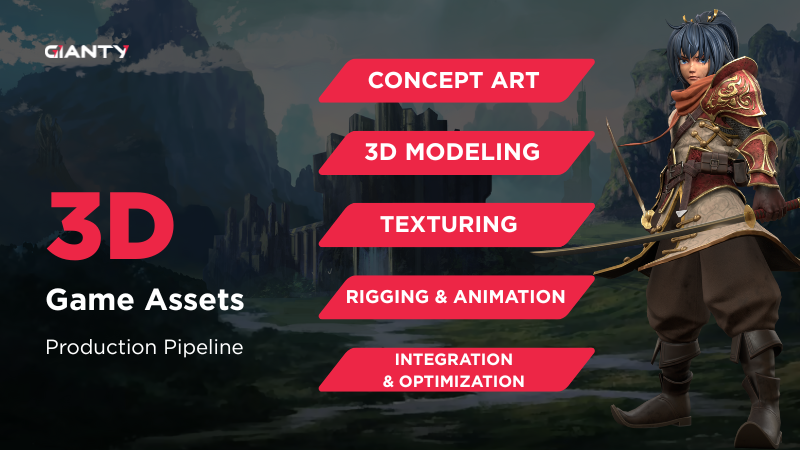
Nearly half of a typical game’s budget is tied to asset creation, which makes game asset production one of the most capital-intensive parts of the entire industry. A major share of that investment goes into building, refining, and maintaining the art pipeline.
Now imagine you’re running a live-service game. Every week, there’s something new to ship.
- A fresh skin.
- An event banner.
- A new gacha character.
- Seasonal UI updates.
- Social media visuals to keep the community engaged.
The content never really stops. At first, the pipeline holds. The team pushes through. Deadlines are met. Assets are approved. Updates go live. The “old” pipeline becomes “a pressure cooker”. And that is why, in the past many years, this is the real tension point Generative AI steps into.
Generative AI Still Can’t Fully Replace Human Creativity, But It Changes What “Creation” Means
What Is The “AI” Hype We Always Hear About
As we mentioned earlier, the cost of game asset production compounds fast. Each stage adds time and budget.
That’s why generative AI is seen as a potential unlock. If it can lower content creation costs and help scale production, it directly targets one of the biggest financial pressures in modern game development.
Generative AI delivers the most value when applied strategically within game asset production as an accelerator across specific stages of the pipeline.
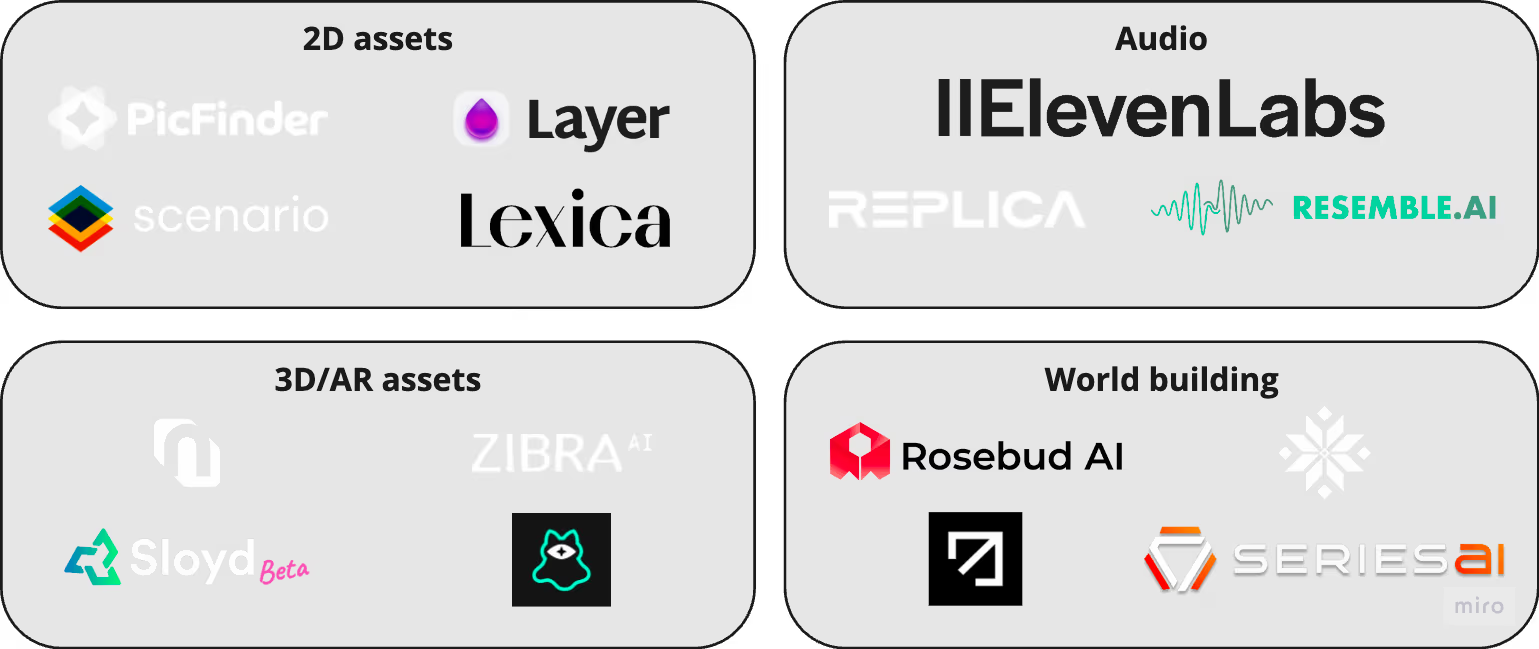
Here are some of the most practical applications today:
- Procedural Content Generation
- Character & Creature Design
- Texture & Material Generation
- Level Design Support
- Animation & Motion Assistance
- Sound & Music Generation
The 2026 Reality Check About Generative AI in Game Asset Production
But here’s the tension.
Studios are curious, even optimistic, like GIANTY with our Pixel Game Art Assets AI Creation, yet cautious.
That gap between promise and production reality is the real issue.
Generative AI is efficient, consistent, and relentlessly productive. But it often produces safe, average outputs.
Human artists, on the other hand, can create distinctive, emotionally resonant worlds – the kind players invest in for years. In an industry driven by immersion and IP value, that creative edge is everything.
The limitations become especially clear in technically demanding areas like:
- Advanced rigging systems
- Fine-tuned 3D mesh corrections
- Shader and material pipelines
- Engine-ready optimization
Layer on licensing concerns and IP compliance, particularly when working with large publishers, and hesitation grows even stronger.
So what’s realistic in the near term?
Not replacing game asset production teams.
But reinforcing the infrastructure around them.
The real opportunity for Generative AI lies in accelerating targeted stages of the pipeline:
- Assisting with rigging preparation
- Generating controlled variations for live-service economies
- Improving asset indexing and reuse
Reducing iteration cycles during early exploration
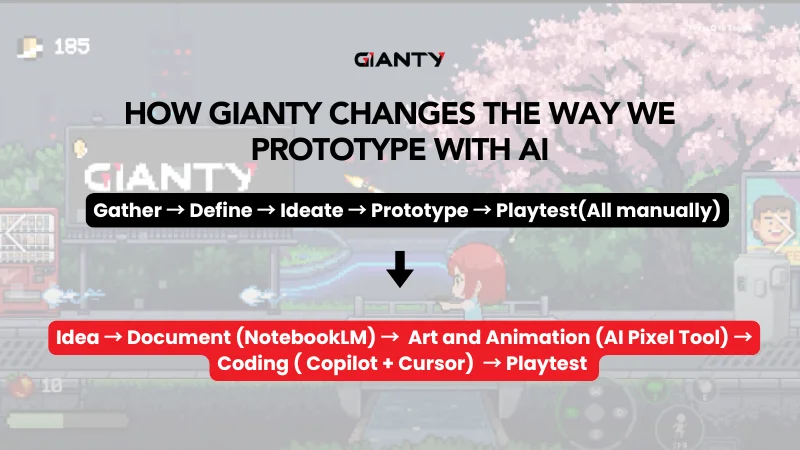
Instead of automating creativity end-to-end, the smarter strategy is targeted efficiency.
For studios navigating rising budgets and increasing content demands, incremental acceleration inside game asset production may be far more valuable than chasing full automation.
Where Generative AI Is Transforming Game Asset Production
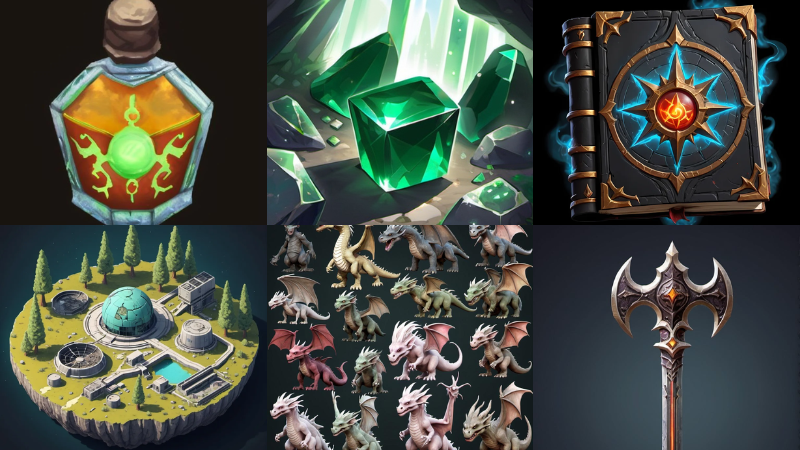
Rapid Concept Exploration
AI can generate dozens of visual ideas from text prompts, helping teams brainstorm and iterate early concepts faster than traditional sketch cycles. This cuts down time to find a visual direction.
Variation & Styling – Not Creation
Instead of creating assets from zero, AI is best at producing variations of existing work, for example:
- Costume variants
- Theme shifts (holiday, environment style)
- Asset reskins
Tools that spin up style-consistent variations accelerate tasks that used to take long revisions, but this is not the same as fully automated content creation.
Asset Indexing & Re-Use
One promising use case isn’t creation at all – it’s smarter cataloging.
AI can help studios search and re-use existing assets by concept, style, or meaning, reducing redundant work and making databases more actionable.
Prototyping & Placeholder Art
Generating quick mockups or placeholders saves time during early prototyping and UI layout stages, but these outputs still need artist refinement before shipping.
In GIANTY’s Mind: Between Hype and Hard Production Reality
The debate around Generative AI in game asset production is often framed too dramatically, either as a revolution that will replace artists or as an overhyped technology that fails to deliver. As a game development company also using AI, we see the truth sits in between.
Generative AI won’t transform production at all because speed isn’t the real problem. The real bottlenecks are quality, consistency, technical precision, and IP safety.
Studios don’t struggle to generate ideas.
They struggle to ship polished, engine-ready assets at scale.
For a solo indie developer, “it saves time” or “it’s cheaper than hiring people” can be the difference between shipping a game and never finishing one. When you’re building alone, efficiency is oxygen.
But a AAA studio doesn’t operate on survival logic. With large teams, long timelines, and significant investment on the line, the goal isn’t just speed or lower cost. It’s polish, consistency, and protecting the long-term value of an IP.
Still, that hasn’t stopped a new generation of well-funded studios from going all in on generative AI. Backed by millions, they’re betting that automation can reshape production from the ground up, even if the quality bar has not fully caught up yet.
The strongest companies in the next phase of gaming won’t be the ones chasing only hype.
So if you’re building a new IP and looking for a partner who understands both game asset production and how to integrate Generative AI intelligently into the pipeline, GIANTY is built for that intersection. Let’s talk about your next game.
Looking ahead to the next trends in gaming and AI? Subscribe to the GIANTY newsletter for expert insights and updates.