“AI is theft. I have to use it, otherwise I’m going to get fired.”
That raw comment from a developer in the GDC 2026 State of the Game Industry survey says more about today’s game industry than any headline.

Generative AI promises faster pipelines, cheaper prototypes, and higher productivity. Yet at the same time, it’s triggering one of the most uncomfortable debates the industry has faced in years: what happens to creativity when machines enter the production pipeline?
And this debate is unfolding at a fragile moment.
The game industry is going through a reset, unlike in the 2025 report. Studios are reorganizing. Investment is harder to secure. Teams are still recovering from waves of layoffs.
The reality, however, is far more complicated than the hype.
AI in game dev isn’t replacing developers overnight. Instead, it’s quietly reshaping how studios brainstorm ideas, prototype mechanics, and accelerate production workflows. Meanwhile, the broader industry is also shifting: more studios are turning to self-funding, engines like Unreal are expanding their lead, and new platforms such as Steam Deck are reshaping the PC ecosystem.
Put simply, AI wasn’t the only shift discussed at GDC 2026. Taken together, these signals point to something bigger: the game industry is entering a new phase.
TL;DR
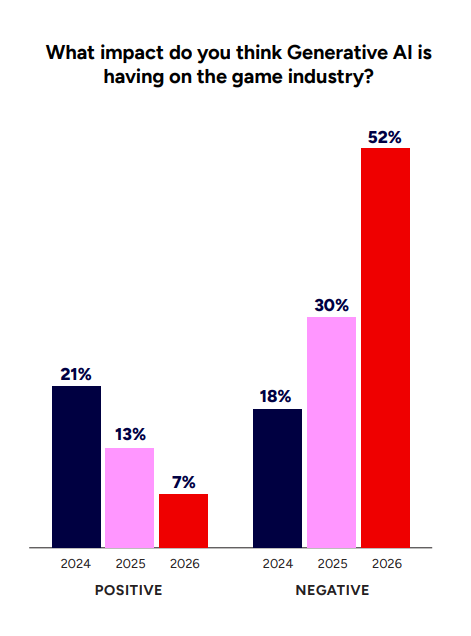
- 52% of game industry professionals say generative AI is negatively impacting the industry.
- Yet 36% are already using AI tools in their daily work.
- Most AI usage focuses on research, coding assistance, and prototyping—not final game assets.
- Funding is tightening, with 35% of studios now relying primarily on self-funding.
- Unreal Engine leads adoption, while Steam Deck and handheld PCs are expanding the PC gaming ecosystem.
The takeaway: AI isn’t replacing game developers but it is forcing the entire industry to rethink how games are created and how studios survive.
AI Is Already in the Pipeline – But Not Where You Might Expect
The most discussed section of the report focuses on generative AI, and for good reason. The technology has moved from speculative conversations into real production environments.
According to the survey in GDC 2026 about Generative AI:
- 36% of game industry professionals already use generative AI in their work
- 52% say their companies are using AI tools somewhere in the organization
- 78% report that their companies now have internal AI policies
Clearly, AI in game development is no longer a personal experiment or side tool. It has become part of the professional production environment.
However, the way studios are using AI today is far more practical and restrained than the media hype often suggests.
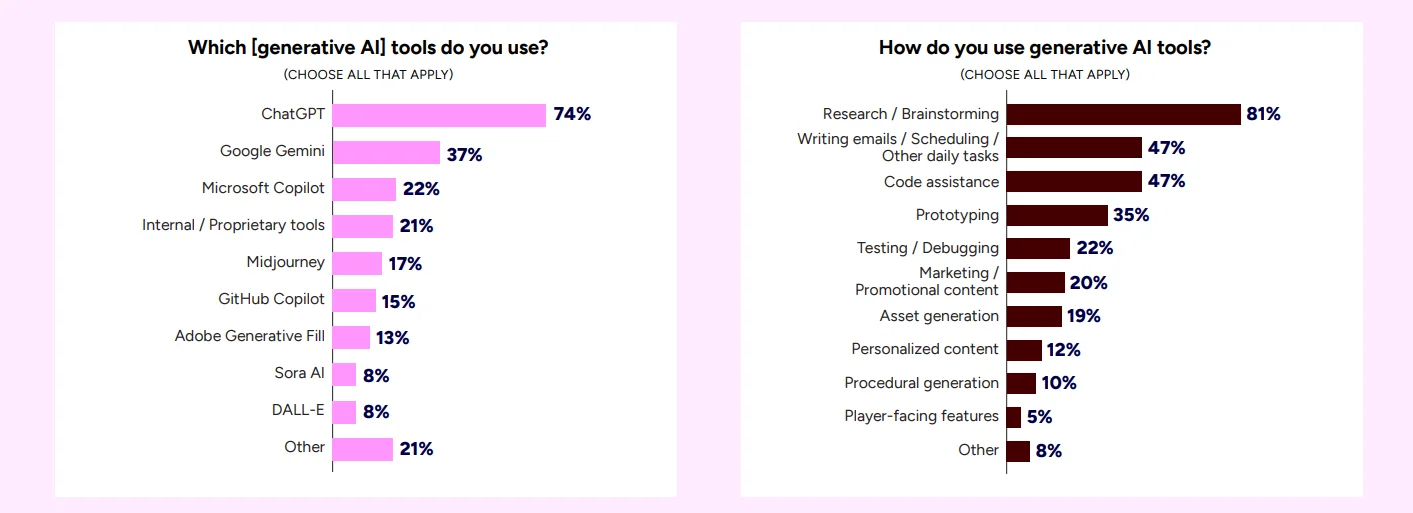
Most AI usage focuses on productivity and workflow support.
The most common use cases include:
- 81% → Research and brainstorming
- 47% → Writing emails and handling daily tasks
- 47% → Code assistance
- 35% → Prototyping
- 22% → Testing and debugging
Meanwhile, AI is used far less frequently in areas tied directly to creative output:
- 19% → Asset generation
- 10% → Procedural content generation
- 5% → Player-facing features
This highlights some important realities about the industry from GDC 2026 report:
- Generative AI in game development functions primarily as a productivity layer not the creative core.
- Large language models clearly dominate adoption. This reflects a broader pattern across the industry: AI for knowledge work is proving immediately useful, while AI-generated creative assets remain more controversial.
- The rise of internal tools is also significant. About 30% of AAA studios report using proprietary AI systems, signaling a shift toward studio-specific AI infrastructure trained on internal data and assets.
“I’d Rather Quit Than Use AI”: Inside the Industry’s Growing AI Backlash
One of the clearest signals from the GDC 2026 State of the Game Industry report is the growing skepticism toward generative AI.
The strongest opposition comes from those closest to the creative process:
- 64% of visual and technical artists
- 63% of game designers and narrative developers
- 59% of programmers
Their concerns reflect deeper questions about authorship, ownership, and the role of human creativity in game development.
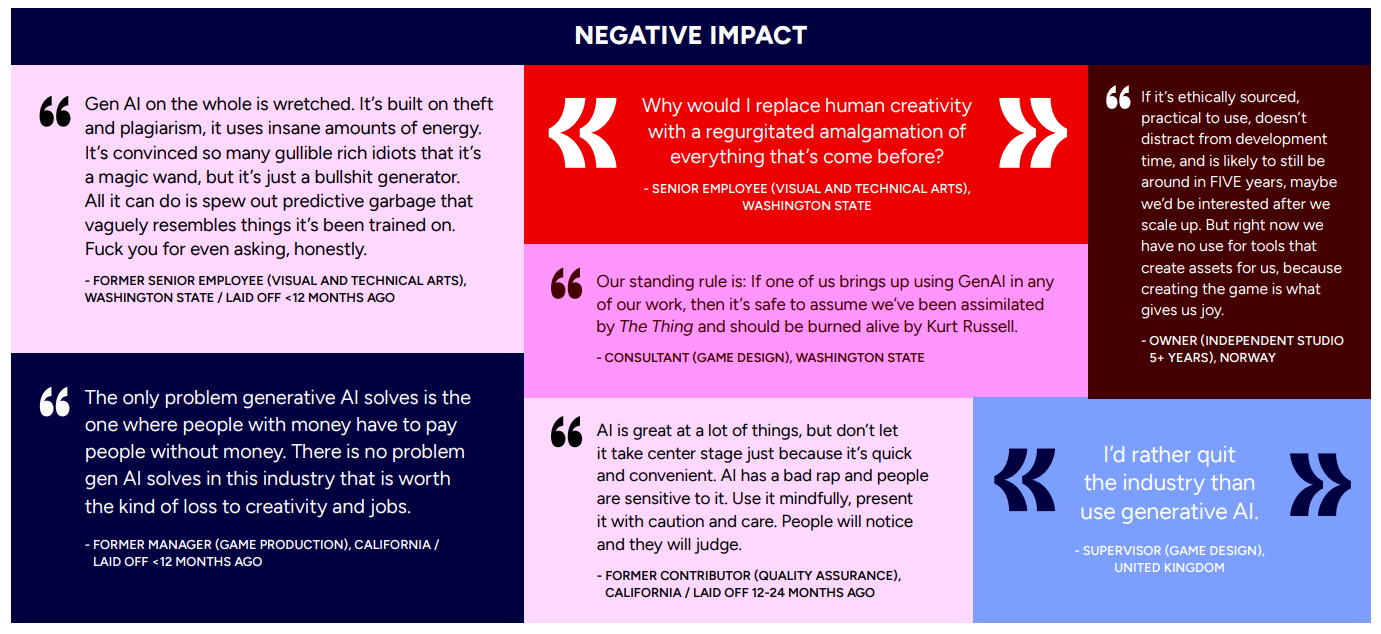
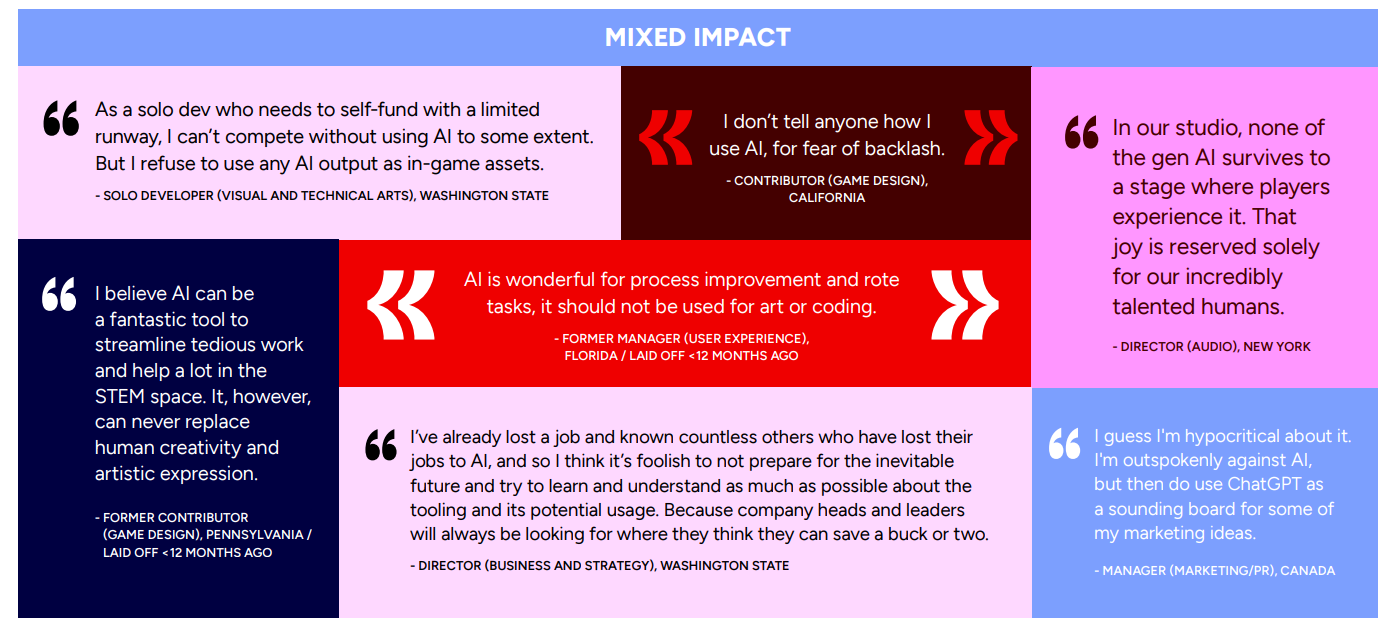
The report notes an interesting pattern: the more professionals understand generative AI, the less enthusiastic they tend to be about it.
This suggests that resistance is not necessarily driven by fear of new technology, but by a clearer understanding of its implications. Developers working closely with production pipelines recognize both the opportunities and the limitations of AI.
When respondents were asked why they oppose generative AI, three main concerns repeatedly surfaced.
- Data sourcing and copyright: The use of scraped artwork, code, and writing from across the internet raises legal and ethical questions that remain unresolved. For artists especially, this issue is personal.
- Job displacement: The fear of automation replacing creative roles remains a major concern.
- Environmental impact: Some respondents expressed concern that widespread AI adoption could conflict with sustainability goals.
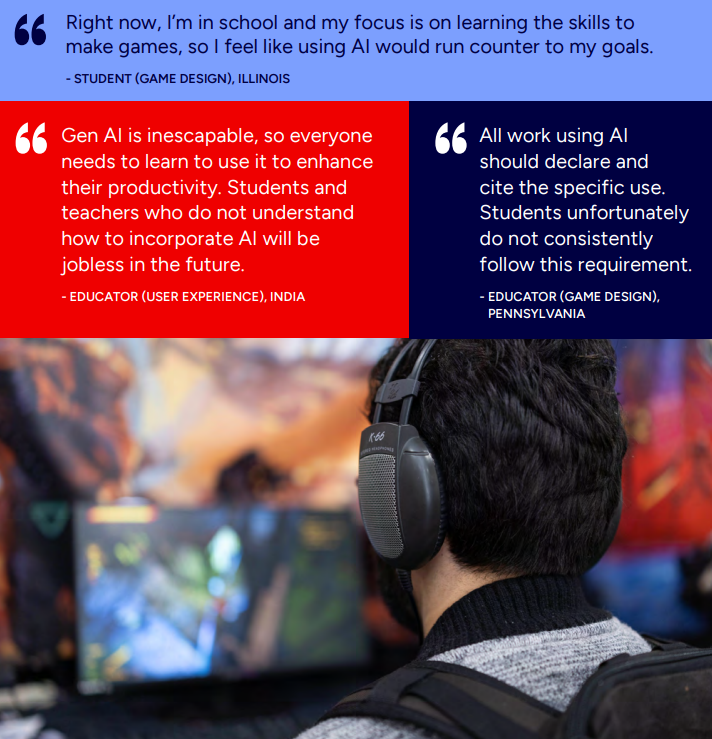
In an unusual experiment, the report fed anonymized survey responses into an internal AI model and asked it a simple question:
Based on these responses, should game industry professionals use generative AI tools?
The AI’s conclusion was surprisingly balanced:
Generative AI can be beneficial for specific non-creative tasks that improve efficiency, but its use in creative production or player-facing content should be approached with caution due to ethical, legal, environmental, and reputational risks.
The Business of Games Is Becoming More Difficult When Solo Devs Becomes A Self-funding
While AI dominates discussion, the report also highlights a major shift in the economics of game development.
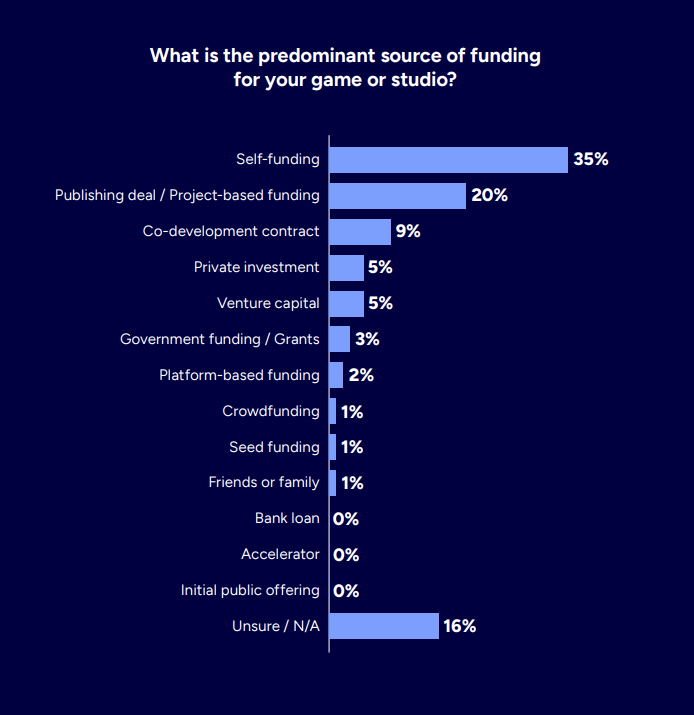
According to the survey, 35% of studios rely primarily on self-funding and for solo developers, self-funding jumps dramatically to 86%.
This reflects a broader contraction in publisher investment and venture capital across the industry. Many studios now must prove strong prototypes or demos before securing external funding.
Developers also report that publishers are increasingly risk-averse, prioritizing proven franchises and predictable returns.
This shift has two major implications.
- First, studios must become more efficient in early-stage development, something that AI-assisted prototyping may help address.
- Second, mid-sized studios are increasingly squeezed between indie budgets and AAA expectations.
Premium Games Still Dominate Production
Despite the popularity of free-to-play titles in the market, most surveyed developers report working on premium games.
The GDC 2026 report shows that 74% of developers are working on premium titles and only 26% are working on free-to-play games.
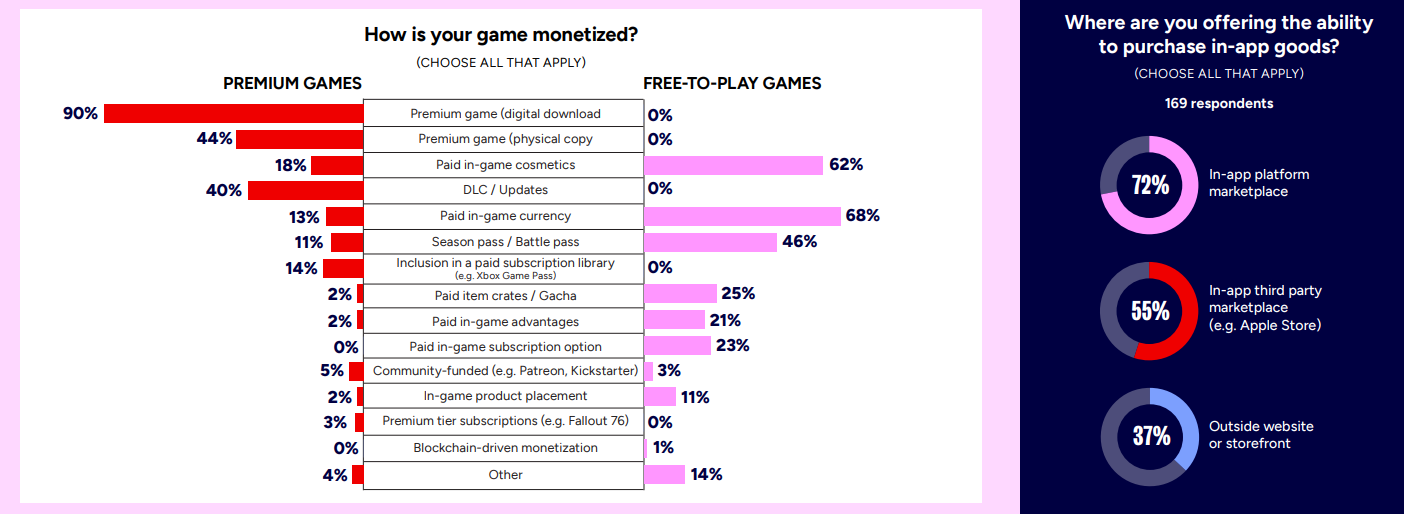
So…Monetization strategies differ accordingly too. For premium games, the most common revenue streams include:
- Digital downloads
- Physical copies
- DLC and updates
- Cosmetic purchases
Free-to-play games rely more heavily on:
- In-game currency
- Cosmetic purchases
- Battle passes
- Gacha systems
Interestingly, blockchain-based monetization appears almost nonexistent, used by less than 1% of respondents. This suggests that many experimental monetization models have yet to gain meaningful traction among mainstream developers.
Unreal Engine Pulls Ahead of Unity
Another major shift highlighted in the report involves game engines. For the first time in the survey’s history, Unreal Engine has pulled ahead of Unity in primary usage.
According to the GDC 2026 report, 42% of developers primarily use Unreal Engine and 30% primarily use Unity.
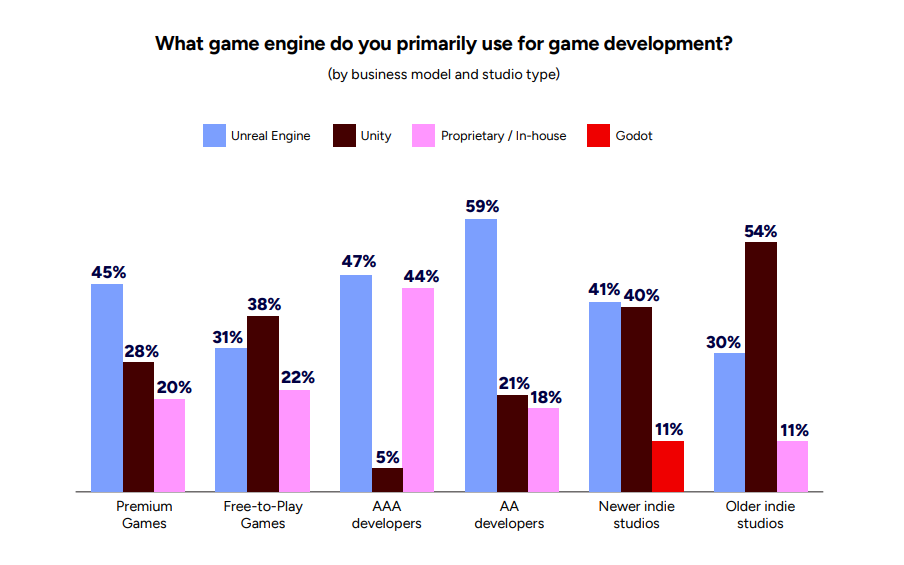
Unreal’s growth appears strongest among AAA and AA studios, where its visual fidelity and robust toolset remain attractive.
Unity, meanwhile, continues to be widely used among indie studios and developers working on free-to-play games.
The Rise of PC Handheld Platforms
Beyond engines, the report also highlights changing platform priorities.
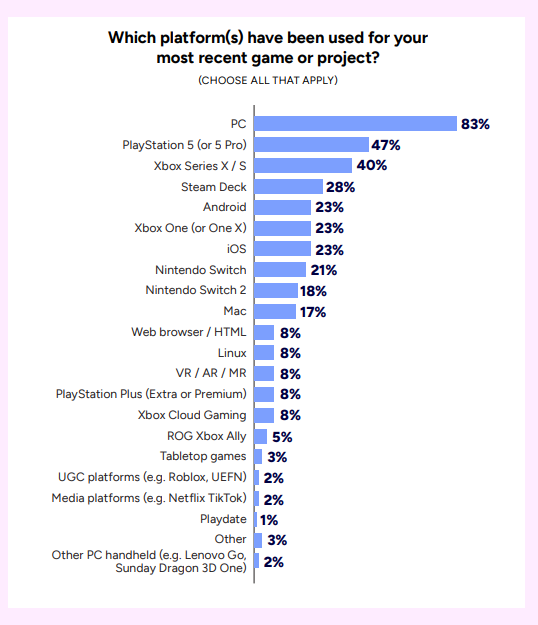
However, one of the most interesting developments is the rapid adoption of handheld PCs.
The Steam Deck has quickly become one of the most supported platforms in development pipelines:
- 28% of developers have worked on games for Steam Deck
- 40% express interest in developing for the platform
This places Steam Deck roughly on par with interest in Nintendo’s upcoming hardware.
The rise of portable PC gaming suggests a future where developers increasingly target PC-first ecosystems that scale across desktop and handheld devices.
Platform Strategy: Reach Still Matters Most
When deciding where to launch a game, developers prioritize several key factors:
- 78% cite audience reach as the most important factor
- 44% cite business model success
- 43% cite discoverability
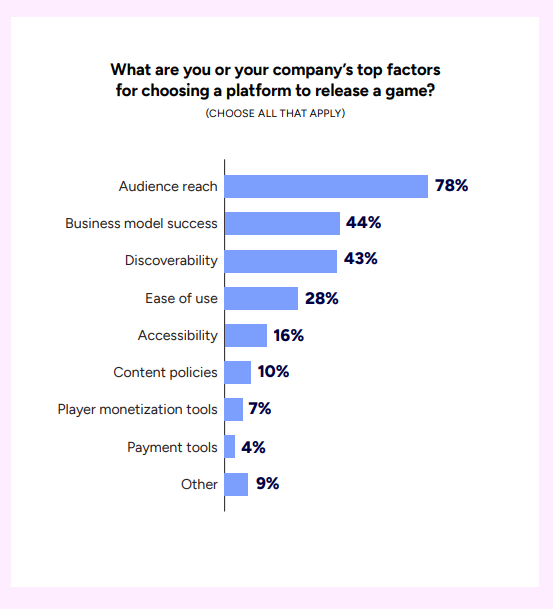
Ease of development and accessibility features also play important roles.
This highlights a simple but important truth: technology choices ultimately follow market opportunity. Developers will continue prioritizing platforms where players already are.
GIANTY’s Perspective from GDC 2026: Technology Alone Won’t Define the Future
Walking through the halls of GDC 2026, one thing became clear very quickly: the industry is not debating a single trend.
Generative AI dominated many conversations, but it was far from the only topic. Developers and studio leaders were also talking about tightening funding conditions, shifting platform ecosystems, and the growing pressure to build sustainable production pipelines.
The State of the Game Industry 2026 report reflects this same tension. The game industry is entering a phase where technology alone will not determine success.
If anything, one of the clearest takeaways from GDC 2026 is that the studios best positioned for the future are not necessarily those chasing every new tool. From what we observed at the GDC 2026 report, 3 capabilities will likely define the next generation of successful studios.
- First, thoughtful AI integration. AI is already entering development pipelines, but the debate at GDC 2026 made one thing clear: studios are still figuring out where it belongs.
- Second, adaptable development pipelines. Studios that design pipelines flexible enough to adapt across engines and platforms will have a strategic advantage.
- Third, treating game development as both craft and business. Great ideas alone are no longer enough; teams must also understand market positioning, platform strategy, and production economics.
The future of games won’t be decided by AI alone but by the studios bold enough to rethink how games are built. And that’s exactly the future GIANTY is building toward.
Looking ahead to the next trends in gaming and AI? Subscribe to the GIANTY newsletter for expert insights and updates.