A product team we spoke to recently had a familiar problem.
They redesigned their UI. They improved onboarding. They even added rewards and badges. But nothing moved.
Users still dropped off after the first few sessions. Because the real problem wasn’t the interface.
In 2026, user engagement is no longer about making things look better or feel smoother. It’s about designing systems that guide behavior, reinforce progress, and continuously adapt to users.
According to McKinsey, companies that get personalization right can unlock 5–15% revenue growth and up to 30% higher marketing ROI.
That sounds impressive. But here’s the real question most leaders don’t ask:
“What actually makes personalization work at that level?”
Because tools alone don’t do it. Dashboards don’t do it. Even AI alone doesn’t do it.
And this is where AI and Gamification come together.
Not as trends. But as a new framework for how your digital app works.
Overview (TL;DR)
- Engagement is no longer a UX layer, but now it’s a system tied directly to revenue and retention.
- AI personalizes the journey in real time, and gamification motivates action.
- The winning pattern is a loop: behavior to feedback to personalization to repeat.
- AI and Gamification together create habits, not just usage.
- Treat engagement as a product capability, not a campaign.
What AI and Gamification Actually Change in App Development
A good product solves a problem. A great product builds a habit.
And habits are not built with logic. They’re built with timing, feedback, progress, and emotion (or we already said that is personalization). That’s exactly where the formula: AI and Gamification actually change in app development.
Actually, some businesses already understand this, but make it wrong. Why? Most teams still treat AI and gamification as features like placing a chatbot here or creating a reward system there – But they’re not.
AI for User Journey
Traditional products assume one ideal journey.
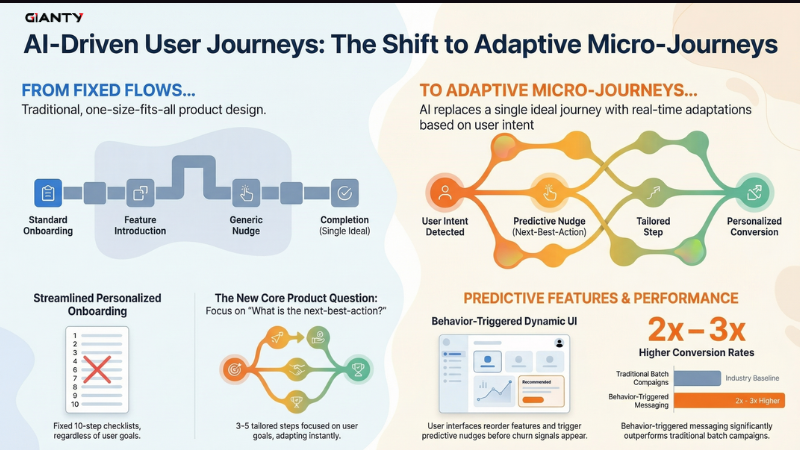
AI breaks that assumption. Instead of a single flow, users now experience micro-journeys that adapt in real time based on intent, behavior, and context:
- Personalized onboarding paths: only 3 – 5 steps tailored to user’s goal instead of a fixed 10-step checklist
- Real-time recommendations: next-best-action based on recent events, not static menus.
- Predictive nudges: triggered before churn signals become visible.
- Dynamic feature prioritization: UI reorders based on likelihood to convert.
This is not theoretical. Behavior-triggered messaging can drive 2–3x higher conversion rates compared to batch campaigns (industry benchmarks).
From a product leader’s perspective, instead of asking “what should the flow be?”
You’re now asking: “What is the highest-probability next action for this specific user – right now?” That’s the real shift.
Example: Fintech App (Activation Flow)
Without AI:
- Same onboarding for everyone (8–10 generic steps)
- Same feature exposure regardless of intent
- Drop-off concentrated at step 3–4 (typical pattern)
With AI:
- Users tagged as “saving intent” see a 3-step budgeting flow first
- “Investment intent” users are routed to portfolio setup immediately
- Users showing hesitation (idle time, repeated exits) receive simplified flows or nudges within minutes
Gamification for fun and user engagement
A source report said that customer engagement surges 48% with gamification, leading to increased time spent on platforms and stronger brand interaction across digital channels.
Gamification is one of the most misunderstood concepts in product design. Most teams think of gamification for user engagement only about:
- Points
- Badges
- Leaderboards
But that’s just the surface. Gamification is about:
- Making progress visible
- Reinforcing meaningful actions
- Creating motivation loops
It’s not about entertainment. It’s about behavior design.
The Dependence of Gamification on AI
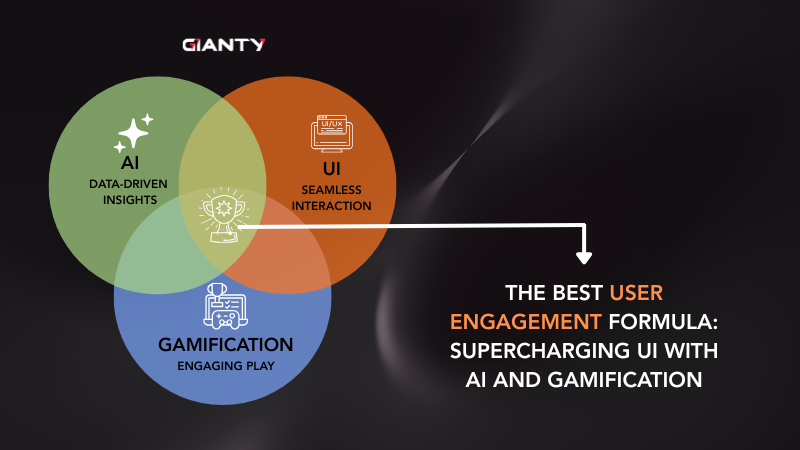
AI Makes Gamification Adaptive
AI transforms gamification from a static layer into a dynamic system.
Instead of fixed mechanics, you get:
- Adaptive difficulty (challenges adjust based on user ability)
- Personalized rewards (aligned with user motivation)
- Context-aware timing (nudges triggered at the right moment)
- Dynamic progression paths (users don’t follow the same journey)
This is the same principle used in AI and gamification high-retention systems like:
- Streaming platforms with content recommendation loops (For example, Spotify combines AI-driven recommendation systems with gamified, shareable experiences like Spotify Wrapped, contributing to high user retention often estimated in the 70–80% range for active users)
- Fitness apps (habit reinforcement + streak systems)
Data Is the Fuel of Gamification
Gamification without data is guesswork.
AI turns every interaction into signals:
- What users complete → intent
- Where users drop → friction
- What users repeat → habit formation
Together, they create a self-improving system: Engagement → Data → AI → Better Experience → More Engagement
Challenges and Considerations with AI and Gamification
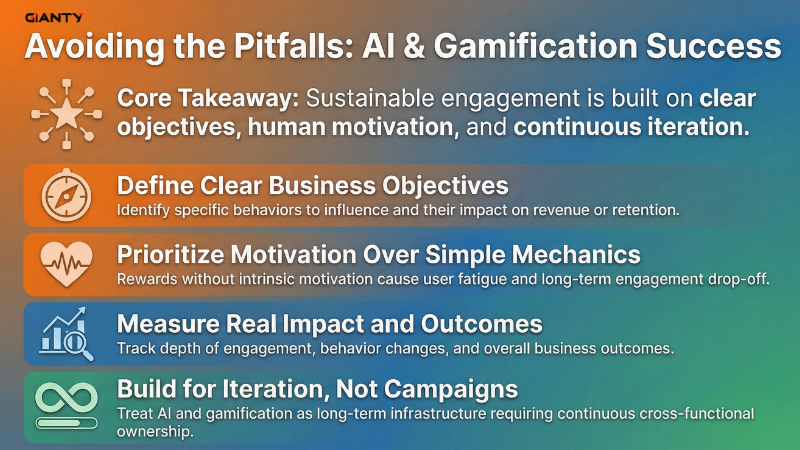
No Clear Business Objective
If you can’t answer:
- What behavior are we influencing?
- How does it impact revenue or retention?
Then your system has no direction.
Over-reliance on Mechanics
Adding rewards without understanding motivation leads to:
- Short-term spikes
- Long-term drop-off
- User fatigue
Lack of Measurement
You should measure:
- Engagement depth
- Behavior change
- Retention impact
- Business outcomes
Treating It as a Campaign
Gamification is not a one-time feature.
AI is not a one-time integration.
Both require:
- Continuous iteration
- Cross-functional ownership
- Data infrastructure
A New Perspective: When Users Don’t Behave Like Users
Most products assume users behave rationally, but in reality, users behave more like players driven by feedback, rewards, and progress. Like we said about personalization, no more “user” – now just “person”. And with AI and Gamification, user behavior is shaped dynamically through real-time feedback and personalized experiences.
Motivation Over Mechanics
- Many teams focus on gamification mechanics such as points, badges, and leaderboards because they are easy to implement and replicate.
- These mechanics alone do not drive long-term engagement and are often ignored by users over time.
- The key driver of user behavior in AI and Gamification is motivation, not mechanics.
- Adding more features without understanding user motivation leads to low engagement and poor retention.
Core Motivation Drivers in AI and Gamification
- Progression: Users need to feel a sense of continuous advancement and visible improvement.
- Mastery: Users are motivated by developing skills and gaining competence over time.
- Recognition: Acknowledging user effort increases satisfaction and encourages repeat behavior.
- Anticipation: Future rewards and expectations keep users returning to the product.
- Participation: Users engage more deeply when they feel involved and part of a system.
Final Thoughts: Engagement Before Revenue?
It may be uncomfortable to admit, but the shift is already happening. In 2026, engagement is becoming the new currency. Businesses can no longer rely on transactions alone. The real competitive advantage lies in sustained interaction over time.
What a Modern Engagement System Looks Like
What does a modern engagement AI and Gamification system look like? A scalable engagement system powered by AI and Gamification typically includes:
- Behavior Objective: Clearly define the action you want users to take and repeat.
- Gamified Structure: Design how progress is visualized and how actions are reinforced.
- AI Personalization Layer: Determine who sees what, when, and why based on user behavior and intent.
- Feedback Loop: Ensure the system responds instantly to user actions with relevant signals.
- Measurement System: Continuously evaluate performance and optimize based on real data.
GIANTY’s Expertise in AI and Gamification
With experience in building AI-driven applications and behavior-focused digital products, we help organizations move beyond surface-level improvements and design engagement systems that deliver measurable business outcomes.
Whether you are launching a new product or looking to improve engagement and ROI in an existing one, we can support you in defining the right behavior strategy, implementing AI and gamification effectively, and scaling it with confidence.
If this aligns with your goals, we’d be glad to explore how we can work together.
FAQs
1. What is AI and Gamification in product development?
AI and Gamification combine artificial intelligence with behavior design to create adaptive user experiences. AI personalizes the journey in real time, while gamification reinforces user actions.
2. How can AI and Gamification improve user engagement?
AI and Gamification improve engagement by delivering personalized experiences, real-time feedback, and meaningful progress systems. Instead of static user flows, products can guide behavior dynamically, increasing activation rates, session frequency, and retention.
3. Does AI and Gamification work for enterprise and B2B products?
Yes. AI and Gamification are highly effective in B2B environments, especially for onboarding, feature adoption, and internal tools.
4. Can AI and Gamification be implemented in existing products?
Yes, but it requires more than adding features. Successful implementation involves redesigning user journeys, identifying key behaviors to drive, and integrating AI-driven personalization with gamified feedback systems.
5. What business metrics should be tracked when using AI and Gamification?
Key metrics include user activation rate, retention, engagement depth, feature adoption, and lifetime value (LTV). In practice, defining and tracking the right metrics requires a strong understanding of both user behavior and system design. This is where working with an experienced partner like GIANTY can help.