Now, agentic systems change the equation of how we work.
Instead of building systems that only follow instructions, businesses can now design agentic systems that:
- Understand goals
- Decide next actions
- Adapt when conditions change
This isn’t future talk. Gartner says executives have 3–6 months to define their Agentic AI strategy or risk falling behind. And by 2026, 40% of enterprise apps will include AI agents (up from <5% today).
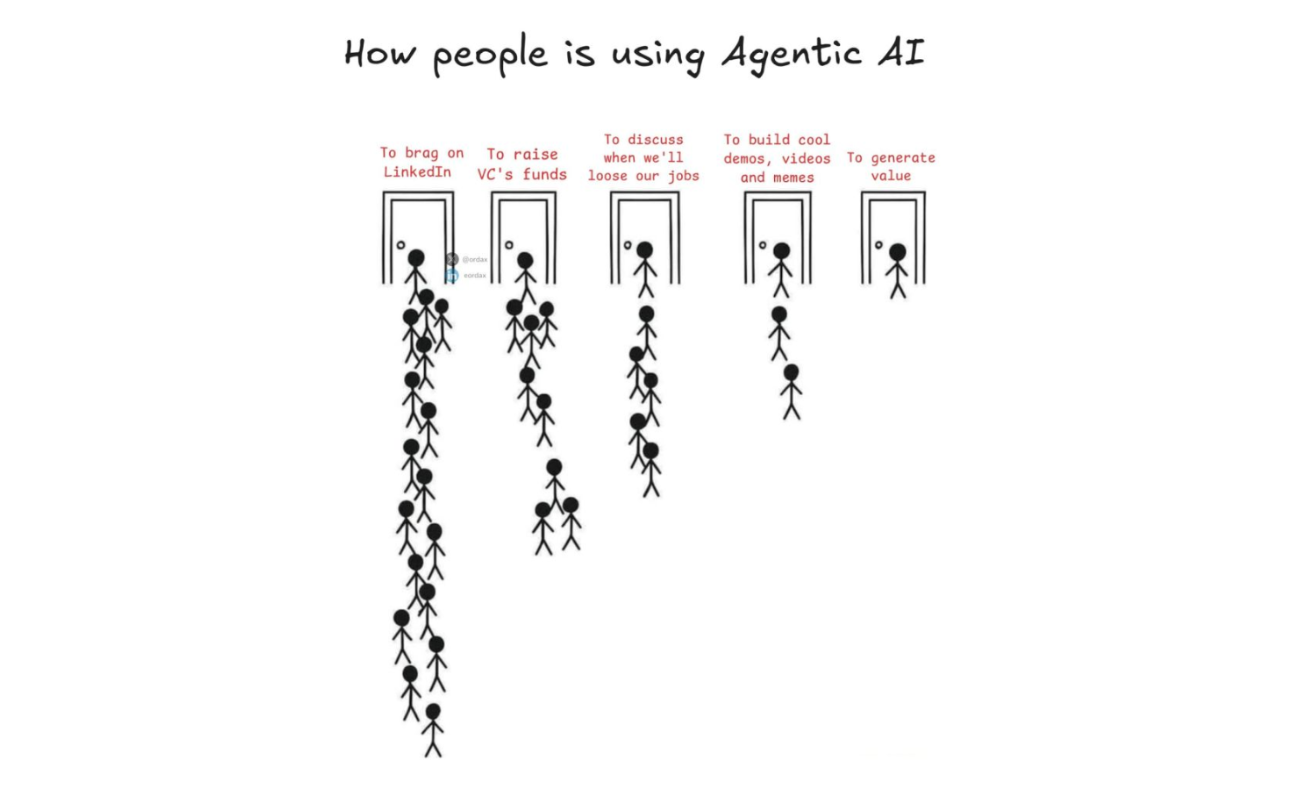
Everyone’s talking about Agentic AI… inside your company, too. But behind all the noise, what’s rare is that not many people use it for something that actually matters.
But first, let’s take a deep dive into the fundamentals of agentic systems—how they actually work, and what it really takes to make them deliver value, with GIANTY.
TL;DR
- Agentic Systems are AI systems that can plan, decide, and take actions autonomously toward a goal.
- They go beyond traditional automation by adapting to changing inputs and environments.
- Best used in complex, multi-step, decision-heavy workflows.
- Not suitable for simple, rule-based tasks where automation is enough.
- Businesses should focus on clear use cases, strong evaluation, and controlled deployment.
What Is an Agentic System?
An Agentic System is best understood through one key idea: goal-oriented delegation.
Instead of telling the system how to do something step-by-step, you define what outcome you want. The system figures out the rest.
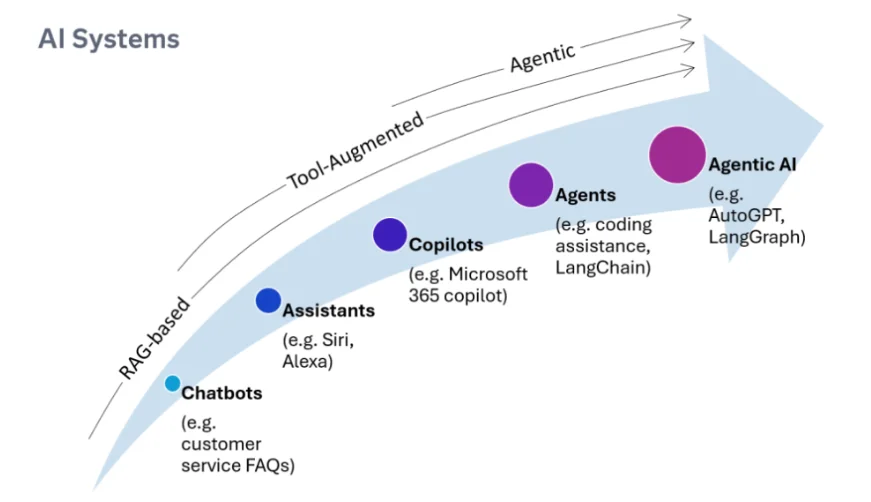
And yes, besides the “AI” factor, this is fundamentally different from traditional systems. It shifts from:
- Micromanagement → Delegation
- Fixed workflows → Adaptive strategies
In The Architect’s Playbook, Stephen Cheng, modern agentic systems also rely on two critical internal mechanisms:
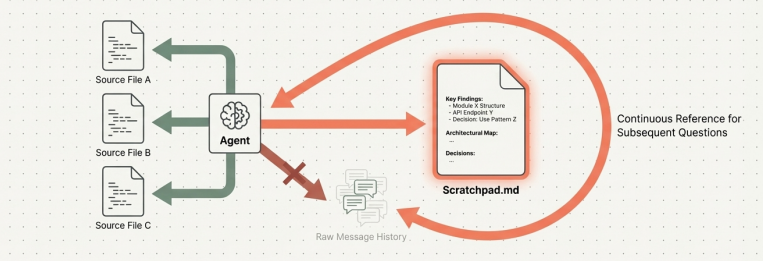
- Scratchpad (working memory): The agent keeps track of intermediate reasoning, decisions, and context while solving a task
- Shared Memory: Enables multiple agents or steps to access and build on the same evolving context
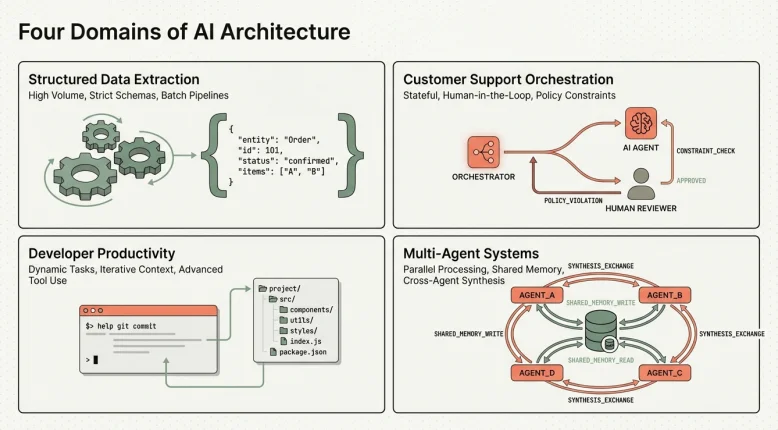
These are what make agents feel “stateful” and capable of handling longer, more complex workflows, not just single prompts. Instead of executing predefined instructions, it can:
- Understand goals
- Break them into steps
- Make decisions along the way
- Take actions across systems
- Adjust based on outcomes
In short, the agentic system behaves less like a tool and more like an operator. It thinks in steps, remembers context, and adapts strategy toward a goal.
How Agentic Systems Work
At a high level, an Agentic System operates through a continuous loop, often described as sense → plan → act → evaluate → improve:
- Define the Goal: The system starts with a clear objective aligned with business outcomes (examples like resolving a support case, onboarding a vendor).
- Sense the Environment: The agent gathers context from systems like APIs, CRMs, databases, or real-time signals to understand the current state.
- Plan the Actions: Based on available data and past patterns, the agent determines a sequence of steps to reach the goal, adapting when uncertainty arises.
- Act Autonomously: The agent executes actions across tools and systems (trigger workflows, update records, send notifications) with minimal human intervention.
- Learn and Improve: The system evaluates outcomes, incorporates feedback, and refines future decisions over time.
This loop is what allows an agentic system to move beyond static automation and operate in dynamic, real-world environments.
But in production systems, this loop is not abstract; it is implemented through a structured architecture:
- Routing Layer: Determines which path or agent handles the request
- Execution Layer: Where agents call tools and perform actions
- State Management: Tracks progress, memory, and intermediate outputs
- Validation Layer: Ensures outputs meet business constraints
The key takeaway: Agentic systems are not just “LLM + tools.” They are carefully orchestrated systems with strict control layers around flexible reasoning.
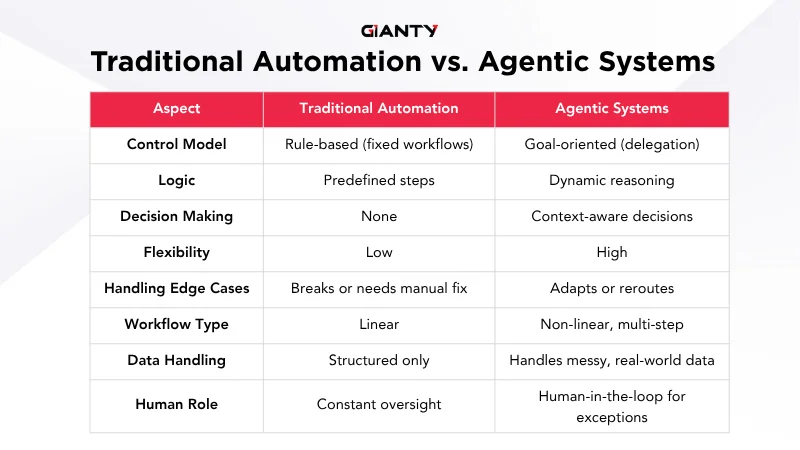
Agentic Systems vs. Traditional Automation
Traditional automation follows predefined rules: If X happens, Do Y. This is essentially micromanagement at scale.
Agentic Systems operate differently: Given a goal, figure out how to achieve it. This is goal-oriented execution.
Common Business Use Cases for Agentic Systems
When Agentic Systems Are Worth Using
Agentic systems shine when you need to balance multiple constraints at once:
- Accuracy
- Latency
- Cost
- Compliance
This trade-off is a core architectural decision, not just a technical one.
They are especially valuable when:
- Tasks can be parallelized to reduce latency
- Workflows require strict compliance (zero-tolerance policies)
- Multiple systems must coordinate dynamically
A practical example: In document-heavy workflows (like tax or finance), instead of processing everything in real-time, you can reduce data entry time in CPA firms to automate extraction and validation. This kind of intelligent routing is something traditional automation cannot handle well.
AI Tax, one of the case study for heavy-document industries
When Agentic Systems Are Not Worth It
There are clear cases where Agentic Systems are overkill.
Avoid using them when:
- Tasks can be handled via batch processing (cheaper, simpler)
- Workflows are deterministic
- Input data is incomplete or unreliable
Important insight: Agents cannot create truth from missing data. If your system lacks data quality, adding an agent will not fix the problem; it will amplify it.
Governance, Guardrails, and Risk
Agentic systems bring autonomy, adaptability, and initiative. That’s what makes them powerful. But these same traits can also make outcomes harder to predict or explain. When agents operate with minimal human input, it becomes essential to ensure they operate within appropriate boundaries.
This is where governance comes in. It provides the oversight, controls, and transparency required to use agentic systems responsibly.
Core Risks to Address
- Automation Bias: As agents become more capable, teams may begin to trust their outputs without question.
- Intent Drift: Agents optimize for the goals you define – not necessarily the outcomes you expect.
- Hallucinations & Data Gaps: Agents may generate plausible but incorrect outputs if data is missing or ambiguous.
- Error Propagation: One incorrect decision can cascade across multiple steps.
- Observability & Cost Gaps: As systems become more autonomous, tracking decisions, debugging issues, and controlling cost becomes more difficult.
Guardrails for Production Systems
Good governance combines both technical and operational controls:
- Outcome Clarity: Define clear success criteria aligned with business goals
- Auditability: Ensure every decision and action is traceable and explainable
- Escalation Logic: Route low-confidence or incomplete cases to humans
- Real-time Monitoring: Track behavior and detect anomalies early
- Compliance Controls: Enforce legal and regulatory requirements automatically
- Security Boundaries: Restrict permissions and isolate sensitive actions
The key idea: Agentic systems should not just be intelligent, they must be governed, observable, and controllable by design.
How to Start with Agentic Systems
From experience, the most successful implementations are not fully autonomous, they are well-governed systems with clear boundaries between AI and human decisions.
Most companies make the mistake of starting too big.
A better approach:
Step 1: Identify a high-friction workflow: Look for processes with delays, manual coordination, or decision bottlenecks.
Step 2: Redesign the workflow (not just automate it): Focus on outcomes, not existing steps.
Step 3: Start with a narrow MVP
- 1–2 use cases
- Limited scope
- Clear success metrics
Step 4: Add evaluation and control layers early
- Define what “good output” means
- Implement validation logic
Step 5: Iterate toward autonomy: Gradually increase the agent’s responsibility over time.
Final Thoughts
Agentic systems represent a shift from task execution to goal-driven operations. By combining reasoning, decision-making, and controlled orchestration, they enable businesses to handle complex, multi-step workflows with greater speed and resilience.
But real value doesn’t come from autonomy alone. The most effective implementations are not fully autonomous; they are well-controlled systems that know when to act and when to escalate.
For most businesses, the winning approach is hybrid:
- Automation for predictable tasks
- AI for reasoning
- Agentic system for orchestration where complexity demands it
GIANTY- As an AI partner, we help enterprises move from experiments to production, designing AI systems that are practical, secure, and built to operate at scale.
If you’re exploring where agentic systems fit in your business, we’re happy to work through your use case with you. Let’s get in touch.

Looking ahead to the next trends in AI? Subscribe to the GIANTY newsletter for expert insights and updates.
FAQs
- What is an Agentic System in simple terms?
An Agentic System is an AI system that can independently plan, make decisions, and take actions to achieve a goal, rather than just following fixed instructions. - How is an Agentic System different from AI automation?
Automation follows predefined rules, while Agentic Systems dynamically decide what actions to take based on context and goals. - What types of businesses benefit most from Agentic Systems?
Businesses with complex workflows, multiple tools, and decision-heavy processes such as finance, logistics, and customer operations. - Are Agentic Systems expensive to implement?
They can be more costly than simple automation due to compute, integration, and monitoring requirements, but they deliver higher value in the right use cases. - How can businesses get started with Agentic Systems?
Start small with a focused use case, build an MVP, implement evaluation and control layers, and gradually scale based on results. In the best case, you can partner with a team like GIANTY to design, build, and operate an agentic system that are not just technically sound but aligned with your business.