Optimistic. Forward-looking. Full of momentum – that’s how GDC 2026 is described.
This year, the tone shifted. Behind the announcements and demos was a different undercurrent – one shaped by ongoing layoffs, growing skepticism around AI, and an industry still trying to stabilize after two turbulent years. More than 20,000 developers gathered in San Francisco for the Game Developers Conference, but the energy wasn’t just about what’s next. It was about where things actually stand. Less hype, more reality.
And through all the noise — the reveals, the panels, the conversations — a clearer picture began to form. After a week on the GDC floor, Jason Schreier from Bloomberg’s outlined five signals shaping where the industry is heading — and reading them, GIANTY realized they weren’t surprising. They were already happening around us.
Here’s what GDC 2026 means — and what studios should do next.
TL;DR
- 52% of game professionals now believe AI is negatively impacting the industry — up from 18% in 2024 from GDC 2026 report
- 28% of all respondents laid off in the past two years; 82% now support unionization
- Co-development and engine reuse are no longer optional — they’re how studios survive
- Indie games are the industry’s creative engine, not its afterthought
- The studios winning in 2026 treat AI as a tool, partners as infrastructure, and creativity as the product
AI Is Everywhere – And the Question Has Changed at GDC 2026
The first thing Schreier from noted: AI isn’t a future topic anymore. It’s in every conversation, every workflow, every hiring decision.
But 36% of developers actively using AI daily coexists with a harder stat: 52% of game professionals now believe generative AI is negatively impacting the industry. That’s up from 30% in 2025 and just 18% in 2024. The trend is moving in one direction.
The opposition isn’t ideological. 64% of visual artists, 63% of game designers, and 59% of programmers — the people making games every day — are concerned. They’re not refusing to use AI. 81% use it for research and brainstorming. They’re refusing to pretend it doesn’t come with costs.
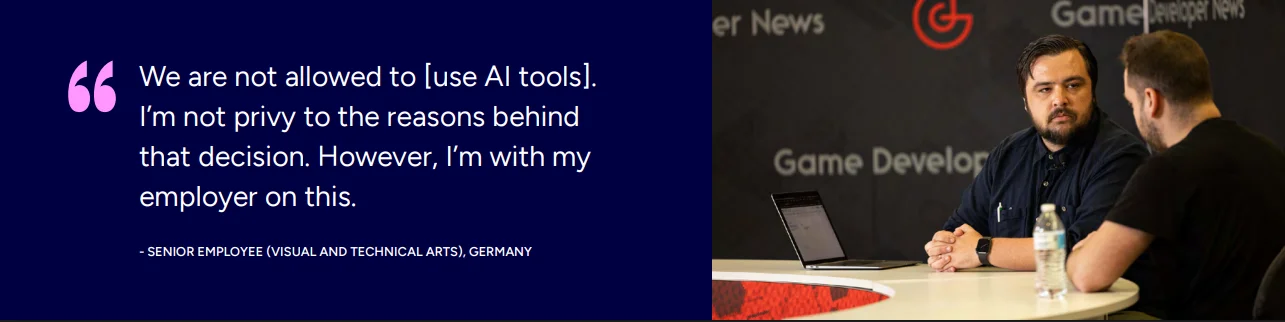
What GDC 2026 made clear: the question is no longer whether your studio will encounter AI — every studio will. The question is how you handle it. Only 5% of studios are using AI for player-facing features. The rest are using it internally — for drafts, for iteration, for efficiency. That’s the pragmatic version of AI adoption. It works. And it doesn’t require pretending that the technology has no impact on the people it’s touching.
Everyone Needs a Job — And the Crisis Isn’t Over
The second thing Schreier said: everyone needs a job. It sounds simple. At GDC 2026, it was devastating.
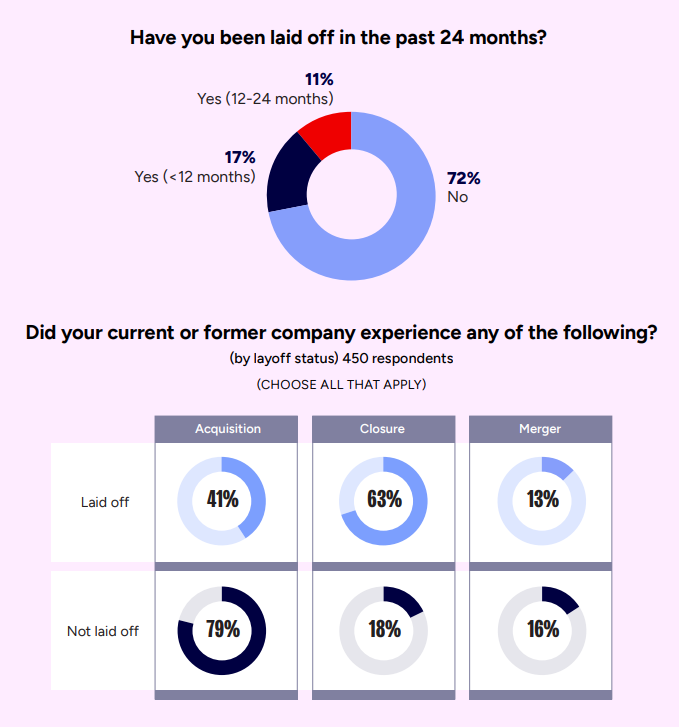
According to GDC 2026 survey, 17% of game industry professionals reported being laid off in the past 12 months, while 11% said they were laid off during the 12 months prior. Altogether, that means over one-fourth (28%) of respondents have experienced a layoff in the past two years, increasing to onethird (33%) for those in the United States.
74% of students are concerned about future job prospects — which means the pipeline into the industry is under stress. And 82% of US game professionals now support unionization, the highest figure in the survey’s history. That’s not just frustration — it’s a fundamental recalibration of how creators view their relationship with the companies they build for.
The layoff crisis is reshaping expectations around compensation, job security, and work-life balance. Studios that want to attract and keep top talent in 2026 can’t operate on the same assumptions they did in 2021. The terms have changed. The industry knows it. GDC 2026 just said it out loud.
3. Co-Dev Is Ubiquitous — Because It Has to Be
Schreier’s third observation at GD 2026: collaboration with external partners isn’t a luxury anymore. It’s how studios survive.
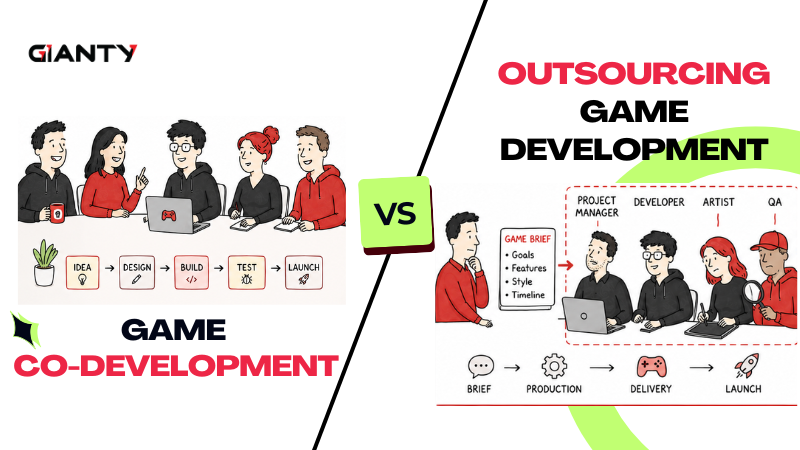
This is the shift that’s been building quietly for years and finally became impossible to ignore. 88% of indie developers work fully remote. 50% of indie studios outsource art, with an average spend of $20,000. The game art outsourcing market is $3.77B in 2025 and growing at ~14% annually. This is not niche behavior. It’s the default model.
What changed in 2026 is the intent. A few years ago, outsourcing was emergency triage — when internal capacity overflowed and a deadline was closing. Now it’s strategic architecture. Studios plan for distributed production from pre-production, not after the team is overwhelmed.
Specialized partners aren’t a last resort. They’re a necessity. The studios that understand this — that a game development partner with deep domain expertise and production standards is a competitive advantage, not a cost line — are the ones shipping ambitious work without the overhead of a 200-person studio.
GIANTY also has the co-dev model for game development, we’ve seen this shift directly. Studios come to us not because they’ve run out of options, but because they’ve figured out that quality game art production at Japanese standards, delivered through a Vietnam-based team, is exactly the kind of partnership that makes their roadmap possible. Co-development isn’t backup anymore.
4. Reuse Is the Name of the Game
Fourth: reinventing the wheel is expensive, slow, and increasingly unnecessary. The studios winning in 2026 are the ones building on what already works.
Unreal Engine adoption sits at 42% among GDC 2026 respondents, Unity at 30%, proprietary engines at 19%. The dominance of licensed engines reflects a matured industry understanding: the engine is not the differentiator. The game is.
Middleware dominated the GDC expo floor. Modular asset pipelines, shared toolsets, and co-development workflows were everywhere. The ethos has shifted from “we build everything ourselves” to “we build what only we can build — and we partner for the rest.”
This is practical wisdom with direct business implications. Studios that invest their limited resources in what makes their game unique — the vision, the design, the creative direction — and lean on established infrastructure for everything else, move faster, spend less, and ship better. The hardware side reinforced the same logic: Microsoft’s Project Helix uses FSR Diamond upscaling and a custom AMD SoC — performance gains through intelligent reuse of existing architecture, not brute force. NVIDIA’s DLSS 4.5 Dynamic Multi Frame Generation now runs in 20 games. The industry’s best engineers are building on top of proven foundations.
5. Indies Are More Interesting Than Ever
The fifth thing Schreier got right: the most interesting games at GDC 2026 weren’t in the biggest booths.
The Independent Games Festival’s Seumas McNally Grand Prize went to Titanium Court by AP Thomson. It wasn’t the most polished game at the show. It was the most bold. And bold is winning right now.
This isn’t a coincidence. As AAA studios consolidate, downsize, and play it safe — making sequels to sequels of proven franchises — the indie space has been filling with creative risk. Small teams with clear vision, distributed production tools, and global partner networks are shipping games that feel genuinely new. The indie game market is forecast to reach $10.83B by 2031, growing from $4.85B in 2025 at a 14.32% CAGR. Asia-Pacific — where much of the world’s best game art talent is concentrated — holds a 44.35% revenue share and 16.08% CAGR.
The indie scene isn’t a side category anymore. It’s the industry’s innovation engine. The commercial ceiling for a 2–10 person studio has never been higher. And the tools, talent networks, and production partnerships available to small teams have never been better.
What This Means for Your Studio
GDC 2026 wasn’t a manifesto. It was a mirror.
The studios that left San Francisco with a clear-eyed view of the landscape are the ones who can act on what it showed. AI is a tool to be used deliberately, not a strategy. The talent market demands fair treatment, not just competitive salaries. Collaboration is the production model, not the fallback. Engines and middleware are infrastructure, not compromise. And the most creative work in the industry right now is coming from the teams with the most autonomy.
If any of those five points describe something you’re navigating — or something you need to change — the conversation to have isn’t theoretical. It’s operational. Who are your production partners? What are you building in-house versus what should you be outsourcing? How are you treating the people who make your games?
Final Thoughts of GDC 2026
GDC 2026 mattered because it was honest. That honesty is the industry doing exactly what it should — acknowledging what’s broken so it can build something better.
At GIANTY, those five takeaways aren’t commentary. They’re operating principles. We partner with studios across Japan, Vietnam by co-dev works. We’ve shipped game art and development many IPs because reuse and specialization produce quality. And we show up to every project understanding that the people building games deserve partners who are serious about both craft and production.
Let’s talk about what your studio is building next. →
FAQs
1.What were the biggest themes at GDC 2026?
Five themes defined the conversation: AI adoption with growing skepticism, the ongoing jobs crisis and layoff wave, the normalization of co-development partnerships, engine and middleware reuse as standard practice, and the rising quality and commercial relevance of indie games. All five were captured cleanly in Jason Schreier’s post-GDC takeaways.
2.Why do 52% of game developers in GDC 2026 report think AI is harmful to the industry?
The opposition reflects real concerns about creative displacement, consent around AI-generated art, and the use of AI to justify headcount reductions. It’s not a rejection of productivity tools — 81% of developers use AI for research and brainstorming — it’s skepticism about how generative AI is being deployed at the expense of the people who make games.
3. Is the game industry layoff crisis over?
No. In GDC 2026 report, 28% of respondents were laid off in the past two years, and 50% said their employer conducted layoffs in the past 12 months. The restructuring of AAA studios is ongoing. The talent it’s releasing is increasingly finding its way into smaller studios and partnerships.
4. What hardware was announced at GDC 2026?
Microsoft unveiled Project Helix — the next-generation Xbox with a custom AMD SoC, FSR Diamond upscaling, and order-of-magnitude ray-tracing improvements, with alpha hardware going to developers in 2027. NVIDIA launched DLSS 4.5 with dynamic multi-frame generation in 20 games. Arm released Neural Frame Rate Upscaling for mobile into Early Access.
5. Are indie games a sustainable business model in 2026?
Increasingly yes. The indie market is projected to double to $10.83B by 2031. With accessible engines, global talent networks, and distributed co-development partnerships, small teams are shipping work that competes with mid-tier AAA quality. The ceiling has risen dramatically.