When people talk about AI’s impact on jobs, the conversation usually defaults to one of two extremes: robots replacing everyone, or AI being mostly hype. The truth sits somewhere far more nuanced — and far more actionable.
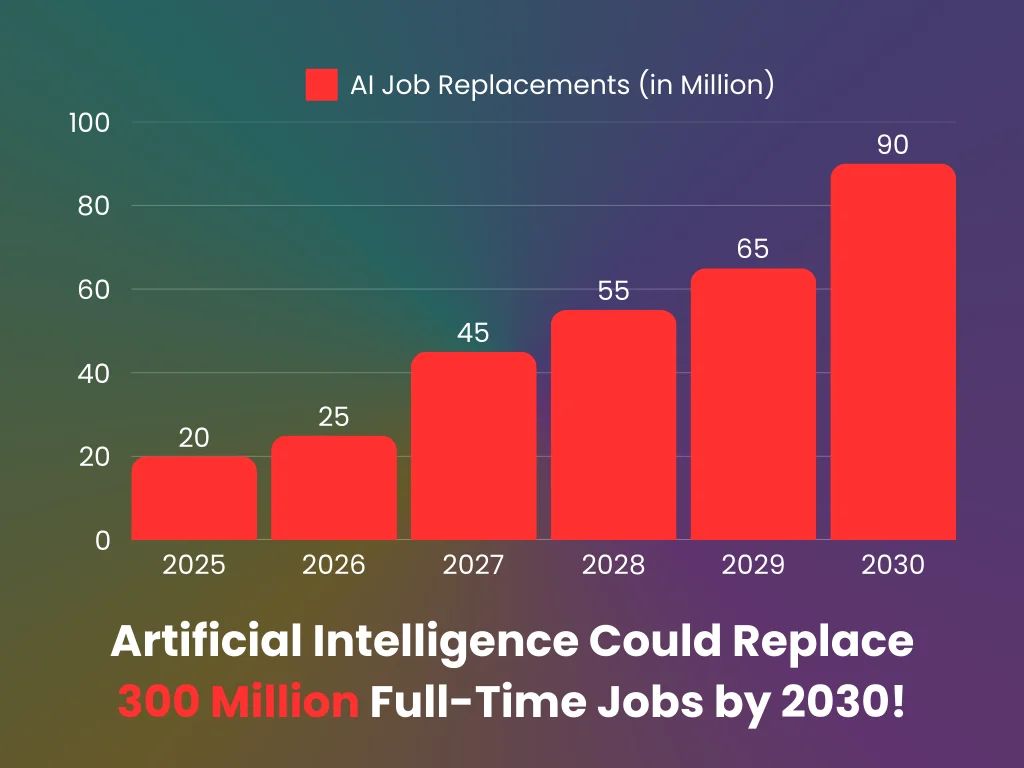
The AI impact on jobs refers to the measurable changes in how work is structured, distributed, and hired for as a result of artificial intelligence adoption. This includes changes in task composition within roles, shifts in hiring volume by occupation, and productivity gains that alter how many people are needed to deliver a given output.
Critically, this is not the same as job elimination. At least not yet.
A major new study from Anthropic — “Labor Market Impacts of AI: A New Measure and Early Evidence” — offers the most rigorous look to date at what is actually happening in the AI labor market. And its findings challenge almost every assumption businesses are making right now.
Why the Labor Market Is Misread About AI Impact
The popular narrative about AI and employment tends to borrow from the theoretical — what AI could do — rather than the empirical — what AI is actually doing at scale today – the AI impact.
This distinction matters more than most leaders realize.
For years, researchers have estimated AI’s economic potential by mapping large language model (LLM) capabilities to occupational tasks. These theoretical exposure scores suggested that vast swaths of the workforce — particularly knowledge workers — were highly automatable. Alarm bells rang.
But Anthropic’s research reveals something important: theoretical exposure and actual adoption are two very different things. The gap between them is where most companies are living right now — and it’s where the real strategic opportunity lies.
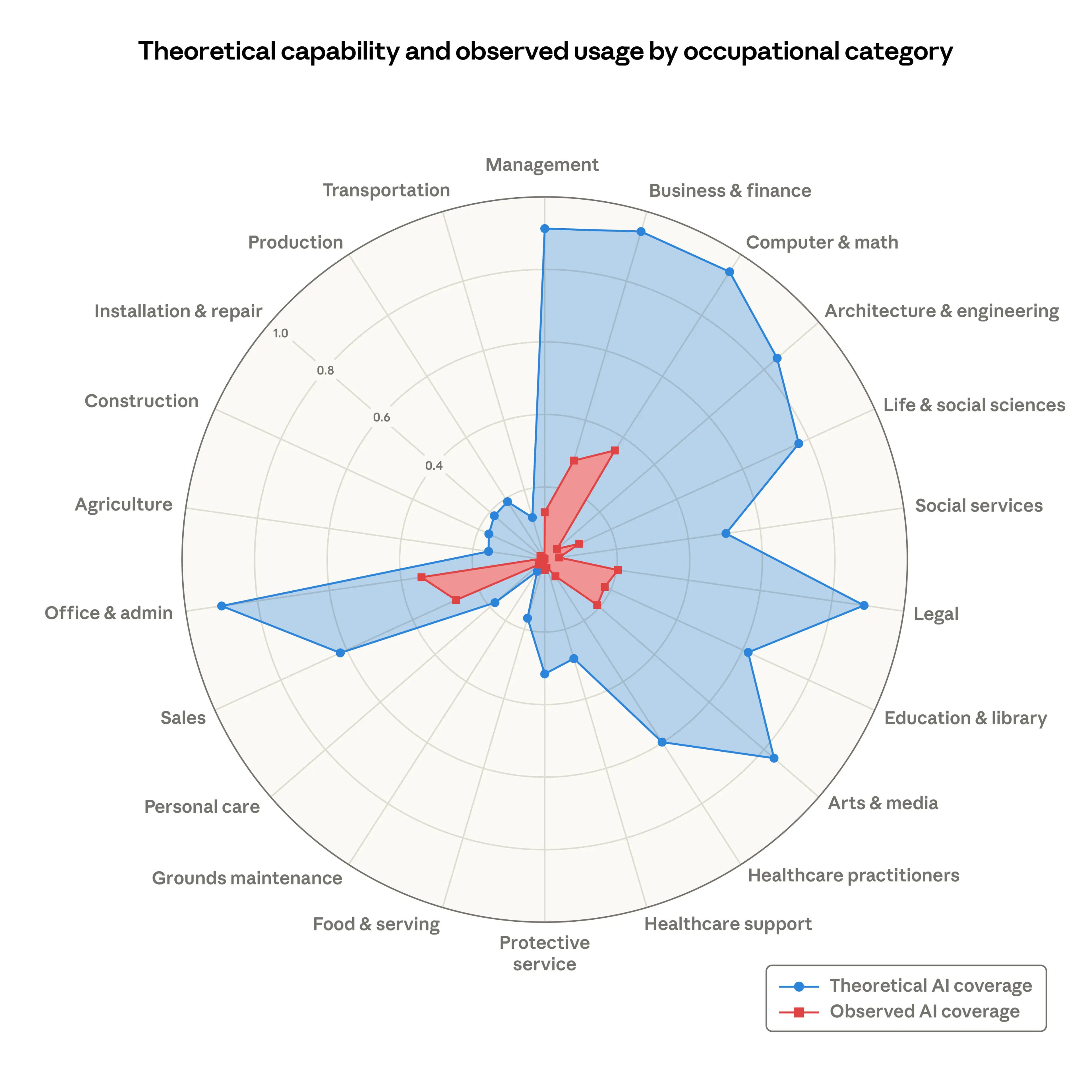
Understanding this gap is not just an academic exercise. It is the foundation for making smart decisions about AI in business.
Key Insights from the Anthropic Labor Market Report
The Concept of “Observed Exposure”
The study introduces a new metric called Observed Exposure — and it changes how we should think about AI’s real-world economic footprint.
Traditional AI exposure scores assess what could be automated based on LLM capabilities. Observed Exposure goes further by layering in actual usage data from Anthropic’s Economic Index — tracking how workers are genuinely using AI tools on the job today.
The methodology draws from three sources:
- The O*NET database (covering 800+ U.S. occupations and their tasks)
- Real-world Claude usage patterns from Anthropic’s Economic Index
- Theoretical feasibility scores from prior academic research
The result is a far more grounded picture of AI’s current impact — and it is sobering.
AI Adoption Is Still Far Below Its Potential
Even in the most AI-exposed occupations, actual usage represents only a fraction of what the technology is theoretically capable of delivering.
Take Computer & Math occupations: theoretical AI capability covers 94% of the tasks in these roles. Observed actual usage? Just 33%.
Office and administrative roles show a similar pattern — nearly 90% theoretical exposure, but real-world adoption is a fraction of that. The reasons include model limitations, organizational inertia, compliance concerns, and the absence of domain-specific AI tools built for real workflows.
The takeaway: most businesses are leaving the majority of AI’s value on the table.
No Unemployment Spike — But Hiring Is Already Slowing
One of the most important findings in the study: there has been no significant unemployment increase among workers in highly AI-exposed occupations since ChatGPT’s release in late 2022.
This should reassure workers worried about immediate job loss. But it should not reassure business leaders into complacency.
Because beneath that stable unemployment figure, something more subtle — and more consequential — is happening.
- Young workers (ages 22–25) in AI-exposed roles are seeing a 14% decline in job-finding rates compared to 2022.
- This decline does not appear for workers over 25.
- BLS employment projections for highly exposed occupations are measurably weaker — every 10 percentage-point increase in AI coverage correlates with a 0.6 percentage-point lower employment growth forecast.
In plain terms: companies are not firing existing employees in large numbers. They are simply hiring fewer new ones in roles that AI can now partially fill. The workforce is being reshaped from the entry point.
The Most and Least AI-Exposed Jobs
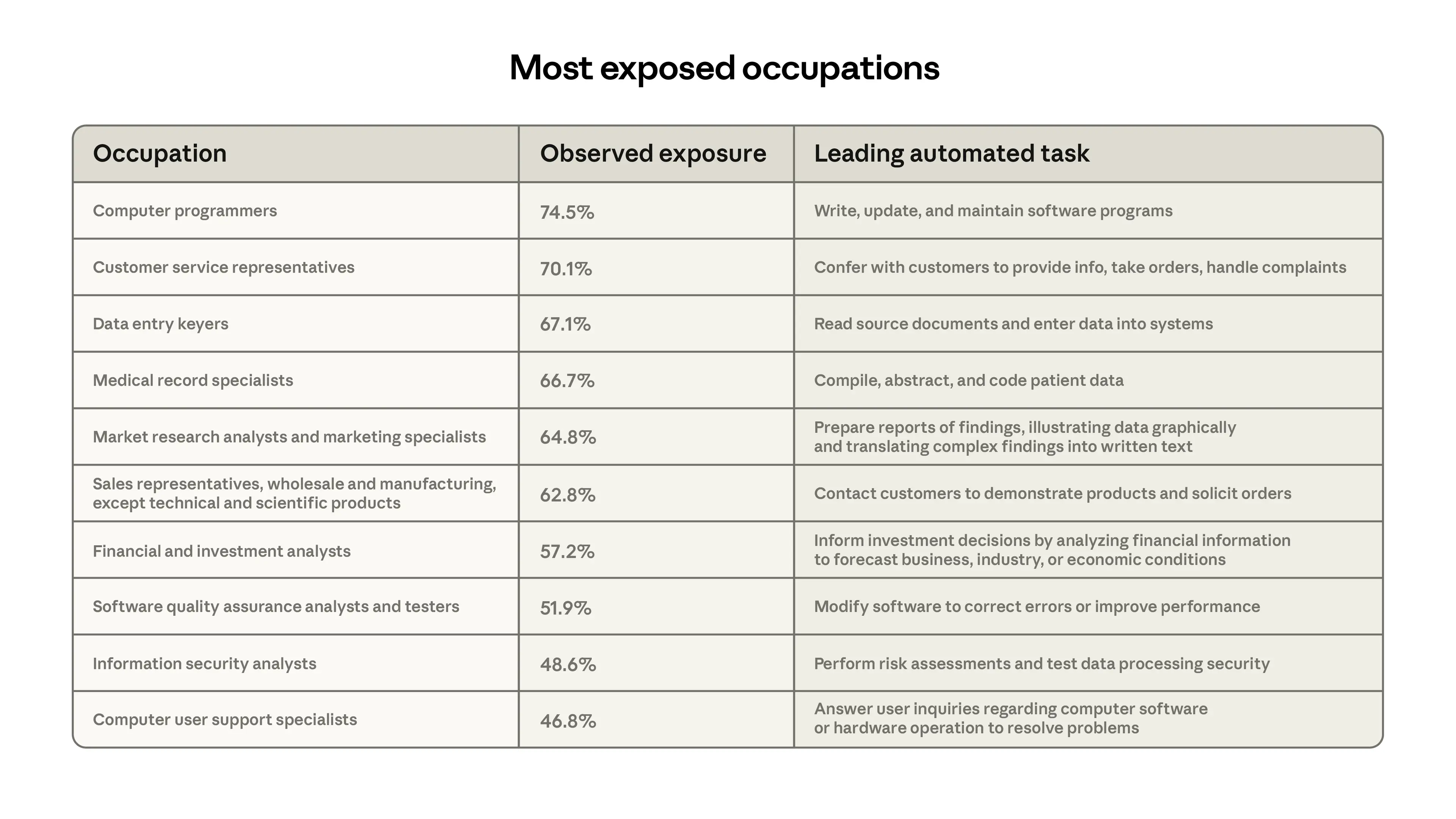
The Anthropic data paints a clear picture of which occupations are most affected:
Highest AI exposure (observed):
- Computer Programmers — 75% task coverage
- Customer Service Representatives
- Data Entry Keyers — 67% task coverage
- Financial Analysts
- Writers and content roles
Lowest AI exposure (near zero):
- Construction workers
- Cooks and kitchen staff
- Bartenders and hospitality workers
- Motorcycle mechanics
- Lifeguards
Approximately 30% of all workers have zero AI coverage in their current roles. For them, the near-term disruption risk is low. For the other 70% — particularly those in knowledge-intensive, administrative, or data-heavy roles — the transformation is already underway.
AI Is Shifting Labor Demand, Not Eliminating It
Perhaps the most important interpretive takeaway from the Anthropic report is this: AI is changing what is in demand, not eliminating demand altogether.
Highly exposed workers tend to be older, more educated, and better paid — with average earnings 47% higher than unexposed workers. This is not the profile of a vulnerable, low-skill workforce. This is the core of the knowledge economy.
What this tells us: the restructuring is happening at the level of tasks, not jobs. Roles are being redefined. Workflows are being reorganized. And businesses that understand this shift will be positioned to capitalize on it.
How AI Impact Is Reshaping Work Across Industries
Knowledge Work: Tech, Finance, and Administration
Knowledge work occupations — software development, financial analysis, data processing, customer support — face the highest AI exposure of any sector. And the impact is already visible.
AI tools are:
- Writing, reviewing, and debugging code at scale
- Automating financial modeling and report generation
- Handling tier-1 customer service queries without human intervention
- Processing and summarizing large document sets in seconds
The workforce impact is nuanced. Productivity per worker is rising. But the need for junior workers — those whose primary job is executing routine tasks — is declining. Companies are hiring fewer analysts to run standard reports when AI can generate them automatically. They are hiring fewer entry-level coders when AI can produce first drafts of functional code.
The AI impact is toward senior, strategic, and interpretive roles — people who can direct AI, evaluate its outputs, and apply judgment that models cannot replicate. This is not job elimination. It is job elevation — but only for those who adapt.
Regulated Industries: Tax, Legal, and Healthcare
Here is where the most interesting tension lives.
Tax, legal, and healthcare represent sectors with enormous theoretical AI potential and relatively low actual adoption. The gap is wider here than almost anywhere else.
Why? Because these industries operate under strict compliance requirements, accuracy standards, and professional liability frameworks that generic AI tools were not designed to navigate. A large language model that occasionally hallucinates is acceptable when drafting a first-pass marketing email. It is not acceptable when calculating a corporate tax liability or interpreting a patient’s diagnostic results.
This creates a clear opportunity: purpose-built, domain-specific AI that is trained on the right data, validated against the right standards, and integrated into the right workflows.
This is not a problem that generic AI will solve on its own. It requires vertical solutions designed specifically for the domain.
Physical and Offline Work: Stable for Now
Manual labor — construction, hospitality, manufacturing, personal services — remains largely insulated from the current wave of AI disruption.
The Anthropic data confirms what intuition suggests: tasks requiring physical presence, dexterity, and real-world contextual judgment remain beyond the reach of current AI systems. These workers face near-zero AI exposure today.
That said, “stable for now” is not the same as “stable forever.” As robotics and physical AI systems advance, this calculus will change. But for the near term, the transformation is concentrated in knowledge work and data-intensive roles.
The Real Shift: From Job Replacement to Task Automation
The most important reframe for any business leader thinking about AI impact and the workforce is this: AI does not replace jobs. It replaces tasks.
This distinction sounds subtle. The implications are enormous.
Consider an accountant. Their job encompasses dozens of distinct tasks: data entry, calculations, reconciliation, error-checking, client communication, regulatory compliance, strategic advisory. AI can now handle most of the first four with speed and accuracy that exceeds any human.
But the job of accountant does not disappear. It transforms. The accountant who once spent 60% of their time on calculations now spends that time on strategy, client relationships, and the kind of complex judgment that AI cannot yet replicate. They become more valuable, not less — if they adapt.
The same logic applies across knowledge work:
- Teachers → AI handles grading, content generation, and learning analytics. Teachers focus on mentoring, emotional support, and the human dimensions of education that no algorithm can replicate.
- Lawyers → AI handles contract review, case research, and document processing. Lawyers focus on strategy, negotiation, and judgment.
- Marketers → AI handles content drafts, A/B testing, and performance analysis. Marketers focus on positioning, insight, and creative direction.
This is what “AI-augmented” work looks like. It is not a dystopia. It is an upgrade — but one that requires intentional design, the right tools, and organizational willingness to adapt.
The Gap: Where Businesses Are Struggling
If the opportunity is so clear, why is actual AI adoption so far below its theoretical potential?
The Anthropic research points to a structural problem that goes beyond tool availability. The gap between what AI can do and what businesses are actually doing with it comes down to three interconnected challenges:
1. Lack of workflow integration Most AI tools today are point solutions — chat interfaces and standalone generators that exist outside the systems where real work happens. When AI is not embedded in the CRM, the ERP, the case management system, or the document workflow, adoption stays surface-level.
2. Absence of domain-specific AI Generic large language models are trained on general internet data. They do not know your industry’s terminology, regulatory framework, data formats, or business logic. Asking a generic model to handle tax compliance or clinical documentation is like hiring a generalist when you need a specialist.
3. Trust and governance deficits In regulated industries especially, organizations need AI they can audit, explain, and stand behind. When AI outputs cannot be traced, verified, or governed, adoption stalls — not because the technology fails, but because the trust infrastructure around it does not exist.
These three gaps are not going to close themselves. They require deliberate investment in the right kind of AI.
Vertical AI Solutions: Closing the Gap Between Potential and Reality in AI Impact
That is where Vertical AI comes in.
Generic AI is a starting point, not a finish line. What businesses in high-exposure industries actually need is AI that is built for their domain — trained on their data, integrated into their workflows, and designed to meet their specific standards for accuracy, compliance, and accountability.
This is the foundation of GIANTY’s approach to AI in business. GIANTY builds Vertical AI solutions for specific industries — not off-the-shelf tools that require massive internal effort to customize, but purpose-designed systems that fit the way each industry actually operates.
The focus is always the same: real-world ROI, not experimentation. Not pilots that never scale. Not dashboards that nobody checks. AI that is embedded in daily work, measurably improves output, and compounds its value over time.
Another example in education: in a class of 30–40 students, over 50% of engagement signals go unnoticed by the teacher. GIANTY’s AI Classroom Analysis turns recorded lessons into clear insights on attention and participation—giving teachers and parents a real view of learning beyond grades.
Future Outlook: The Window Is Now
The Anthropic research is explicit that its findings represent an early assessment. AI capabilities are advancing. Adoption is accelerating. And the gap between theoretical and observed exposure is narrowing.
What does that mean for businesses?
It means the current moment is a window — not a permanent condition. The companies building AI competency now, integrating AI into workflows now, and developing the governance frameworks to scale AI responsibly now will have durable advantages when adoption reaches inflection.
The companies waiting for the technology to mature, or for competitors to demonstrate the case, will find themselves playing catch-up against organizations that have already baked AI efficiency into their cost structures and their capabilities.
Every 10 percentage-point increase in AI coverage correlates with meaningfully lower employment growth projections in that sector. That is not a threat to existing employees — it is a signal about where competitive advantage is being built.
The biggest risk in the AI impact labor market is not AI replacing human jobs. It is companies that fail to adapt, watching more agile competitors — with leaner teams, higher output per person, and faster execution cycles — take the market.
FAQs
1. What does the Anthropic research say about AI impact on employment?
The study about AI impact found no significant increase in unemployment among workers in highly AI-exposed occupations since late 2022. However, it identified a 14% decline in hiring rates for young workers (ages 22–25) entering AI-exposed roles, suggesting that AI is already reshaping who gets hired — even if it is not yet displacing existing employees at scale.
2. Which jobs are most exposed to AI impact according to the data?
The highest observed AI exposure belongs to Computer Programmers (75% task coverage), Data Entry Keyers (67%), Customer Service Representatives, and financial analysis roles. Approximately 30% of workers — including cooks, construction workers, and hospitality staff — have near-zero AI exposure in their current roles.
3. What is “Observed Exposure” and why does it matter for the AI impact labor market?
Observed Exposure is a metric developed by Anthropic that combines theoretical AI capability with real-world usage data. It reveals that most industries are capturing only a fraction of AI’s potential — for example, Computer & Math occupations have 94% theoretical AI coverage but only 33% actual observed usage. This gap represents both the current state of AI in business and the opportunity ahead.
4. How is AI impact in business different from what most companies are doing with AI today?
Most businesses are using AI as a standalone tool — a chat interface or a content generator disconnected from core workflows. True AI in business means integration into the systems where work happens: ERP, CRM, document processing pipelines, and compliance frameworks. This requires domain-specific AI built for the industry, not generic models applied to niche problems.
5. What are Vertical AI solutions and why do businesses need them?
Vertical AI solutions are domain-specific AI systems designed for the unique requirements of a particular industry — its data formats, regulatory constraints, accuracy standards, and workflow patterns. Generic AI models trained on general internet data cannot reliably handle the precision required in tax, legal, healthcare, or education contexts. Vertical AI closes this gap by providing tools purpose-built for real-world professional use.
6. Will AI replace jobs in regulated industries like tax and healthcare? The evidence suggests that in regulated industries, AI is more likely to transform jobs than eliminate them. High compliance requirements and accuracy standards make wholesale automation unlikely in the near term. Instead, AI handles the high-volume, routine task layer — document processing, data extraction, calculations — while professionals focus on judgment, strategy, and client-facing work that requires human expertise. This is why Vertical AI solutions, rather than generic tools, are the right fit for these sectors.