Cross-platform game development has rapidly become one of the most important production strategies in the global gaming industry. As players move fluidly between mobile, PC, and console devices, studios are under pressure to deliver gaming experiences that work seamlessly across multiple platforms without fragmenting development budgets or timelines.
The opportunity is enormous. The global mobile gaming market is projected to reach $775.69 billion by 2032, while the PC gaming sector is expected to exceed $189 billion by 2036. Studios that build for multiple platforms simultaneously can capture these markets with a single product line.

Modern tools, engines, and frameworks now make this possible and experienced service providers like GIANTY help studios design, build, and optimize cross-platform games that perform consistently across device categories.
In this blog, we’ll give you key insights into cross-platform game development, including:
- What is cross-platform game development?
- The benefits of cross-platform game development
- Key strategies for cross-platform game development
- Best game engines for cross-platform game development
- When to choose native development instead
- Why choose GIANTY as your cross-platform game development partner?
What is Cross-Platform Game Development?
Cross-platform game development is the process of creating a single video game that runs on multiple platforms such as PC, consoles, mobile devices, and cloud streaming services – using one shared codebase and adaptable assets.
Instead of building separate native versions for each platform, developers use engines and frameworks that allow a unified project to be deployed across different operating systems, hardware configurations, and input methods.
Modern game engines like Unity, Unreal Engine, and Godot make this possible by providing:
Shared code architecture
Cross-platform asset pipelines
Tools for handling device-specific settings
Build systems that export to multiple platforms
In cross-platform development, the game is built for multiple platforms simultaneously using common code and assets. While it may take longer initially to develop a cross-platform game, it’s faster and more efficient than creating separate versions for each platform or porting the game later.
How cross-platform Game Development Services Work in 2025
In 2025, cross-platform development has become more structured, mature, and tool-driven. Service providers typically follow a workflow like:
1. Technical Analysis & Platform Exploration
Evaluate target platforms (iOS, Android, PC, Nintendo Switch, PlayStation, Xbox, WebGL) and identify shared and platform-specific requirements.
2. Unified Architecture Planning
Architect a system that supports shared logic + platform-specific modules:
Input systems (touch/controller/mouse)
Rendering settings
Asset compression
Online multiplayer integrations
Store compliance (Steam, PSN, App Store, etc.)
3. Cross-Platform Engine Selection
Choosing between Unity, Unreal Engine, Godot, or custom engines depending on genre, budget, and long-term scale.
4. Creating Shared Assets & Reusable Code
Teams build modular UI, gameplay logic, and art pipelines that adapt to multiple screens and hardware profiles.
5. Platform-Specific Optimization
Even with shared code, each platform requires adjustments for:
FPS targets
Memory limitations
Texture compression
Graphics performance
Control schemes
6. Certification, Compliance & Build Automation
Modern CI/CD pipelines auto-generate builds for every platform—reducing manual work and cutting release cycles.
7. Unified QA Across Platforms
Automated and device-specific testing ensure consistent stability and performance.
Why is Cross-Platform Game Development Important?
Cross-platform development is critical in 2025 because players, markets, and platforms now demand seamless multi-device access. Gamers routinely switch between mobile, PC, and console, and expect their progress, accounts, and social features to work everywhere.
According to Global Growth Insights:
67% of developers now build multi-device features directly into their pipelines
55% of studios prioritize games that run across PC, console, and mobile
This shift reflects player expectations. Three major industry shifts make cross-platform essential:
- Multi-device player behavior: They expect to start a session on PC, continue on console, and finish on mobile without losing progress. Multi-device journeys are now a standard part of how players engage with modern games.
- Cloud gaming is accelerating this trend. With cloud streaming, hardware limitations become less important: players can instantly access a game on any devices.
- Developers no longer need to produce multiple heavy builds for low-end hardware; a single build can now run or stream to nearly any device.
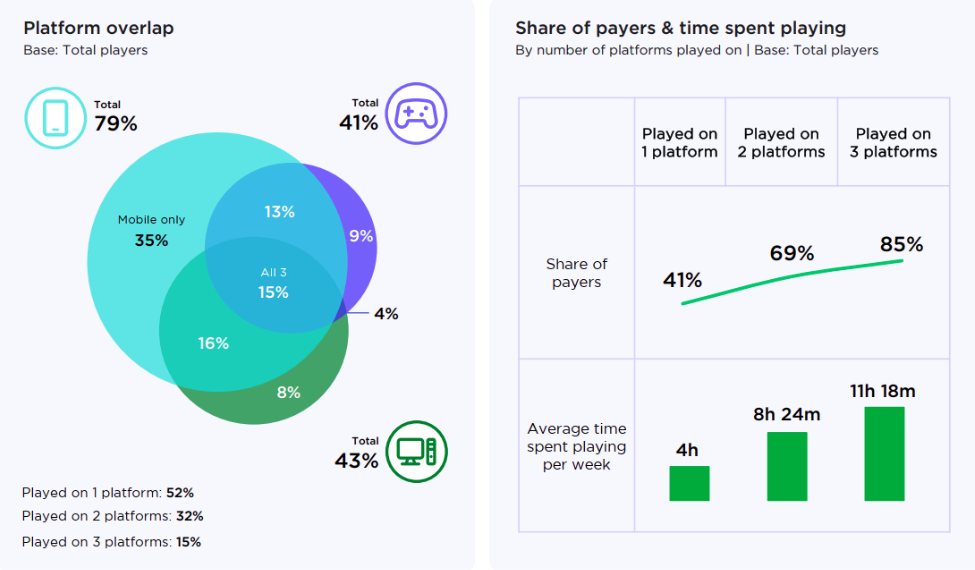
Publishers and top studios increasingly treat cross-platform game development as a core business strategy rather than a niche feature. It is a strategic requirement for studios that want to grow their audience, reduce costs, and remain competitive in a multi-device gaming ecosystem.
Best Game Engines for Cross-Platform Game Development
The game engine you choose will significantly impact the ease and efficiency of your cross-platform game development process. Here are the best game engines commonly used for cross-platform games:
Unity
Unity is arguably the most popular game engine for cross platform development. Unity engine supports over 25 platforms, including Windows, macOS, Android, iOS, PlayStation, Xbox, and even VR devices.
Its robust asset store, which supports both 2D and 3D game development, makes Unity an ideal choice for developers aiming to target multiple platforms.
Unreal Engine
Unreal Engine is known for its high-quality graphics and robust features, making it a great choice for developers who want to create visually stunning cross-platform games.
Unreal Engine supports a wide range of platforms and offers tools like Blueprints, which allow developers to create complex games without extensive coding knowledge.
Godot
Godot is an open-source engine that is gaining popularity among indie developers for its simplicity and flexibility. It supports multiple platforms, including Windows, macOS, Android, and iOS. Godot is particularly suited for smaller studios looking for an affordable and scalable engine for their cross-platform projects.
There is no single “best” engine for every project. The right choice depends on the game’s genre, visual direction, performance goals, and the studio’s development expertise. Mature studios understand when to use Unity, Unreal, Godot, or lighter frameworks based on project requirements.
The Benefits of Cross-Platform Game Development
Cross-platform games are designed to work across multiple devices, offering players a flexible and accessible gaming experience. This broad compatibility not only enhances player satisfaction but also opens up new opportunities for game developers and business owners.
Here are some of the key benefits that both players and businesses can enjoy through cross-platform game development:
Wider Audience Reach
One of the most significant benefits of cross-platform game development is the ability to reach a broader audience. By creating a game that works across multiple platforms, you open the door to players using consoles, desktops, and mobile devices. According to Epic Games, over 60% of Fortnite players use cross-play to join matches with players on other platforms. Cross-play users also show dramatically higher engagement, spending 570% more time in-game compared to non-cross-play players.
This ensures your game is accessible to more players and ultimately helps increase revenue potential.
Cost and Time Efficiency
Developers can build one architecture instead of separate native builds.
Cost efficiencies come from:
Shared gameplay logic
Shared rendering layers
Shared asset libraries
Fewer engineering hours overall
This is one of the reasons many publishers turn to external game development partners like GIANTY, who already have built multi-platform pipelines that reduce time and cost.
Easier Maintenance and Updates
Cross-platform games allow developers to:
Deploy patches once
Synchronize updates
Fix bugs across all platforms in one cycle
Maintain version consistency
This dramatically simplifies long-term operations and reduces post-launch overhead.
Better Player Engagement
Cross-platform games often allow players to interact and compete with others regardless of their device. This fosters a more engaging and unified gaming community.
Popular titles like Fortnite and Minecraft have successfully leveraged this strategy, allowing players from different platforms to engage with one another.
Key Strategies for Cross-Platform Game Development
While cross-platform game development offers numerous advantages, it requires strategic planning and execution. Here are some key strategies that can help ensure success:
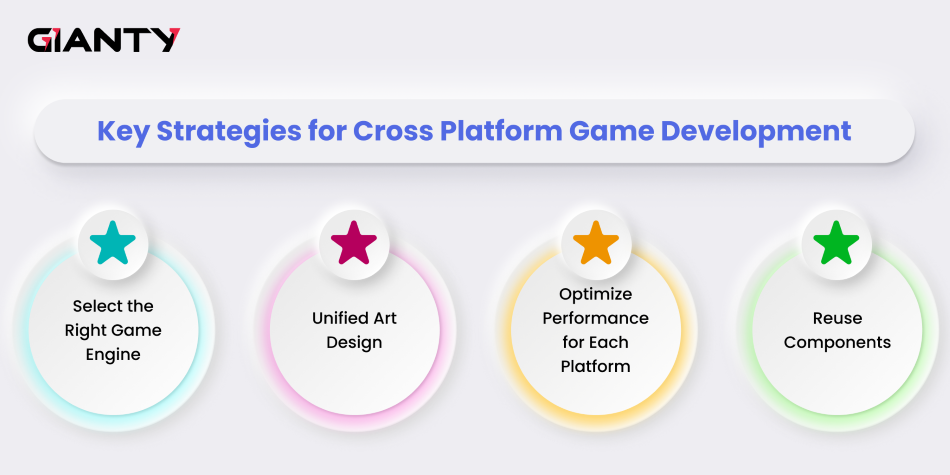
Select the Right Game Engine
Choosing the right game engine is critical to building a successful cross-platform game. Different engines offer varying levels of support for multiple platforms, and the decision you make can affect performance, graphics quality, and user experience.
Popular engines like Unity, Unreal Engine, and Godot offer robust cross-platform development features.
Unified Art Design
It’s essential to maintain a consistent art style across all platforms. Avoiding design elements that are specific to one platform (e.g., touch-only controls for mobile) and considering how the game will perform across different platforms.
Optimize Performance for Each Platform
Even though you’re working with a unified codebase, optimizing performance for each platform is essential. This might involve reducing texture sizes, adjusting frame rates, or modifying graphical effects.
Reuse Components
To optimize development efficiency, developers can reduce redundancy by reusing existing code, UI elements, libraries, and frameworks that function across multiple platforms. This approach not only saves valuable time and resources but also helps maintain a consistent user experience across different devices.
When Should a Studio Choose Native Development Instead?
While cross-platform development delivers major advantages in reach, efficiency, and multi-device support, it also introduces challenges that studios must plan for. Understanding the pros and cons of cross-platform game development helps teams decide whether this approach aligns with their project’s technical requirements, performance goals, and target platforms.
Pros of Cross-Platform Development
Lower development cost thanks to a shared codebase and reusable assets
Faster multi-platform releases, enabling simultaneous launches on PC, console, and mobile
Simplified updates and live-ops, since patches can be deployed across all platforms at once
Larger global reach, giving games access to wider audiences and more revenue channels
Higher player engagement, especially through cross-play and cross-progression
More efficient long-term maintenance with fewer duplicated systems and fewer platform-specific builds
Cons of Cross-Platform Development
Performance differences across devices, requiring platform-specific optimization and testing
UI and control challenges, since touch, controller, and keyboard/mouse all require distinct interaction patterns
Greater QA complexity, with more device combinations and platform ecosystems to verify
Different certification requirements for each platform (App Store, Google Play, Steam, PlayStation, Xbox, Nintendo)
Possible feature compromises to ensure consistent behavior across low-end and high-end hardware
Choose Native Development When
Cross-platform development is powerful, but native development is still the better option in specific cases. Studios should consider native development when:
Maximum performance is required, such as high-end AAA games, advanced physics systems, or visually intensive open-world projects
Deep hardware integration is needed, including platform-specific haptics, motion controls, adaptive triggers, or custom rendering features
The game is a platform exclusive, supported or funded by a console manufacturer (PlayStation, Xbox, Nintendo)
VR, AR, or mixed-reality features are central to gameplay, where platform-level optimizations significantly impact experience
You want full control over memory, GPU, and CPU usage, especially for tightly optimized console or PC builds
The primary target platform dominates your audience, making multi-device support unnecessary
You must comply with strict platform constraints where cross-platform abstractions may limit peak performance
In Short:
Choose cross-platform for reach and speed.
Choose native for performance and platform-specific features.
Key Takeaways for Studios Choosing Cross-Platform Game Development Services
Cross-platform game development comes with clear strengths and limitations, and studios need to evaluate these factors early—ideally during the core concept and pre-production phase. The insights below summarize the most important considerations for teams planning cross-platform titles in 2025 and upcoming 2026.
Plan for platform differences early—UI scaling, input patterns, and performance tuning must be addressed in pre-production.
Weigh the trade-offs: cross-platform saves time and budget but may introduce performance limits or broader QA needs.
Native development still matters for projects requiring maximum performance, VR comfort, or deep hardware integration.
Hybrid workflows are rising, combining shared codebases with selective native optimization.
Experienced partners are crucial, ensuring consistent performance, stability, and a unified player experience across platforms.
When selecting a development partner, don’t just look for a studio that “does everything.” Choose a team with a proven track record in the type of game you’re building. The right partner understands both the creative and technical demands of multi-device development.
Why GIANTY Is a Trusted Partner for Cross-Platform Game Development?
Cross-platform game development is an essential strategy in today’s gaming landscape, allowing developers to reach wider audiences and optimize their resources. By choosing the right strategies, tools, and engines, you can create games that perform exceptionally well across multiple platforms.
GIANTY is an Asia-based top game development company with a strong track record of building high-quality games, specializing in Unity development. Our team excels at creating cross-platform titles that run seamlessly across devices, delivering smooth performance and a consistent experience for players on mobile, PC, and console.
What sets GIANTY apart is our passion for gaming and dedication to delivering exceptional gaming experiences. We ensure that your game will not only function across devices but also provide an engaging and consistent experience for all players.
Contact GIANTY today to learn more about how we can help!