Gamification has evolved from a “nice-to-have” UI trick to a core product strategy used by top apps, games, and digital platforms. As users become harder to retain and competition rises across industries, companies now look to game development thinking to increase engagement, loyalty, and long-term business value.
Let’s be honest, users in 2025 are harder to retain than ever. Every product from your competitors, new apps are fighting for the same two things: time and habit. If your product can’t win those two, it won’t matter how powerful your features are. And if you’re building or planning to build a gamified app, this blog is for you.
This guide breaks down what gamification is, why it works, and how businesses can deploy it to dramatically improve user engagement.
What Is Gamification?
Gamification is the process of applying game mechanics like points, progress bars, leaderboards, rewards, challenges, and levels to non-game environments.
The goal:
- User Growth: Encourage more people to discover, sign up, and return to the product.
- User Retention: Build daily habits, increase repeat engagement, and convert inactive users into active (and eventually paying) users.
- Increased Time Spent: The longer users stay and interact, the deeper their engagement to the product and the higher the likelihood of purchase.
- Revenue Growth: Higher engagement and stronger habits naturally lead to more conversions, upgrades, and long-term monetization.

According to a report from Mordor Intelligence, the global gamification market is valued at USD 29.11 billion in 2025 and is projected to surge to USD 92.51 billion by 2030, growing at an impressive 26.02% CAGR. The numbers tell an important story: businesses worldwide are moving from passive interfaces to experience-driven, behavior-shaping systems.
How Gamification Works and Boosts User Engagement

Gamification boosts user engagement by 100%-150% compared to traditional approaches of recognition. It works because it taps directly into intrinsic human motivation. Here are the four core psychological drivers:
The Need for Achievement (Mastery)
Users feel rewarded when they see progress:
- Levels
- XP
- Progress bars
- Skill trees
- Completion checklists
Seeing improvement even small keeps users returning to complete the next step.
The Need for Autonomy (Choice & Control)
Gamification gives users:
- Choices
- Pathways
- Flexible tasks
- Personal goals
This increases satisfaction and reduces friction.
Social Connection (Relatedness)
Humans are naturally driven by:
- Competition
- Collaboration
- Recognition
- Community
Leaderboards, co-op challenges, and team missions amplify motivation.
Rewards & Dopamine
Small, frequent rewards keep users engaged:
- Badges
- Daily streaks
- Mystery boxes
- Limited-time events
Reward timing influences habit formation – an essential part of retention.
Where Gamification Is Applied?
In today’s SaaS and digital-product ecosystem, gamification consistently creates measurable business value in four primary areas:
Customer Engagement
- Gamification boosts product stickiness by layering in rewards, progress bars, streaks, and checklists.
- Impact KPIs: DAU/WAU, feature adoption, onboarding completion, retention, CLV.
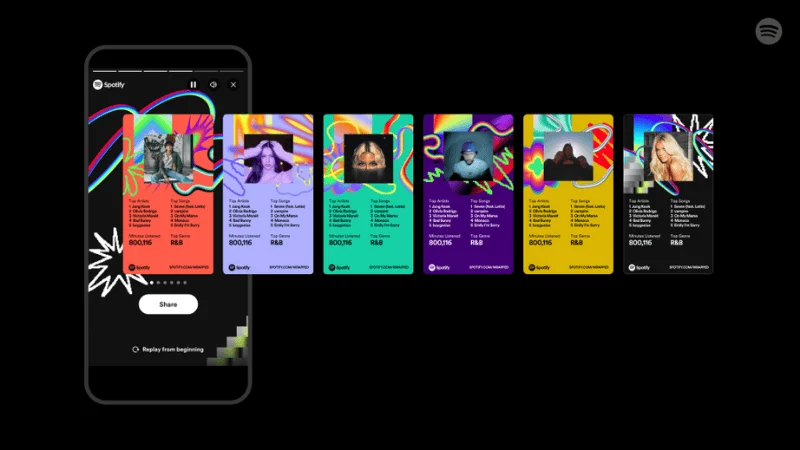
- Real Use Cases: Spotify “Wrapped” milestones and listening achievements to increased annual engagement and sharing.
Employee Engagement
- Internal tools and HR platforms use XP, badges, and team challenges to increase motivation and reduce workplace friction.
- Impact KPIs: productivity, training completion, employee satisfaction.
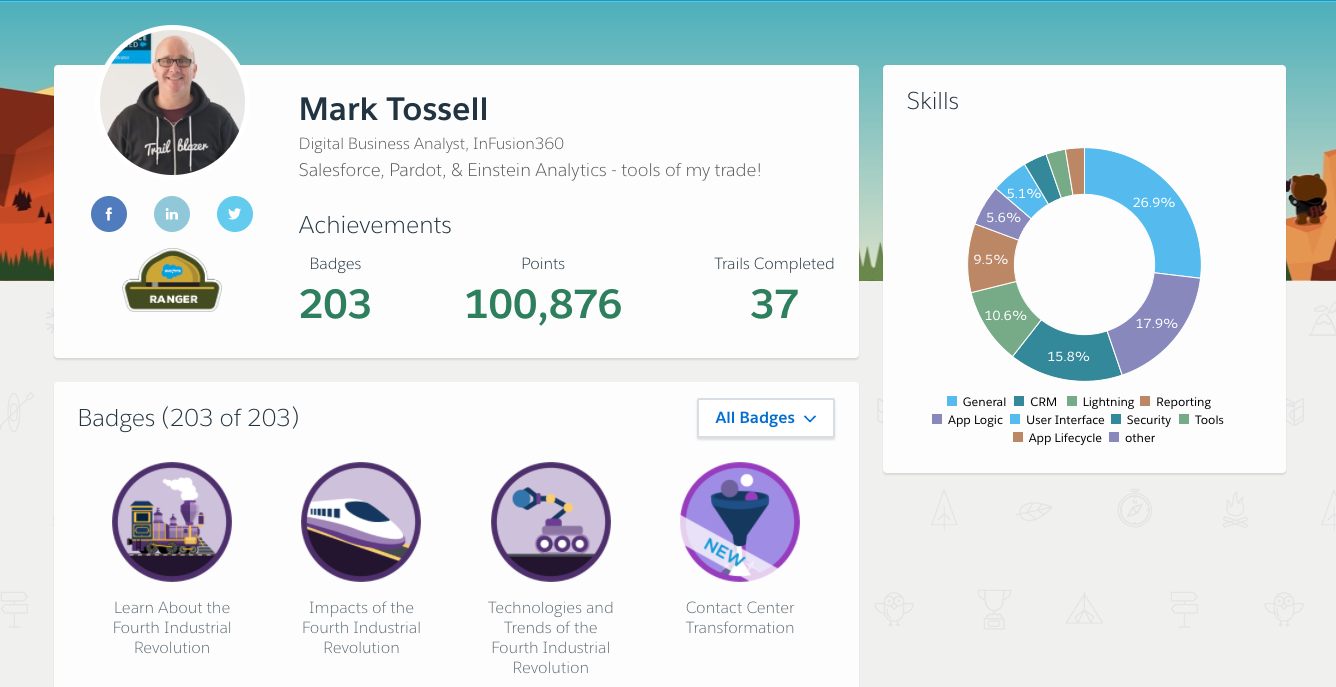
- Real Use Cases: Salesforce Trailhead “Badges and ranks” has created significantly higher training completion.
Marketing & Growth
- Gamified campaigns: spin-to-win, loyalty points, missions, limited-time events turn promotions into interactive experiences that convert better.
- Impact KPIs: CTR, conversions, virality, customer acquisition cost (CAC) efficiency.
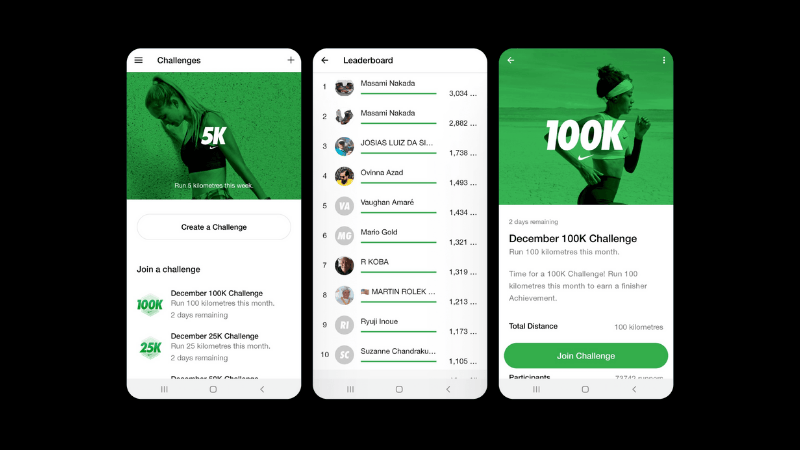
- Real Use Cases: Nike Run Club “Community challenges and trophies” brought higher app engagement and social sharing.
Education & Product Learning
- Gamification makes learning enjoyable with streaks, quizzes, skill paths, and achievement badges.
- Impact KPIs: onboarding speed, course completion, activation rate, reduced support tickets.
- Real Use Cases: Duolingo with daily streaks, XP, and league competitions → massive boost in lesson completion and daily active users.

How to Apply Gamification?
Top Gamification Mechanics That Increase User Engagement
Not all gamification features are equal. Below are the most effective mechanics with examples and when to use them.
1.Points, XP, and Coins
- Best for: motivation, micro-engagement, beginner experiences
- How it helps: Users instantly understand “do X → get reward,” creating fast gratification loops.
2. Progress Bars & Checklists
- Best for: onboarding, habit formation, feature adoption
- Why it works: A nearly-complete progress bar triggers a psychological need to finish incomplete tasks.
3. Badges & Achievements
- Best for: motivation, recognition, social proof
- Badges give users a sense of accomplishment, especially when tied to community sharing.
4. Levels & Skill Trees
- Best for: long-term retention
- Levels give users a visible progression path, turning apps into personal journeys.
- Use cases: Learning platforms, productivity apps, skill-building tools
5. Daily Missions & Streaks
- Best for: daily active usage, habit loops
- Daily goals work because missing a streak creates a loss-aversion response.
6. Leaderboards & Social Competition
- Best for: communities, teams, collaboration
- Leaderboards motivate users through competition or cooperation.
7. Quests, Challenges, and Events
- Best for: boosting re-engagement and excitement
- Special events add urgency and novelty to keep users coming back.
Best Practices to Boost Engagement Gamification
Gamification only delivers results when it’s designed with intention. Based on GIANTY’s experience building games, live-ops systems, and gamified SaaS products for global clients, here are the three proven best practices that consistently drive real engagement, retention, and habit formation.
Personalize Challenges, Rewards, and Difficulty
Generic gamification fails. Users engage more when the experience feels tailored to their goals, skills, and journey stage.
Best practices:
- Segment users (new vs. power users).
- Match challenge difficulty to product knowledge.
- Personalize rewards based on behavior.
- Use analytics to refine quests and progress paths.
Build Continuous Engagement Loops
High-performing products use engagement loops, not one-off rewards.
A strong loop: Trigger → Action → Reward → Progress → New Trigger
Examples:
- Daily streak notifications
- XP for feature usage
- Unlockable levels
- Weekly missions or challenges
Give Users Control
Gamification must feel optional, fun, and empowering—not forced.
Best practices:
- Let users opt out of challenges/leaderboards
- Provide multiple gameplay paths
- Avoid harsh penalties for missed tasks
- Keep failure low-pressure and forgiving
How to Implement Gamification in Your Product (Step-by-Step)
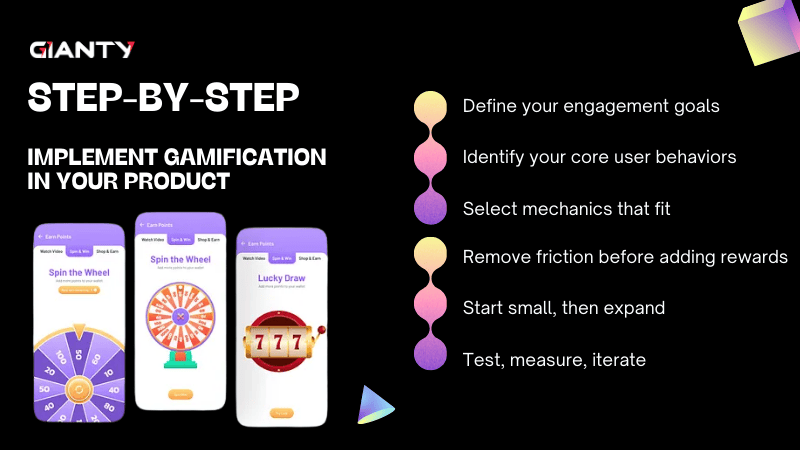
Here’s a simple roadmap your team can follow:
- Step 1: Define your engagement goals (Increase DAU, improve onboarding completion, reduce churn, boost community activity)
- Step 2: Identify your core user behaviors (What actions should users do daily?/ What actions lead to positive business results?/ Where do users drop off?)
- Step 3: Select mechanics that support those behaviors
- Step 4: Remove friction before adding rewards (Gamification works only if the underlying UX is smooth)
- Step 5: Start small, then expand (Begin with streaks, checklists, XP, simple achievements)
- Step 6: Test, measure, iterate (You refine it based on: data, user feedback, behavior patterns)
Didn’t find an example that fits your industry?
Gamification looks different for every product and business model.
Discover “20+ Real Gamification Use Cases Across Industries”. See how companies across SaaS, e-commerce, fintech, education, and enterprise applied gamification to achieve engagement, retention, and revenue growth. Sign up to get the full resource.
Think About This Before You Gamify
As we mentioned earlier, users in 2025 change fast: their habits, expectations, and interaction patterns evolve quicker than ever. Gamification works only when the core motivation already exists. This is a critical mindset shift.
User expectations are shifting constantly. They want:
- Low friction
- Instant value
- Clear progress
- High usability
Gamification can amplify all of that but it cannot replace genuine motivation. So before adding any gamified system, ask:
- Is the user already motivated to do this action?
- Are we reducing friction, or masking it?
- Is the behavior aligned with what the user actually wants?
Only when motivation and gamification align will your engagement strategy truly work.
Final Thought: Build Gamification With Intent and With the Right Partner
Gamification is a core engagement strategy. But as we’ve seen throughout this article, it only works when it’s grounded in real user motivation, supported by smart UX, and aligned with the behaviors your product truly needs.
Users in 2025 (and beyond) will continue evolving fast. Their habits, expectations, and digital routines shift quicker than ever. The products that win will be the ones that pair psychology-backed gamification with seamless, low-friction experiences.
This is where GIANTY’s development capabilities shine. With over 20 years of experience building games, apps, and engagement ecosystems that serve millions of users, the team brings together:
- Japan-quality craft
- Global delivery powered by hub in Vietnam
- Deep expertise in gamification, behavioral design, live-ops systems, and cross-platform app development
If your next step is to elevate user engagement through gamification, GIANTY delivers the strategy, execution, and quality needed to build systems that users love.
Reach out to us to craft experiences that keep your users active, motivated, and loyal.
FAQs
1.What is the definition of gamification?
Gamification is adding game-like elements: points, rewards, challenges to apps or platforms to increase motivation and user engagement.
2. How does gamification increase user engagement?
Gamification boosts engagement by leveraging:
- Rewards
- Progress feedback
- Competition
- Social interaction
- Habit formation
3. What industries benefit the most from gamification?
Top industries benefit the most from gamification: Education, E-commerce, Fitness & health, SaaS platforms, HR & training, Finance apps, Gaming.
4. Is gamification only for games?
No. Gamification is used across all industries to improve behavior, motivation, and engagement.
5. What is the most effective gamification mechanic?
Daily streaks and progress bars are among the most effective because they directly influence habit formation.
6. How do you measure gamification success?
Track these numbers for gamification success: Retention, DAU/WAU, feature adoption, session time, conversion rates, challenge completion.