The business is growing. Roadmaps are full. Deadlines keep moving closer. And somewhere between strategy meetings and delivery standups, the same concern quietly surfaces:
How do we scale engineering capacity fast without losing control, blowing the budget, or locking ourselves into long-term risk?
We hear this from founders pushing for speed, and from enterprise teams balancing ambition with operational reality. For many organizations, the answer is IT Outstaffing, also widely known as IT Staff Augmentation.
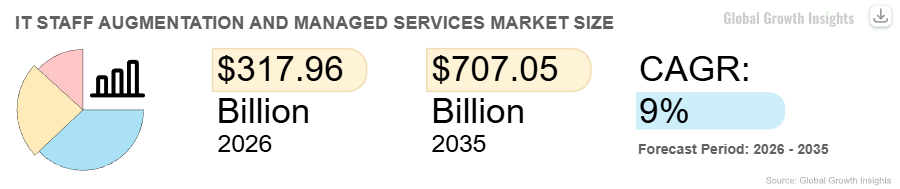
According to Global Growth Insights, the IT staff augmentation and managed services market is projected to grow from USD 317.96 billion in 2026 with a CAGR of approximately 9%.
Yet, despite its popularity, outstaffing remains misunderstood. Some see it as a cheaper alternative to hiring.
This article breaks down IT outstaffing in depth: what it really is, how it works in practice, its trade-offs, and most importantly, when it actually makes sense to choose it for your next projects.
What is IT Outstaffing?
IT outstaffing (also known as IT staff augmentation) is a workforce model that allows companies to extend their internal IT or engineering teams with external professionals, while retaining full control over execution, priorities, and delivery.
How IT Outstaffing Is Positioned

In an outstaffing model:
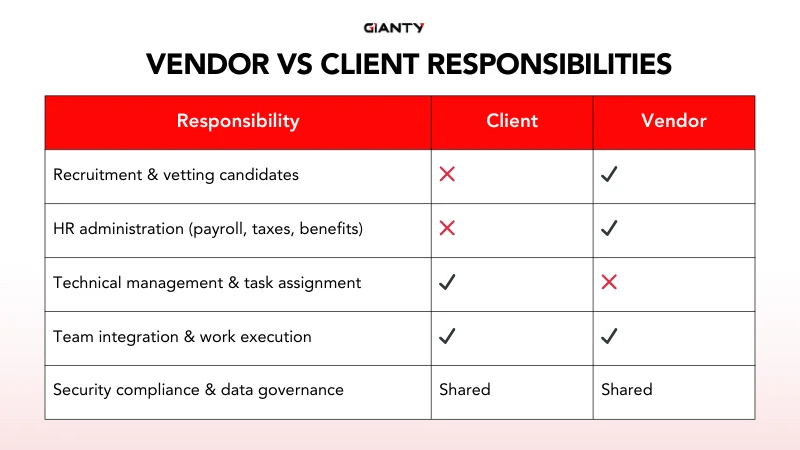
- The client manages day-to-day work, tasks, and technical direction
- Outstaffed professionals work as dedicated members of the client’s team
- The vendor handles recruitment, employment, payroll, and compliance
In simple terms, you own the work; the vendor manages the people’s operations.
Companies typically choose IT outstaffing when:
- Hiring locally is slow or highly competitive
- Specialized technical skills are needed for a project or growth phase
- Teams need to scale up or down without restructuring headcount
- Execution speed and control are more important than delegating ownership
Common IT Outstaffing Talent Categories
Businesses use IT outstaffing to access a wide range of technical and supporting roles, depending on project scope and maturity.
Core Development Roles
- Frontend, backend, and full-stack developers (React, Angular, Java, Python, .NET, Node.js)
- Mobile developers (iOS, Android)
Specialized & Emerging Technology Roles
- DevOps engineers (CI/CD, automation, infrastructure)
- QA engineers and test automation specialists
- Cybersecurity specialists
- Cloud engineers (AWS, Azure, Google Cloud)
- Data engineers, data analysts, and data scientists
- AI & machine learning engineers (LLMs, NLP, computer vision, intelligent automation)
These roles are typically execution-heavy, skill-specific, and scalable, making them ideal for outstaffing rather than permanent hiring.
How IT Outstaffing Works in Practice
The success of IT outstaffing depends less on contracts and more on clear ownership. When roles and responsibilities are well defined, outstaffing becomes a powerful execution model. When they are not, it quickly breaks down.
Task Ownership: Who Decides What Gets Done?
In an IT outstaffing model, task ownership always remains with the client.
The client decides:
- What features or systems are built
- How work is prioritized
- Which technologies, architecture, and standards are used
- How success is measured
Outstaffed engineers work inside the client’s existing setup:
- Sprint planning and backlog grooming
- Daily stand-ups and reviews
- Internal tools, repositories, and documentation
- Client-defined workflows and timelines
This is a key distinction from outsourcing. Outstaffed talent does not “figure out the work” independently and they execute against client direction as part of the internal team.
Delivery Ownership: Who Is Accountable for Results?
With IT outstaffing, delivery ownership also stays with the client.
This means:
- The client is accountable for deadlines, quality, and outcomes
- Technical leads and product owners manage performance
- The vendor does not commit to fixed deliverables or timelines
This model works best when the client already has:
- Clear product goals
- Technical leadership
- Decision-making authority
Outstaffing strengthens delivery capacity, but it does not replace internal ownership or leadership. Companies that expect vendors to fully own outcomes are usually better suited for outsourcing instead.
Vendor vs Client Responsibilities
In practice, IT outstaffing works because responsibilities are clearly split. Think of the vendor as talent infrastructure, not a delivery owner.
Common Myths About IT Outstaffing
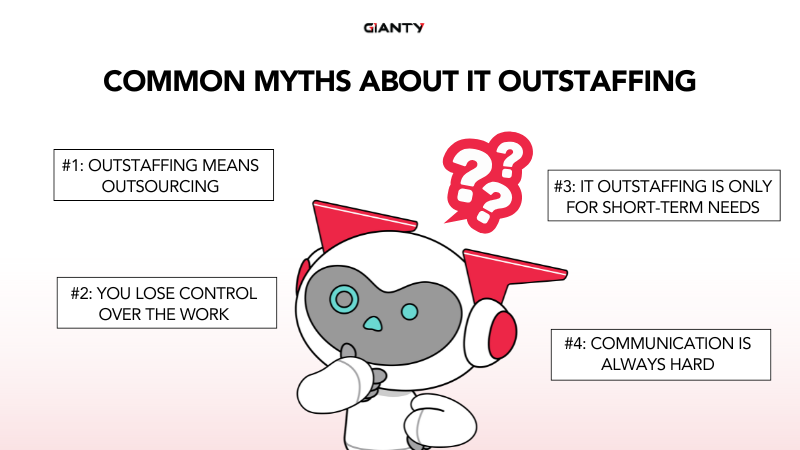
Despite its popularity, IT outstaffing is often misunderstood, mainly because it is confused with outsourcing or short-term contracting. Below are some common myths worth clarifying.
Myth 1: Outstaffing Means Outsourcing
This is the most frequent and costly misconception.
While both models involve external vendors, IT outstaffing and outsourcing serve very different purposes. In an outsourcing model, an external provider is responsible for delivering a complete project or outcome, often with limited client involvement in day-to-day execution.
When leaders treat outstaffing like outsourcing, ownership quietly erodes. Decisions slow down, accountability blurs, and teams wait for direction that never comes. What was meant to increase speed ends up reducing it.
Myth 2: You Lose Control Over the Work
In practice, the opposite is true.
Unlike outsourcing, where control is exercised through contracts, IT outstaffing enables direct, real-time management. The level of control depends less on the model and more on how actively the client leads the team. Outstaffing doesn’t remove responsibility but it concentrates it. Teams that expect “less involvement” after scaling up often discover that velocity drops precisely because no one is steering execution closely enough.
Myth 3: IT Outstaffing Is Only for Short-Term Needs
While outstaffing is commonly used to handle short-term workload spikes, it is increasingly adopted for longer-term engagements.
Many organizations use IT outstaffing to:
- Support multi-year product roadmaps
- Maintain and evolve core platforms
- Embed specialized skills into ongoing teams
The key advantage is flexibility, not duration. Treating outstaffing as “temporary by default” leads to fragile team design. Knowledge isn’t documented, engineers rotate too often, and continuity suffers—creating exactly the instability leaders were trying to avoid.
Myth 4: Communication Is Always Hard
Communication challenges are often attributed to outstaffing, but they are rarely caused by the model itself.
In reality, collaboration quality depends on:
- Clear ownership and decision-making
- Consistent communication rituals (standups, reviews, retrospectives)
- Shared tools for documentation, tracking, and messaging
When these elements are in place, distributed and outstaffed teams can collaborate as effectively as in-house teams, even across time zones.
IT Outstaffing: Pros & Cons
The Power of IT Outstaffing
- Speed to talent – scale teams in weeks, not months.
- Flexible scaling – adjust team size without long-term hiring risk
- Access to specialized skills – AI, cloud, DevOps, cybersecurity, game tech
- Cost predictability – reduced recruitment and employment overhead
- Execution control – architecture, quality, and delivery stay in-house
Trade-Offs to Consider
- Requires strong internal leadership
- Needs clear onboarding and integration
- Knowledge retention must be managed
- Not suitable for unclear or undefined scope
How to Choose an IT Outstaffing Vendor in 2026
By 2026, choosing an IT outstaffing vendor is no longer about who can supply developers fastest. It’s about who can operate as a long-term execution partner in an environment shaped by AI, distributed teams, and constant change.
Look Beyond Headcount – Evaluate Execution Readiness
In an AI-shaped environment, execution readiness also means knowing what should be and not be automated. A strong outstaffing vendor should not just “provide talent,” but ensure that talent is:
- Production-ready, not just technically qualified
- Familiar with modern workflows (Agile, DevOps, CI/CD)
- Able to integrate quickly into your tools, codebase, and culture
Ask: How do you onboard engineers into an existing product team within the first 30 days?
Prioritize Specialized Talent, Not Generic Roles
In 2026, the highest demand is no longer for generalist developers—but for specialized execution roles, such as:
- AI/ML and LLM integration engineers
- Cloud, DevOps, and platform engineers
- Security and compliance-focused roles
- Domain-specific engineers (e.g., fintech, gaming, enterprise systems)
Choose vendors who can demonstrate real project experience, not just resumes.
Assess Talent Stability and Retention
High turnover kills velocity. A reliable outstaffing partner should show:
- Clear retention strategies
- Low annual attrition for long-term engagements
- Backup and replacement processes without disrupting delivery
Ask directly: What happens if a key engineer leaves mid-project?
Demand Transparency in Communication and Management
By default, outstaffed teams should operate with:
- Clear reporting lines
- Regular syncs and performance reviews
- Visibility into progress, risks, and capacity
Avoid vendors who rely solely on “hands-off” delivery or vague status updates.
Security, Compliance, and IP Protection Are Non-Negotiable
In 2026, security is not optional, especially with AI, data, and distributed teams.
Ensure the vendor has:
- Clear IP ownership terms
- Secure access controls and data policies
- Experience working with enterprise security standards
If a vendor cannot clearly explain how they protect your data and IP, they are not enterprise-ready.
Top 10 IT Outstaffing and Outsourcing Vendor in SEA
Southeast Asia has become a major tech hub by combining a large, fast-growing engineering talent pool, competitive operating costs, and strong alignment with global development standards. As a result, IT Outstaffing in Southeast Asia has become a preferred choice for business and technology leaders looking to scale efficiently without losing control.
- GIANTY (Vietnam Delivery – Japan Quality)
GIANTY is an IT outstaffing partner delivering Japan-quality execution with scalable SEA engineering teams across software, AI and game development. - FPT Software (Vietnam)
Global IT services provider offering large-scale IT outstaffing, outsourcing and digital transformation across multiple industries. - CMC Corporation (Vietnam)
Enterprise IT outsourcing company supporting complex, large-scale software and infrastructure projects. - AIS (Thailand)
Telecommunications-led IT outsourcing provider delivering enterprise IT and digital solutions. - Win-Pro Consultancy (Singapore)
IT consulting and outsourcing firm supporting SMEs with managed IT and software services. - Thrive (Indonesia)
IT services provider delivering outsourced software and digital solutions for local and regional clients. - ITC Group (Australia–Vietnam)
Global IT outsourcing partner combining cloud, AI, and software engineering with SEA delivery teams. - Adventus (Malaysia)
Malaysian IT services firm providing outsourced software development and enterprise IT solutions. - Sourcefit (Philippines)
Offshore IT outsourcing and staffing provider supporting software and operational teams. - Orfeostory (Singapore)
Software outsourcing company delivering web, app, and CRM solutions for SMEs.
IT Outstaffing: From GIANTY’s Perspective
From GIANTY’s experience, IT outstaffing works when leaders treat it as an execution strategy, not a hiring shortcut.
The strongest outcomes come when:
- Clients keep clear ownership of product and decisions
- Talent is chosen for delivery readiness, not speed alone
- Teams are built for continuity, not constant rotation
In practice, outstaffing is less about where talent sits and more about how execution is led. When leadership is clear, IT outstaffing becomes a force multiplier for speed, quality, and focus.
GIANTY delivers IT outstaffing for teams that need to scale execution without sacrificing control or quality. Our engineers integrate directly into your workflows, providing production-ready talent across AI, cloud, web, and game development. Ready to scale? Reach out to GIANTY to discuss your IT outstaffing needs!
FAQs
- What is IT Outstaffing, and how is it different from hiring?
IT Outstaffing is a model where companies extend their internal teams with external IT professionals while keeping full control over tasks and delivery. Unlike hiring, it avoids long-term employment commitments and speeds up access to skilled talent.
- Why do companies choose IT Outstaffing?
Companies use IT Outstaffing to scale teams faster, access specialized skills on demand, reduce hiring friction, and stay flexible as project needs change—without increasing permanent headcount.
- What IT Outstaffing models are available?
Common models include short-term outstaffing for urgent needs, long-term outstaffing for ongoing development, and project-based outstaffing for specific initiatives. The right model depends on skill depth, duration, and team integration needs.
- When is IT Outstaffing better than outsourcing?
IT Outstaffing is a better choice when businesses want direct control over execution, close collaboration with internal teams, and ownership of architecture and outcomes—rather than handing delivery to a third party.
- How do businesses choose a reliable IT Outstaffing partner?
A reliable IT Outstaffing partner has proven experience, strong talent screening, clear communication, and the ability to integrate seamlessly with your team while ensuring continuity and security – partners like GIANTY, which combines Japan-quality standards with a scalable global delivery model, are built specifically for this role.