AI Agents in Game Development are emerging at a pivotal moment for the industry. Development costs continue to climb, production cycles stretch longer each year, and players now expect worlds that feel reactive, intelligent, and constantly evolving. In this pressure-filled landscape, studios are rethinking not just what they build but how they build it. And this is where AI agents step forward, not as another hype cycle, but as a co-dev embedded into the modern game pipeline.
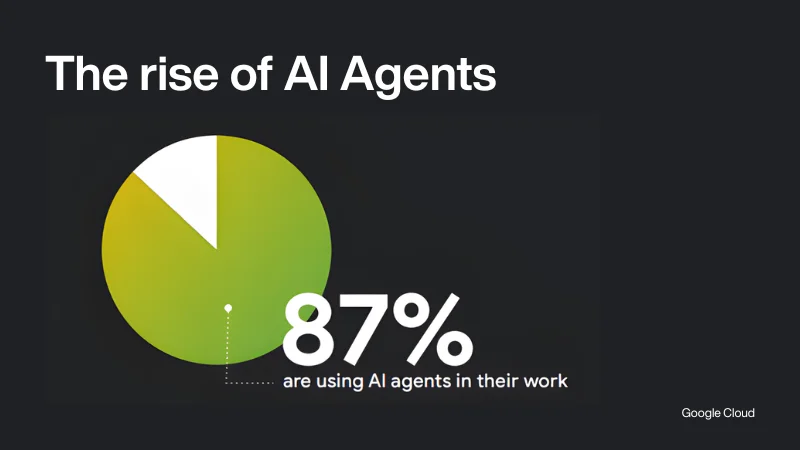
What many teams don’t realize is how far this shift has already progressed. According to Google’s “AI Meets the Games Industry” report, 87% of developers are already utilizing AI agents. The question for studios is no longer “Should we explore AI?” but rather “Can we afford not to?” The gap between teams that adopt AI-driven workflows and those that don’t is widening rapidly.
In this article, we explore why AI agents are rising now and what their rapid adoption means for the future of game development as AI becomes a true production partner.
What Are AI Agents in Game Development?
AI agents in game development are intelligent systems that can understand context, make decisions, and act independently to support gameplay or production tasks. They don’t follow fixed scripts – they learn, adapt, and respond in real time.
Traditional AI in Game Dev
- Fixed rules and behavior trees
- Limited adaptability
- Predictable and non-learning
- Designed only to run inside the game for players
AI Agents
- Pursue goals autonomously
- Demonstrate reasoning, planning, and memory
- Learn and adapt from outcomes
- Process multimodal inputs (text, audio, video, code)
- Collaborate with other agents for complex workflows
What makes this possible now?
The report emphasizes multimodal foundation models as the breakthrough, allowing agents to interpret and act on complex forms of information, not just text.
This new intelligence layer allows agents to:
- Understand player behavior
- Test systems autonomously
- Modify game parameters dynamically
- Support developers during production
AI in Game Development has evolved from “enemies following patterns” to autonomous systems that co-create and co-operate.
A notable example is AI People by GoodAI – a sandbox experience where AI-driven NPCs autonomously interact with each other, the environment, and the player, generating emergent narratives without traditional scripting.
Why AI Agents in Game Development Are Rising Now
According to Google’s AI Meets the Games Industry report, it highlights a powerful combination of market momentum and AI capability leaps that are accelerating agent adoption.
Rising complexity of modern games
Game worlds are bigger, more dynamic, and more player-driven than ever. Developers need systems that can react in real time, personalize experiences, and reduce manual balancing work.
New production pressures
Developers are using agents because they meaningfully reduce the need for manual adjustments across the pipeline.
The report states this clearly: “This signals a shift toward systems that respond in real time, reducing the need for manual adjustments, and enabling more flexible and dynamic game environments.”
AI Agents can now reason, plan, and make decisions
The report defines AI agents as software systems that use AI to pursue goals, reason, plan, and learn autonomously. These capabilities are enabled largely by multimodal foundation models, which can process text, audio, video, and code.
Tangible AI Agents adoption is already happening
Despite early skepticism, this isn’t theoretical – developers are already using AI agents at scale. The Google Cloud’s survey of 615 game developers across five countries (June–July 2025) confirms it: AI agents have officially moved past early adoption and into mainstream game development.
- 87% of developers say they already use AI agents in their work
- 44% use agents for content optimization
- 38% use agents for dynamic balancing
- 38% use agents for in-game coaching or tutorials
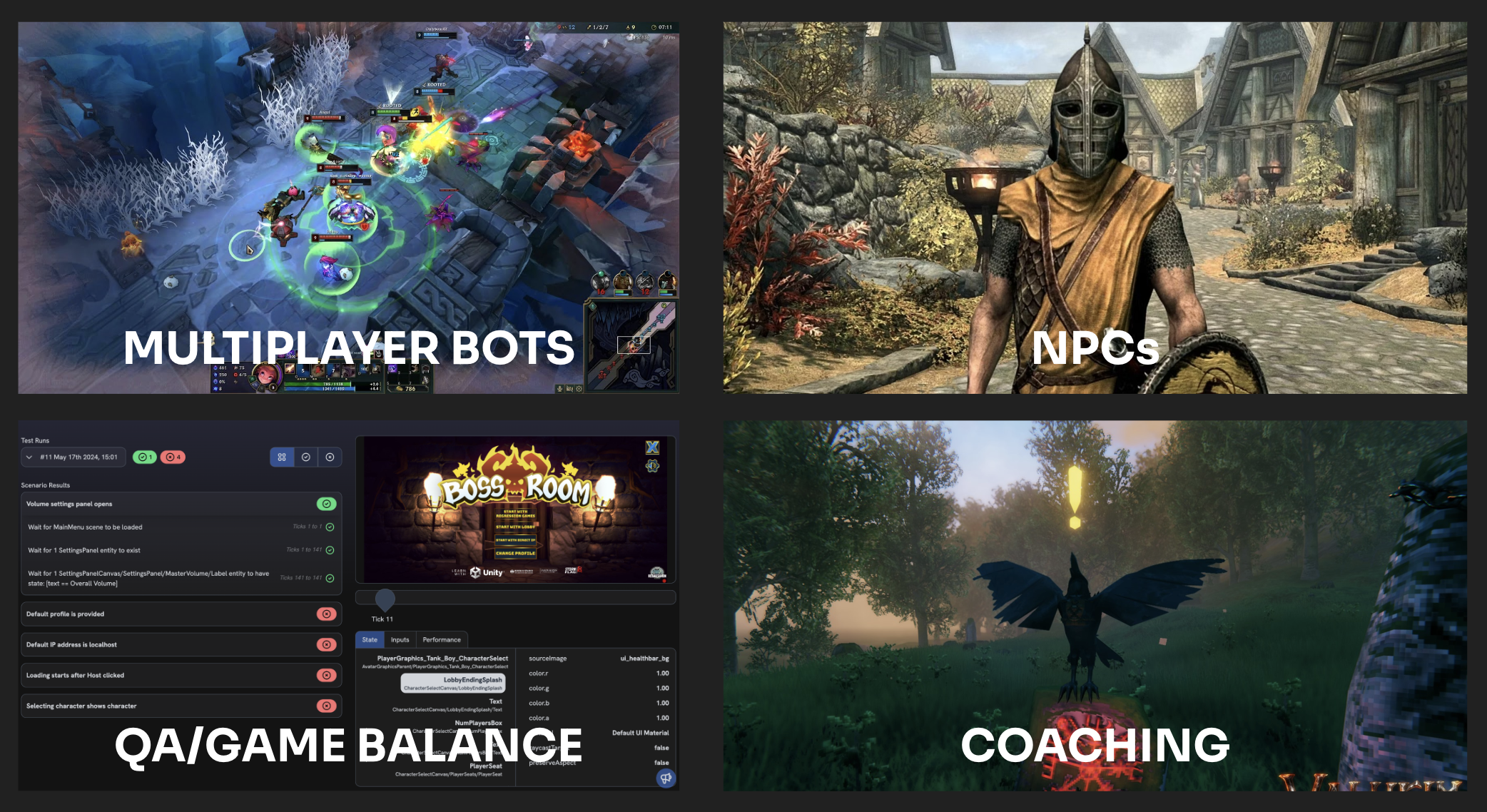
How Developers Are Using AI Agents Today?
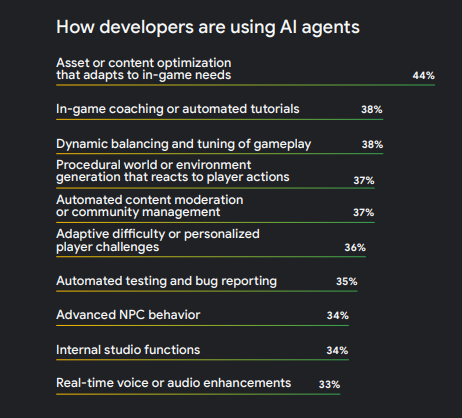
Asset or Content Optimization (44%)
AI agents automatically optimize textures, meshes, audio, UI assets, or level elements to fit in-game requirements. They can adjust resolution, format, compression, lighting, or metadata without manual intervention, reducing content bottlenecks and ensuring consistent quality across platforms.
Dynamic Balancing and Gameplay Tuning (38%)
Agents monitor gameplay data and adjust variables such as enemy stats, spawn rates, loot tables, or difficulty curves in real time. Instead of manual patching, AI agents continuously analyze player behavior and update balance parameters to maintain fair, engaging gameplay.
In-Game Coaching & Automated Tutorials (38%)
AI agents detect player skill level, mistakes, or hesitation points and offer contextual guidance. Examples include tutorial prompts, adaptive onboarding flows, or strategy suggestions, making games more accessible and reducing early-game drop-off.
Procedural World or Environment Generation (37%)
AI agents dynamically generate terrain, dungeons, missions, or environmental events that react to player actions. Worlds evolve based on playstyle, adding replayability and reducing the burden on designers.
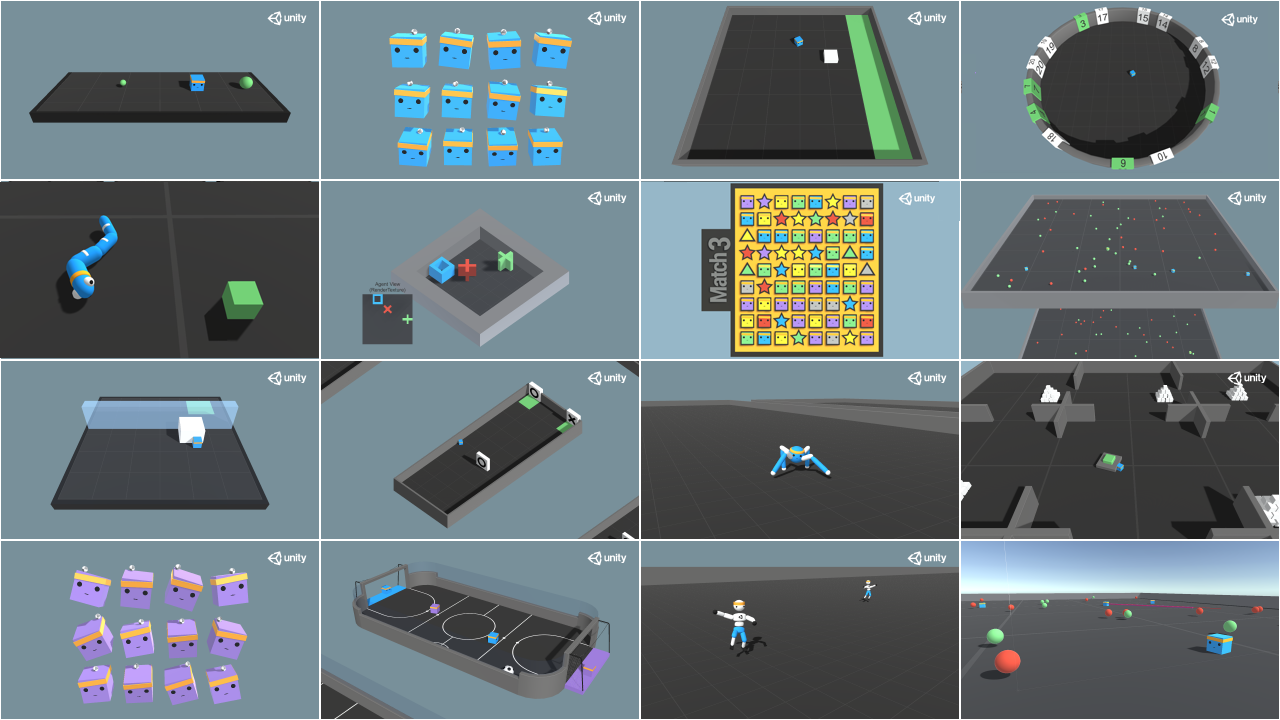
Example: Tools like Unity ML-Agents help test these dynamic environments, enabling worlds that adapt to player behavior with less manual design work.
Automated Moderation & Community Management (37%)
Agents filter toxic chat, intercept harmful behavior, manage user-generated content, and flag suspicious activity. This helps studios maintain safer communities without relying solely on human moderators.
Adaptive Difficulty & Personalized Challenges (36%)
AI agents adjust encounters, puzzles, resource availability, and enemy behavior to match individual player abilities. This leads to more immersive, less frustrating gameplay and higher retention.
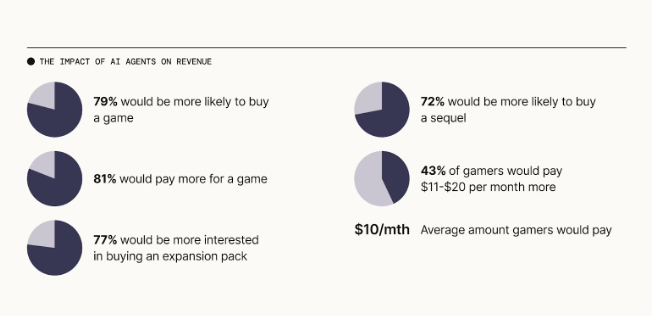
According to The Future of NPCs report with a survey of 1,000 US players, gamers are ready to spend on AI NPCs. 79% said they’d be more likely to buy a game with AI NPCs, 81% would pay more for it, and 77% would even buy expansions with AI characters.
Automated Testing & Bug Reporting (35%)
Agents simulate thousands of gameplay scenarios, identify bugs, reproduce edge cases, and generate reports automatically. They help QA teams catch issues earlier, shorten testing cycles, and reduce regression risk.
Advanced NPC Behavior (34%)
NPC agents can collaborate, share resources, coordinate flanking maneuvers, set traps, or modify terrain. This represents a jump from scripted AI to emergent, multi-agent behavior that can create richer and less predictable gameplay.
Internal Studio Functions & Workflow Automation (34%)
AI agents support production pipelines by automating tagging, asset classification, documentation, localization prep, or build management. They assist designers, engineers, and producers with repetitive work to reduce operational overhead.
Real-Time Voice or Audio Enhancements (33%)
Agents clean audio input, modify voices, enhance environmental soundscapes, or localize voice lines dynamically. This improves accessibility, immersion, and global reach.
Impact of AI Agents in Game Development Pipelines
There are some major areas where AI agents are already redefining how studios design, build, and operate games.
Accelerated Development Cycles
AI agents automate time-consuming tasks like testing, balancing, content optimization, and allowing teams to iterate faster and ship updates more frequently.
- Faster prototyping and iteration
- Reduced manual QA workload
- Shorter time-to-market for features and updates
New Creative and Design Possibilities
AI agents in game development unlock systems and ideas that were previously too complex or resource-heavy to build manually.
They support:
- Emergent gameplay and dynamic narratives
- Worlds that evolve based on player behavior
- Storytelling that adapts in real time
These capabilities expand what small teams can produce and allow larger studios to innovate faster.
Smarter Resource Allocation for Studios
As AI agents in game development take on repetitive or technical tasks, teams can redirect their energy toward high-value creative work. The report notes that studios will increasingly require roles such as:
- AI system designers
- Prompt engineers
- Data and agent orchestration specialists
This marks a shift toward hybrid teams where humans focus on creativity and strategy while AI agents handle scale and execution
Final Thoughts
GIANTY believes the strongest studios will be those that embrace hybrid workflows: human creativity combined with AI acceleration. Our mindset at GIANTY is simple: AI is a multiplier, not a replacement.
We are already integrating: AI-powered rapid prototyping, AI art & pixel pipelines, AI animation, AI-assisted coding,…This gives studios the velocity of large teams without the overhead.
And because AI tools are maturing rapidly, the advantage will go to the studios that adopt early. If you’re exploring AI in your next game, whether for prototyping, gameplay systems, or AI-driven NPCs, our team is ready to collaborate. Reach out to GIANTY for your next AI in Game Development plan!
FAQs
- What are AI agents in game development?
AI agents are autonomous systems that can reason, plan, learn, and make decisions to support gameplay or development tasks. They process multimodal data (text, audio, video, code) and adapt in real time, unlike traditional scripted AI.
- Do AI agents in game development reduce time?
Yes. AI agents automate repetitive tasks like testing, asset optimization, and balancing, which can shorten overall time-to-market for new gameplay features.
- Can small or mid-sized studios benefit from AI agents?
Yes. AI agents help smaller teams scale production, automate QA, and accelerate iteration even without large budgets.
- Are there concerns about using AI agents in game development?
Yes. Developers cite concerns such as Data ownership, player data privacy, and unclear licensing for AI-generated content. Studios must implement clear governance and responsible AI practices.
- What are the most common uses of AI agents?
Top use cases include content optimization, dynamic balancing, in-game coaching, procedural world generation, and automated testing.
- What if my studio wants to experiment with AI agents but lacks in-house AI expertise?
You don’t need to hire an internal AI team to get started. For fast development, you can look for a partner like GIANTY can help you prototype and integrate AI agents into your game pipeline with technical support and AI-driven development expertise.