Picture this, a scene from the industry floor: a Senior Art Director at a mid-size publisher opens a new vendor proposal. The portfolio is strong. The pricing is fair. The team seems capable and after all, she passes.
Not because the work wasn’t good. But because the last external partner also strong on paper like delivered 40% of the assets in the wrong format three months into the engagement. By the time it was fixed, the sprint was gone, the lead character had to be redesigned, and no one was sure who had approved the original brief.\
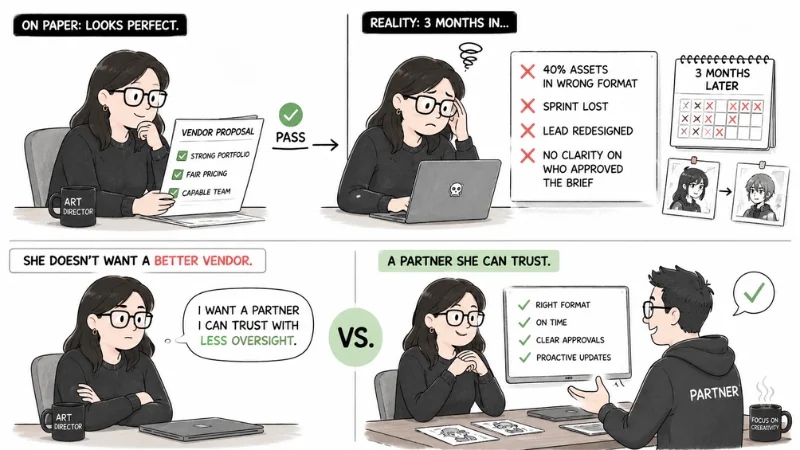
She doesn’t want a better vendor. She wants a partner she can trust with less oversight.
This single story replicated across hundreds of studios is what the XDS 2026 Insights Report is actually documenting. The XDS (External Development Summit) is the leading annual conference for the game industry’s external development ecosystem, and each year, they survey 250+ professionals worldwide: developers, publishers, and service providers to map where the market is moving.
GIANTY read the full 51-page XDS 2026 Insights Report. Here’s what it says, what it confirms, and where we think the industry still isn’t being honest enough with itself.
What Is External Development And Why It Matters More Than Ever in 2026?
External development refers to the practice of game developers and publishers partnering with specialist studios and service providers to deliver Art, Animation, Engineering, Audio, QA, Localization, and Co-Development work — at scale, across the full production lifecycle.
It’s no longer niche. According to the XDS 2026 Insights Report:
Most Developers and Publishers are sending between 30–60% of their projects to external studios. Certain disciplines — art, localization, QA, audio — frequently exceed 50%.
The report’s conclusion is direct: “External development is now structural, not cyclical.”. This is a market where the question has shifted from “do we use external partners?” to “how well do we manage them?”
TL;DR — Key Findings from the XDS 2026 Insights Report
- #1 friction point: Communication challenges, up +15% YoY for both sides
- AI adoption: Blanket prohibitions dropped from 44% → 18%; now it’s about governance, not bans
- Engineering: Entered the top 3 services for the first time at 34% (up from 10%)
- Partner loyalty: Incumbent advantage dropped 24% — more studios are willing to switch
- Trust barrier: Bad prior experience is now the #1 reason not to partner (55%)
How Developers and Service Providers Are Connecting And Where It’s Breaking Down
The Market Is Optimistic. But Read the Fine Print.
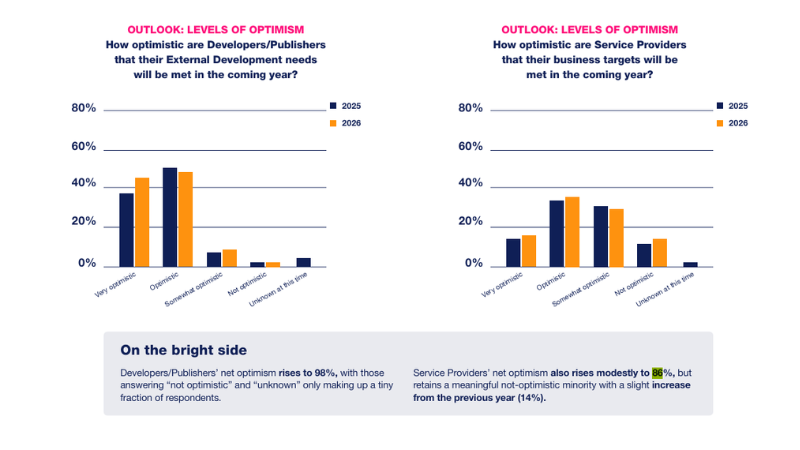
Developers and Publishers entered 2026 at 98% net optimism about external development. Service Providers are at 86% still positive, but with a 14% minority who are not. We’d argue that 14% is the more telling number.
The XDS 2026 Insights Report frames confidence as “increasingly conditional” and what that means practically is that studios are optimistic about the concept of external development but increasingly frustrated by the execution of it. Budget pressure, project cancellations, and misaligned expectations are eroding trust from the Service Provider side. 65% of service providers cite project cancellations as their top concern in 2026.
Our read: optimism at the macro level is not the same as satisfaction at the engagement level. The gap between “we believe in external developers” and “our last three partnerships worked well” is where a lot of the real market tension lives right now.
How Partnerships Form And Why the Channel Mix Is Changing
Industry events and conferences remain the primary discovery channel at ~75% of responses. Referrals come second. But the most significant movement in the XDS 2026 Insights Report is happening at the edges:
Portfolio and Marketplace Platforms saw the largest year-over-year growth. Developers/Publishers are increasingly running parallel searches starting with relationships from XDS or GDC, then vetting finalists through online presence, case studies, and portfolio depth before committing.
This tells us something important: the handshake opens the door, but the portfolio now closes it. A studio that shows up at an event but has a thin digital footprint is losing deals it doesn’t even know it’s competing for.
For Service Providers building their business development strategy, the conference-first model isn’t wrong — it’s incomplete. The studios investing in inbound presence alongside relationship-building are creating a compounding pipeline that outperforms conference-only reach over 18 months.
The Onboarding Problem Nobody Talks About Honestly
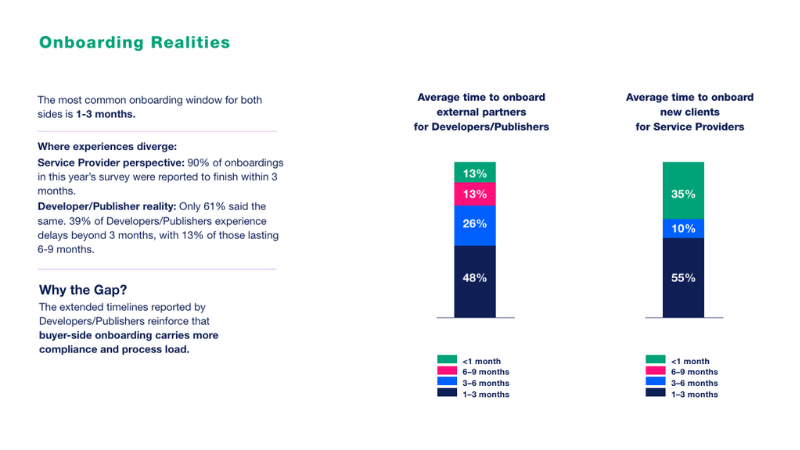
Here is one of the most underreported friction points in the XDS 2026 Insights:
90% of Service Providers say they complete onboarding within 3 months. Only 61% of Developers/Publishers agree.
That 29-point gap is not a perception problem. It’s a process problem — and most of it sits on the buyer side.
Vendor approval systems, security reviews, procurement workflows, legal sign-off chains: by the time a publisher has cleared a new external partner through their internal compliance process, the sprint they were trying to staff has already started. 13% of Developers/Publishers report onboarding delays extending 6–9 months.
Our opinion: this is the silent margin killer in external development. Studios budget for the work but not for the ramp-up. Service Providers should be having direct conversations with new clients about this before contracts are signed — not as a disclaimer, but as a joint project with clear milestones. The studios that do this reduce their effective onboarding time by weeks, sometimes months.
GIANTY’s view: We’ve seen firsthand that the best external partnerships aren’t transactional. They become an extension of the internal team — with shared context, shared goals, and a relationship that makes every subsequent project faster and better. That only happens in retainer structures over meaningful timelines.
The Key Friction Points: Communication Is the New Quality Problem
The Problem Isn’t Delivery Anymore. It’s Coordination.
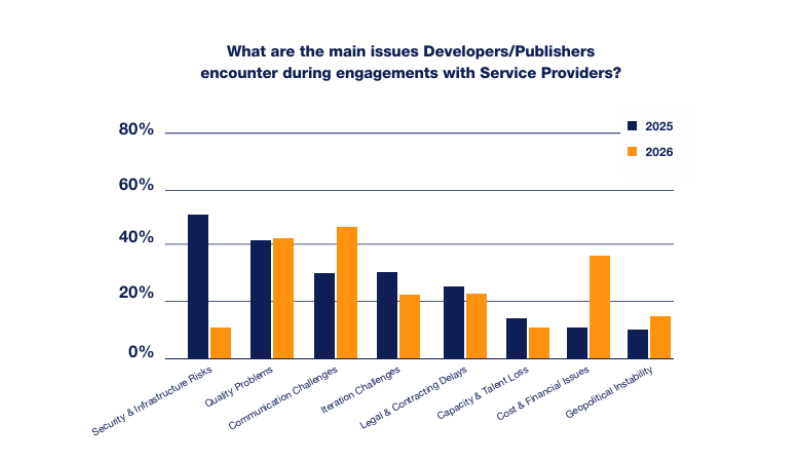
This is the finding from the XDS 2026 Insights Report that, frankly, surprised us — not because we didn’t believe it, but because of how fast it moved.
Communication Challenges rose +15% YoY and are now the #1 source of friction for both Developers/Publishers and Service Providers.
Meanwhile, Security & Infrastructure Risks dropped 38 points. Quality and delivery misalignment dropped 29%, “suggesting better scoping and expectation management.” The foundational execution problems are being solved.
The new problem is softer and harder to fix: who owns which decision, what does “approved” actually mean in a distributed team, how does feedback close across time zones, how do you maintain creative alignment 6 months into a production arc when the original brief has evolved three times?
Quality concerns remain at 42% — but we’d argue this number isn’t primarily a capability problem anymore. It’s a communication problem wearing a quality label. When briefs are ambiguous, when revision rounds don’t have clear sign-off, when “approved” means different things to the art director and the producer — the output suffers, even if every individual deliverable was technically executed well.
The Trust Equation Has Inverted
The XDS 2026 Insights Report shows a significant shift in why studios don’t partner with Service Providers. Geographic and logistical barriers — once the #1 concern — dropped 21 points.
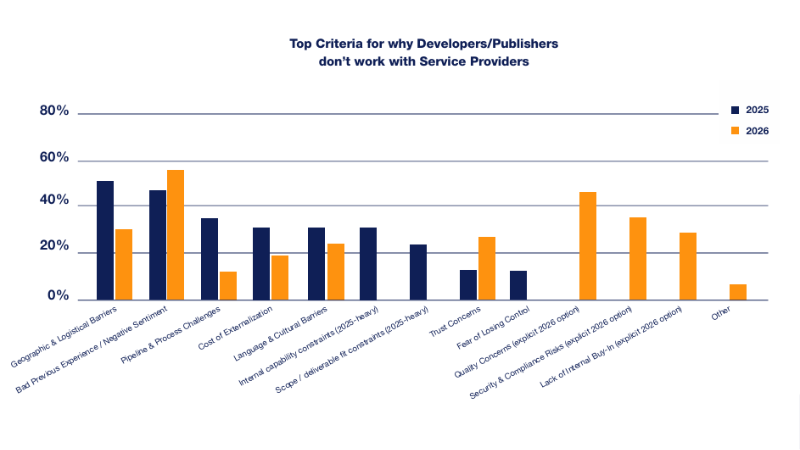
Bad previous experience is now the #1 barrier to new partnerships at 55%, up 10% YoY.
The world has gotten smaller. Remote collaboration tools, cloud pipelines, async workflows — they’ve neutralized geography as a meaningful objection. What hasn’t been neutralized is memory.
Every failed engagement leaves a trace. In an industry that runs on relationships and referrals, bad experiences don’t stay contained — they travel. A director who had a painful partnership with a studio in 2023 mentions it in a Slack channel in 2025, and the ripple goes further than anyone tracks.
We think this is the most important structural reality in the XDS 2026 Insights: the industry’s tolerance for “good enough” partnerships has collapsed. Studios aren’t comparing you to a perfect standard — they’re comparing you to their worst experience and asking whether you’re different enough to justify the risk.
The answer has to be yes, demonstrably, before the first invoice.
Incumbent Advantage Is Eroding and That’s a Warning for Comfortable Partnerships
A 24% drop in Developers/Publishers saying they will NOT switch partners is a significant number. It suggests that loyalty, once the dominant force in External Development relationship management, is now conditional on performance rather than inertia.
Budget constraints drive 51% of switching decisions. Better fit for new projects drives 38%.
The implication is clear: no partnership is automatically renewed. Every engagement is, in effect, an audition for the next one. Service Providers who have been operating on relationship equity without investing in communication infrastructure, quality systems, and continuous improvement are going to find that equity evaporating faster than they expect.
The State of AI Adoption in External Development
The Permission Gap Is Real and Most People Are Misreading It
Here is the honest read of AI in the XDS 2026 Insights Report: the gap is not between studios that want AI and studios that don’t. It’s between studios that have a governance framework and studios that are still defaulting to prohibition.
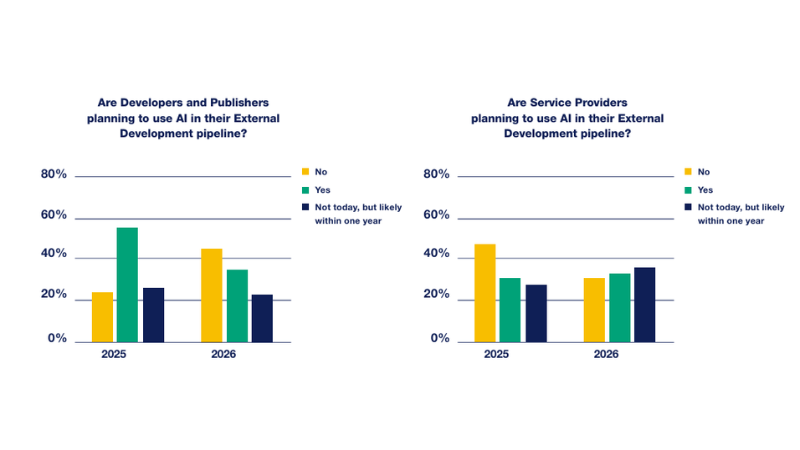
Not everyone is betting on AI. While service providers are building AI capacity, developers and publishers are pulling back, with the proportion saying “No” nearly doubling.
These two things are not contradictory. Studios are moving away from blanket bans while still being cautious about case-by-case AI use. The market is trying to solve the same problem from two different directions: how do you get the efficiency benefits of AI-assisted production without losing control of your IP, your training data, or your quality standards?
The answer the data points to: disclosure + governance > prohibition.
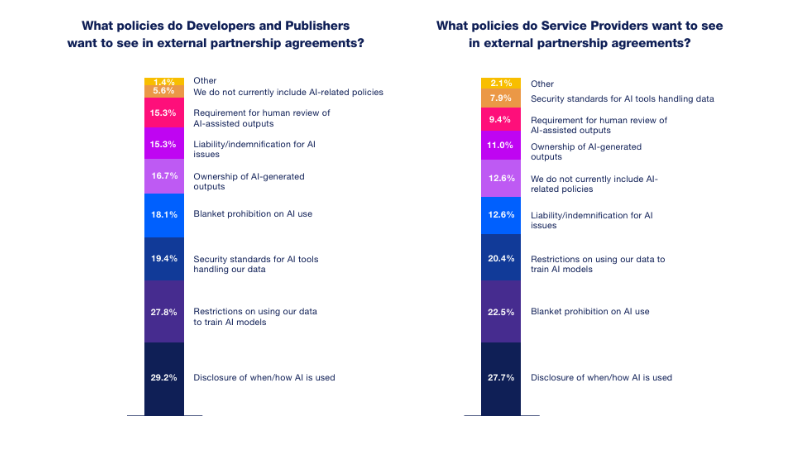
Disclosure of AI use is the #1 contractual priority for both sides in 2026. The market wants to know where AI is being used, on what assets, under what review process, and with what liability structure. 54% of service providers currently operate where AI is permitted in only 0–9% of engagements — not because clients don’t want efficiency, but because the governance framework hasn’t been established yet.
What AI Governance Actually Needs to Look Like
Based on the XDS 2026 Insights Report data and our own conversations with clients, the four questions that govern every AI decision in an external pipeline are:
1. Where is AI being used? — Asset type, production phase, tool/model specifics
2. What happens to client IP and training data? — Clear contractual protection, no training on proprietary assets
3. Who reviews the output before delivery? — Human checkpoints documented and defined
4. What is the liability structure if something goes wrong? — Indemnification, quality escalation path, remediation process
These are answerable questions. Every studio using AI tools — in concept art generation, QA automation, localization pre-translation, code review acceleration — needs written answers to all four before a client asks.
GIANTY’s opinion: The studios that will define the next era of AI-assisted external development are not the ones with the most powerful models. They’re the ones with the most legible governance. Clients are not afraid of AI. They’re afraid of opacity. Make your process transparent, document your human review layer, and the conversation changes completely.
The Disciplines Where AI Is Moving Fastest
The XDS 2026 Insights Report points to AI movement in QA (automation of regression and smoke testing), Localization (pre-translation and terminology management), and Art (concept generation, asset variation, texture generation). Engineering AI tooling is also accelerating — which helps explain why Engineering entered the top 3 services for the first time.
The studios that are winning with AI in these disciplines share a common pattern: they’re using AI to accelerate the volume and variation work, freeing human talent for the creative judgment, quality review, and client communication that machines cannot replicate.
What’s Actually Being Outsourced at Scale in 2026
The Outsourcing Services That Have Become Structural
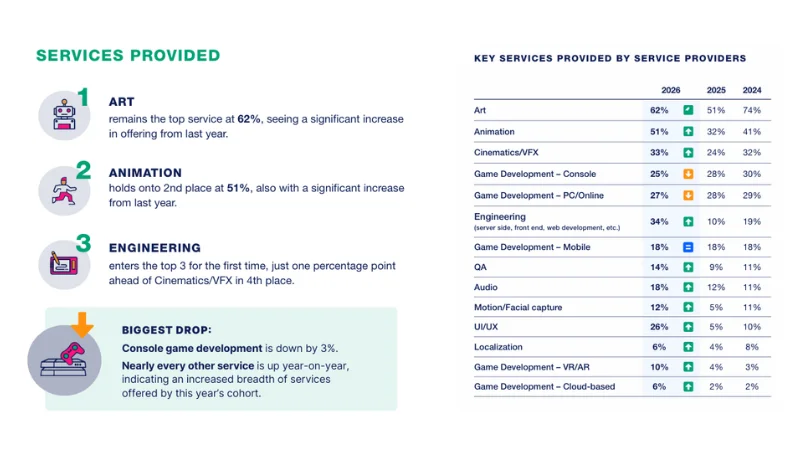
The top 3 in 2026: Art (62%), Animation (51%), Engineering (34%) with Engineering entering the top 3 for the first time, just one percentage point ahead of Cinematics/VFX in 4th.
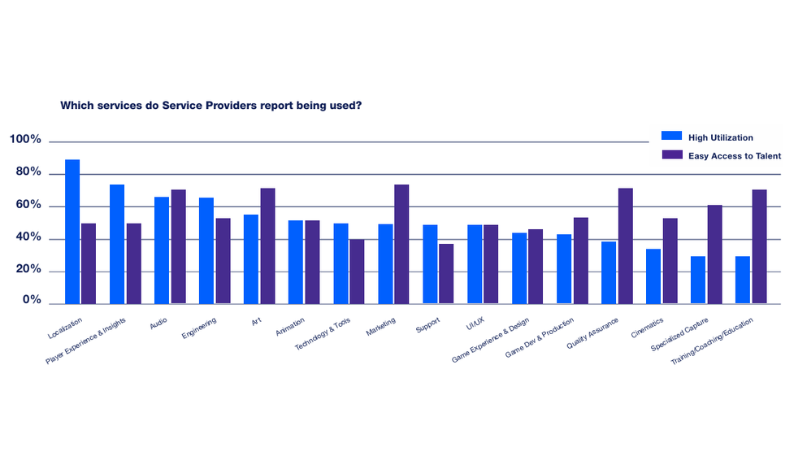
The utilization data in the XDS 2026 Insights tells a clear story about which disciplines have moved from “useful supplement” to “permanent infrastructure”:
Localization is the single most relied-upon external service — highest utilization rates, most consistent engagement across studio sizes. It is no longer considered “external” in any meaningful sense; it is simply how localization gets done.
Audio has made the same transition. Once commissioned project-by-project, Audio is now an always-on relationship for most studios with active development pipelines.
Engineering is the 2026 story. At 34% of Service Providers up from 10% in 2025 it entered the top 3 for the first time. This is not incremental growth. It is a structural shift reflecting studios’ recognition that specialized engineering capability (tools development, technical art, engine-specific optimization, systems engineering) is faster to access externally than to hire and retain internally in a volatile talent market.
Art remains the backbone at 62% of SP offerings (up from 51%). Animation holds second at 51% (up from 32%). Both increases are significant — they reflect not just more providers entering the space, but more Developers and Publishers formalizing what had previously been informal or ad-hoc external art capacity.
The Pricing Signal
For years, the External Development market faced downward rate pressure. The XDS 2026 Insights Report signals that pressure has eased.
Rates largely held flat in 2025–2026, with selective increases in Audio, Localization, QA, and Engineering. The report’s framing:
“Quality, expertise, and delivery confidence now outweigh pure cost considerations in external partner selection.”
We think this is accurate, with one caveat: “now outweigh” is doing a lot of work in that sentence. Budget remains the #1 driver of switching decisions at 51%. Studios value quality and reliability — but they value it within budget tolerances that have gotten tighter, not looser.
The real story is that the studios willing to pay premium rates are choosing providers more carefully, staying longer, and switching less. The studios operating on thin budgets are cycling through partners faster. These are two different markets operating simultaneously within the same industry.
What the XDS 2026 Insights Mean, in Plain Terms
The XDS 2026 Insights Report is not a neutral document. It is an industry telling itself the truth about where things are breaking down.
Here is our honest synthesis:
- External Development has grown up. The systems are more mature. The problems are more human. Communication, trust, governance, expectation calibration — these are not problems you solve with better software or faster pipelines. You solve them with better operating models, clearer contracts, and a genuine commitment to treating partnership as a shared investment rather than a transaction.
- The incumbent advantage is over. Comfortable relationships based on inertia are being replaced by performance-based retention. Every engagement is now an argument for the next one.
- AI is not the threat. Opacity is. The studios that navigate AI governance well — disclosure, human review, clear liability — will have a meaningful competitive advantage. The ones still defaulting to prohibition will fall behind as the efficiency gap widens.
- Engineering, Animation, and Co-Development are the growth disciplines. Studios that can offer bundled capabilities across Engineering + Art + Co-Development are positioning for the direction the market is heading — not just filling gaps, but functioning as integrated co-production partners.
Four Market Trends Developers and Publishers Should Pay Attention To
Beyond the partnership dynamics and AI governance, the XDS 2026 Insights Report flags four broader market trends shaping how games are made — and where external capacity will matter most in the next 12–24 months.
- Platform stability — the target hasn’t moved much, but the competition has.
- PC market saturation — more titles, more noise, tighter margins for error.
- Growth in tool development — engineering is becoming a creative discipline.
- Community as a differentiator — the product doesn’t end at launch.
GIANTY’s pov: These 4 trends point in the same direction. The games market is maturing. There are more titles, more competition, and more sustained engagement cycles. External Development partners who can support the full lifecycle — not just ship dates — are going to be the ones with long-term relationships.
Closing: The Partner Question
We started this piece with a picture of an Art Director passing on a vendor. We want to end with a different picture.
Imagine a Senior Producer who has worked with the same external partner for three years. The onboarding was clear. The briefs were tight. When something wasn’t right, the conversation happened early — not after delivery. The quality didn’t just hold; it compounded. Assets got better as the team learned the game’s visual language. The partner flagged risks before they became problems.
That relationship doesn’t end because of budget pressure. It evolves. It deepens. It becomes the model the studio uses for every other external partnership it builds.
That’s the bar the XDS 2026 Insights Report is describing. That’s what the market is moving toward.
At GIANTY, it’s what we’ve been building toward since day one — across Art, Animation, Engineering, Audio, QA, Localization, and Co-Development. Not because the report said so, but because this is what it actually means to be a trusted partner in games production. If you’re a studio rethinking your external partnerships in 2026, we’re glad to have that conversation.
FAQs
- What is the XDS 2026 Insights Report?
The XDS 2026 Insights Report is an annual survey-based report produced by the External Development Summit (XDS) covering the state of external development partnerships in the video game industry. Data was collected September 10 – November 30, 2025, from 250+ industry professionals worldwide including Developers, Publishers, and Service Providers. - What is External Development in games?
Game External Development refers to game studios partnering with specialist external studios to deliver services including Art, Animation, Audio, Engineering, QA, Localization, and Co-Development across production. - What are the key findings of the XDS 2026 Insights Report?
The top findings include: communication challenges surpassed security as the #1 friction point (+15% YoY); Engineering entered the top 3 services for the first time (34%); AI blanket prohibitions dropped from 44% to 18%; and the incumbent partner advantage weakened by 24%. - Why is Engineering the fastest-growing external service in 2026?
According to the XDS 2026 Insights Report, Engineering jumped from 10% to 34% of services offered by Service Providers. This reflects rising demand for specialized technical capability — tools development, systems engineering, engine optimization — that studios find faster to source externally than hire and retain. - How is AI changing external game development?
The XDS 2026 Insights Report shows AI blanket prohibition policies dropped from 44% (2025) to 18% (2026). Both buyers and sellers now prioritize AI disclosure, human review requirements, and data usage restrictions over outright bans. 54% of Service Providers still operate where AI is permitted in only 0–9% of engagements, reflecting a governance gap rather than a technology gap in using AI in game development.