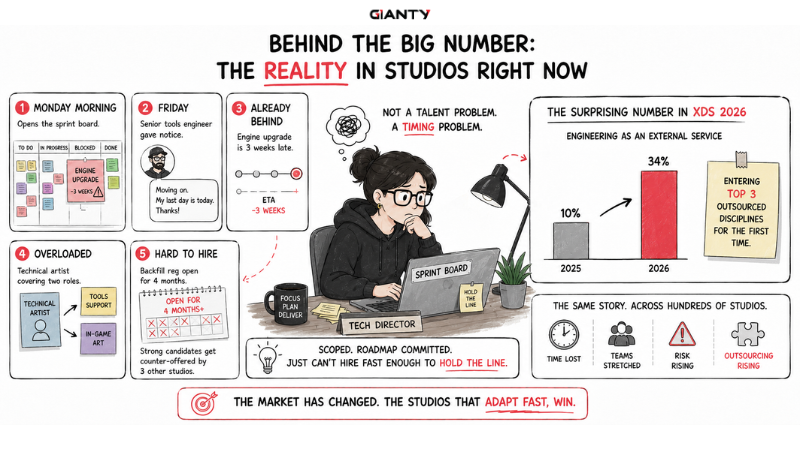
A technical director at a mid-size studio opens the sprint board on a Monday. The senior tools engineer who owned the build pipeline gave notice on Friday. The engine upgrade is three weeks behind. The technical artist is covering two roles. And the req to backfill has been open for four months, because every strong candidate is being counter-offered by three other studios.
She doesn’t have a talent problem. She has a timing problem. The work is scoped, the roadmap is committed — she just can’t hire fast enough to hold the line.
This scene, repeated across hundreds of studios, is the quiet story behind the single most surprising number in the XDS 2026 Insights Report: engineering as an external service jumped from 10% to 34% in one year — entering the top 3 outsourced disciplines for the first time.
GIANTY already published a full breakdown of the XDS 2026 Insights Report. This piece goes one level deeper on the finding that matters most to us — because engineering, tools, and technical art are exactly the work we do every day.
TL;DR – The Game Engineering Outsourcing Story in the XDS 2026 Data
- Engineering entered the top 3 external services for the first time at 34% — up from 10% the year before (XDS 2026 Insights Report).
- It landed just 1 percentage point ahead of Cinematics/VFX in 4th, so the shift is real but the race is close.
- The full top 3: Art 62% (up from 51%), Animation 51% (up from 32%), Engineering 34%.
- Engineering is one of only a handful of disciplines where rates rose in 2025–2026 — alongside Audio, Localization, and QA — while most rates held flat.
- The report frames the driver plainly: “engineering is becoming a creative discipline” through the growth of tool development.
- This is not incremental growth. The report calls external development “structural, not cyclical.”
The Number That Reframes the Whole Report
Most of the XDS 2026 headlines are about relationships — communication friction, trust, AI governance. Those matter. But buried in the services data is a structural shift that changes what studios actually buy.
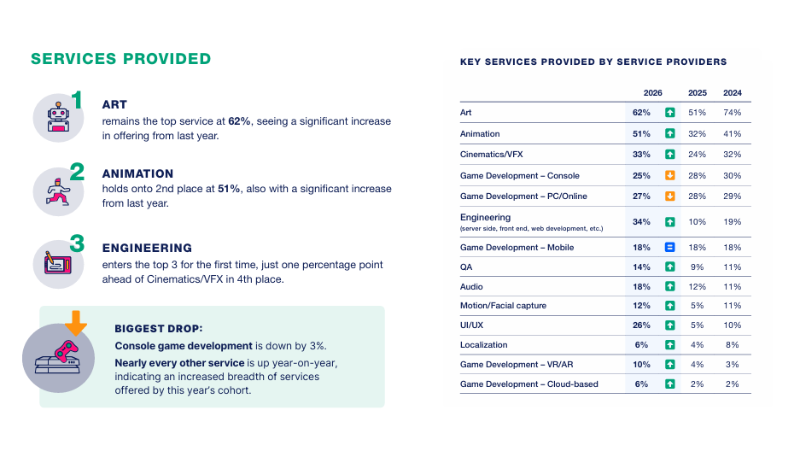
According to the “Key Services Provided by Service Providers” chart in the XDS 2026 Insights Report, the 2026 top three are:
- Art — 62% (up from 51%)
- Animation — 51% (up from 32%)
- Engineering — 34% (up from 10%), edging out Cinematics/VFX by a single percentage point for the third slot
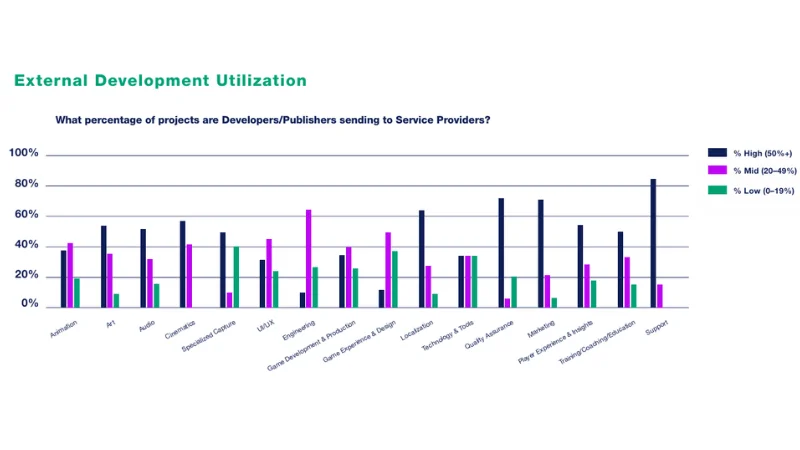
A jump from 10% to 34% in twelve months isn’t a rounding change. It’s a category crossing a threshold — moving from “occasionally useful” to “permanent infrastructure.” For context, the report also notes that most Developers and Publishers now send 30–60% of their projects to external studios, with art, localization, QA, and audio disciplines frequently exceeding 50%. Engineering is the newest discipline to join that structural tier.
The report’s own summary of the shift is direct: engineering capability is now “faster to access externally than to hire and retain internally in a volatile talent market.” That sentence is the whole thesis in one line.
Why This Isn’t a Blip: “Engineering Is Becoming a Creative Discipline”
The XDS 2026 Insights Report flags four broader market trends shaping how games get made over the next 12–24 months. One of them is “growth in tool development,” captured in a phrase we keep coming back to:
“Engineering is becoming a creative discipline.”
For years, “engineering” in games sat in the background — gameplay code, backend, plumbing. What the report is describing is different. The engineering that studios now outsource is upstream of the creative output itself:
- Tools development — the pipelines, editors, and automation that let art and design teams move faster
- Technical art — the bridge between what artists imagine and what the engine can render at frame budget
- Engine-specific optimization — squeezing performance out of Unreal, Unity, or proprietary tech across a fragmenting hardware landscape
- Systems engineering — the architecture that keeps live games stable as they scale
This is why the jump matters more than the percentage suggests. When tooling is the thing that determines how fast your whole production moves, an external engineering partner isn’t filling a gap at the edge — they’re accelerating the core.
GIANTY’s view: The studios treating engineering as “just code” are the ones still trying to hire it like a commodity. The studios treating it as a creative multiplier — tools that unlock the art team, optimization that unlocks the platform — are the ones already sourcing it as a partnership. The report is describing the second group winning.
The Real Driver: The In-House Hiring Math Broke
The XDS 2026 Insights Report is explicit that the engineering surge is a talent-market story, not just a preference shift. Specialized engineering – tools, technical art, engine optimization, systems — is now faster to source externally than to hire and retain internally.
Two other trends from the same report compound the pressure:
- Platform stability — the target platforms haven’t moved much, “but the competition has.” More studios are chasing the same engineering talent to hit the same performance bars.
- PC market saturation — “more titles, more noise, tighter margins for error.” When there’s no room for a missed optimization pass or a broken build pipeline, you can’t afford a four-month hiring gap on a critical engineering role.
Put those together and the in-house-only model starts to crack. Hiring a senior tools engineer or a technical artist in 2026 means competing in one of the tightest talent markets in the industry, waiting months, and betting they’ll stay through the next project cycle. An external engineering partner gives a studio the same capability on a timeline that matches the sprint — not the recruiting funnel.
This is the exact bottleneck in our opening scene. The work was scoped. The roadmap was committed. The only broken part was the ramp-up. External engineering exists to close that specific gap.
AI Is Accelerating Engineering Demand — Not Replacing It
A reasonable question: if AI is writing more code, why is human engineering outsourcing tripling?
The XDS 2026 data answers it. AI tooling is accelerating across engineering — which the report says helps explain why Engineering entered the top 3 in the first place. The pattern that’s winning isn’t “AI replaces engineers.” It’s engineers using AI to move faster on volume and variation work, while human judgment stays on architecture, optimization, and quality.
And the market is deliberately keeping humans in the loop. From the same report:
- AI blanket prohibitions dropped from 44% to 18% — studios stopped banning AI outright, but didn’t hand over control.
- Disclosure of AI use is now the #1 contractual priority for both sides — Developers at 29.2% and Service Providers at 27.7%.
- 54% of Service Providers still operate where AI is permitted in only 0–9% of engagements — not because clients reject efficiency, but because the governance framework isn’t built yet.
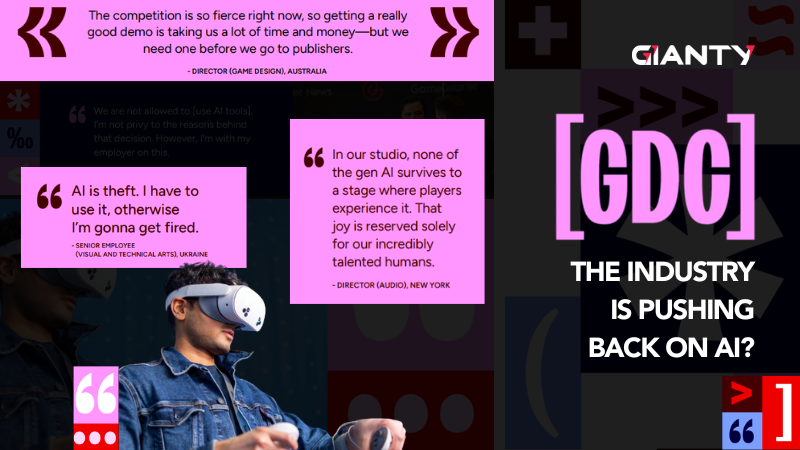
The takeaway for engineering specifically: AI raises the ceiling on what a strong external engineering team can deliver, but it raises the bar on how transparently they have to deliver it. Clients want the speed — and a documented human review layer they can point to. (We’ve written more on AI governance as the missing layer.)
The Pricing Signal: Engineering Is One of the Few Rates That Went Up
For years, external development lived under downward rate pressure. The XDS 2026 Insights Report says that pressure has eased — and engineering is a specific reason why.
Rates largely held flat in 2025–2026, with selective increases in Audio, Localization, QA, and Engineering. In other words, engineering is one of the disciplines where studios are willing to pay more, not less. The report’s framing:
“Quality, expertise, and delivery confidence now outweigh pure cost considerations in external partner selection.”
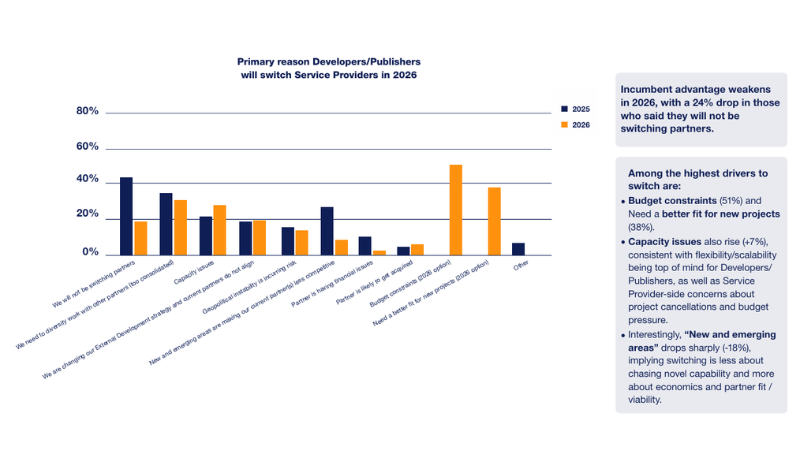
We’d add one honest caveat the report itself supports: budget still drives 51% of switching decisions, the single biggest factor. So this isn’t a market that stopped caring about cost — it’s a market that stopped treating specialized engineering as a place to cut it. The studios paying premium engineering rates are choosing partners more carefully, staying longer, and switching less. That’s the tier worth competing in.
The Catch: Outsourcing Engineering Carries a Higher Trust Tax in 2026
Here’s where the engineering opportunity meets the rest of the XDS 2026 story. As more studios move critical engineering work external, the cost of a bad engineering partnership goes up — because tools and systems sit at the center of production, not the edge.
The report’s friction data makes the stakes clear:
- Communication challenges are now the #1 source of friction for both sides, up +15% year over year. For engineering — where “approved” has to mean the same thing to a producer and a lead engineer, and where a misread spec can break a build for everyone — this is the whole game.
- Quality concerns remain at 42% — and much of that, the report argues, is a communication problem wearing a quality label.
- Bad previous experience is now the #1 barrier to new partnerships at 55% (up 10% YoY), while geography as an objection dropped 21 points. The world got smaller; memory didn’t.
- Incumbent advantage eroded 24% — a big drop in studios saying they will not switch partners. No engineering partnership is auto-renewed.
- Onboarding is a hidden tax on the buyer side: 90% of Service Providers say they onboard within 3 months, but only 61% of Developers/Publishers agree — a 29-point gap — and 13% of Developers/Publishers report onboarding delays of 6–9 months. For an engineering engagement gated by security reviews and repo access, that ramp can eat an entire milestone.
Read together, the message for any studio outsourcing engineering is this: the capability is now abundant, but the reliability is what you’re actually buying. The engineering partner that communicates clearly, onboards fast, and documents its decisions is worth more than a cheaper team you have to supervise line by line.
What to Look for in an External Engineering Partner
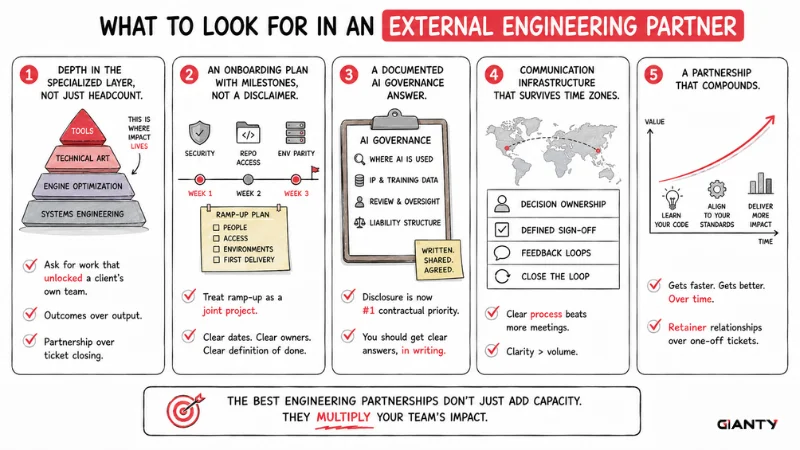
If engineering is moving from in-house-only to sourced-as-partnership, the evaluation criteria change. Based on the XDS 2026 data and our own delivery experience, here’s what separates a real engineering partner from a body-shop:
- Depth in the specialized layer, not just headcount. Tools, technical art, engine optimization, and systems engineering are where the 10%→34% growth is. Ask for work that unlocked a client’s own team — not just tickets closed.
- An onboarding plan with milestones, not a disclaimer. Given the 29-point onboarding-perception gap, the partner should treat ramp-up as a joint project with dates — security, repo access, environment parity — before the contract is signed.
- A documented AI governance answer. With disclosure now the #1 contractual priority, your engineering partner should already have written answers on where AI is used, what happens to your IP and training data, who reviews output, and what the liability structure is.
- Communication infrastructure that survives time zones. Since communication is the new #1 friction, look for clear decision ownership, defined sign-off, and feedback loops that close — not just “we use Slack.”
- A partnership that compounds. The best engineering relationships get faster and better as the team learns your codebase and your standards. That only happens in retainer structures over meaningful timelines — not one-off tickets.
GIANTY’s view: We’ve built toward exactly this since day one — tools development, technical art, engine-specific optimization, and systems engineering delivered to a Japanese quality standard, from our teams in Japan and Vietnam. Not as a vendor filling a gap, but as an engineering partner that becomes an extension of your team. The XDS 2026 data didn’t tell us to build this way. It just confirmed the market finally caught up to it.
The Bottom Line
The 10%→34% engineering jump is the clearest signal in the XDS 2026 Insights Report that external development has matured past art and animation into the technical core of production. Studios aren’t outsourcing engineering because they’ve given up on building teams — they’re doing it because the talent market broke the timing, AI raised the ceiling, and tools became too central to leave to a four-month hiring gap.
Engineering is now a discipline you source the way you source art: deliberately, from a partner you trust, with the reliability priced in. If you’re a studio rethinking where your engineering capacity comes from in 2026, that’s the conversation we’re glad to have.
FAQs
1. What did the XDS 2026 Insights Report say about engineering outsourcing? Engineering entered the top 3 external services for the first time at 34% of offerings — up from 10% the year before — landing just 1 percentage point ahead of Cinematics/VFX. The report attributes the jump to specialized engineering being faster to access externally than to hire and retain in a volatile talent market.
2. What kinds of game engineering are studios outsourcing? Primarily the specialized, upstream layer: tools development, technical art, engine-specific optimization, and systems engineering — the work the report describes as engineering “becoming a creative discipline” through the growth of tool development.
3. Why outsource game engineering instead of hiring in-house? The XDS 2026 Insights Report frames it as a timing and talent-market issue: specialized engineering capability is faster to source externally than to hire and retain internally, especially with platform competition intensifying and PC-market margins tightening.
4. Is AI reducing the need for external engineering? No — the report indicates AI tooling is accelerating engineering demand and helps explain engineering’s rise into the top 3. The winning pattern uses AI for volume and variation work while keeping human engineers on architecture, optimization, and review. Disclosure of AI use is now the #1 contractual priority for both buyers (29.2%) and providers (27.7%).
5. Did engineering outsourcing rates go up in 2026? Yes. While most external development rates held flat in 2025–2026, the report notes selective increases in Audio, Localization, QA, and Engineering — reflecting that quality, expertise, and delivery confidence now outweigh pure cost in partner selection, even though budget remains the top switching factor at 51%.