Indie studios are having a moment and it’s not an accident.
While AAA publishers burn through nine-figure budgets chasing the next photorealistic open world, something different is happening on Steam’s bestseller lists, on mobile charts, and inside small indie studios operating out of shared apartments and co-working spaces. 2D games are generating serious commercial returns. Teams of 3 to 15 people are shipping titles that sell hundreds of thousands of copies. The infrastructure that once required a publisher’s deal — distribution, tooling, production partnerships, global reach now fits inside a lean team’s monthly budget.
This is not a nostalgia cycle. It’s a structural realignment. The market has segmented. The tooling has matured. The outsourcing ecosystem has professionalized. And a generation of players has emerged that actively chooses 2D not as a compromise, but as a preference.
For founders, technical directors, and small game development indie studios paying close attention, 2026 is the best operating environment for an indie studio in the history of the medium. Here’s why and exactly what it takes to build effectively inside it.
TL;DR
- 2D games are commercially viable at indie scale — proven by titles like Hollow Knight, Hades, and Cuphead, with production costs that make strong ROI achievable for lean indie studio teams.
- The market shifted in indie studios’ favor — AAA publishers have retreated upmarket, leaving enormous space for differentiated, niche, and artistically distinct 2D games.
- Tooling is the great equalizer — Unity, Godot, Spine, and a mature outsourcing ecosystem give indie studio teams capabilities that once required publisher infrastructure.
- The Lean Production Triangle (scope / quality / speed) governs every small-team production — studios that manage it explicitly outperform those that don’t.
- Outsourcing is a production tool, not a last resort — but it only works when a studio has style guides, asset specs, and clear briefs ready before the first handoff.
- The biggest production risks are predictable — art consistency drift, animation scope underestimation, and QA debt are the three most common failure modes, all preventable with early process investment.
- 2026’s golden age is real, but earned — the studios that capitalize on it are the ones with disciplined production thinking, not just great ideas.
What Is the 2D Renaissance?
The 2D Renaissance refers to the commercial and creative resurgence of two-dimensional game development, driven by market shifts, tooling maturity, and a growing player preference for gameplay-first design over graphical spectacle.
The term captures a real pattern: 2D indie games are punching commercially far above their production cost. Titles with pixel art, hand-drawn animation, or stylized 2D visuals are generating revenue that, just a decade ago, would have required AAA production values to achieve.
The renaissance is not about retro aesthetics. It’s about the convergence of three forces: a maturing player audience that values artistry and mechanics over raw fidelity, a tooling ecosystem that makes 2D development faster than ever, and a distribution infrastructure (Steam, mobile storefronts, console digital channels) that gives small teams direct access to global audiences.
Why 2D Games Are Commercially Viable Again
Why are indie 2D games succeeding commercially in 2026? Several reinforcing factors explain it.
- Player audience segmentation. The global gaming audience has fragmented dramatically. There are now distinct, large segments of players who actively seek out 2D experiences — not as a compromise, but as a preference. The success of titles like Hollow Knight, Cuphead, Hades, and Shovel Knight demonstrated that 2D games with strong identity can achieve cultural reach comparable to high-budget 3D titles.
- Discovery infrastructure. Steam’s algorithm, combined with wishlist mechanics and content creator ecosystems, have created viable paths to visibility for small studios. A well-executed 2D title with a strong trailer can generate 50,000 wishlists before launch — a number that fundamentally changes the commercial calculation.
- Mobile market maturity. On mobile, 2D games dominate in volume and often in revenue. The casualization of the mobile audience has created massive commercial opportunity for studios that can produce high-quality 2D content efficiently — and the appetite for premium and mid-core 2D experiences continues to grow.
- Production cost asymmetry. A polished 2D game can be built for a fraction of the cost of a comparable 3D title. This cost asymmetry means that commercial returns which would barely break even on a 3D project become highly profitable for a 2D one.
What Has Changed in the Market?
The market of 2026 looks fundamentally different from 2016 in four key ways.
1. The AAA gap has widened. Major publishers are concentrating resources on fewer, bigger bets. This leaves enormous market space for differentiated experiences that large studios are structurally unable to produce — personal, weird, experimental, or niche games with strong artistic voice.
2. Remote game development is normalized. The production infrastructure for distributed teams — version control, real-time collaboration tools, async communication, milestone tracking — has matured to the point where geography is no longer a meaningful constraint. An indie studio in Warsaw can work with 2D game artists in Vietnam and a narrative designer in Canada without meaningful workflow friction.
3. The outsourcing ecosystem has professionalized. Game art outsourcing has evolved from an inconsistent quality to a structured service industry with production pipelines, QA checkpoints, and style-guide adherence that rival in-house standards. Indie studios that know how to brief and manage external partners can extend their effective team size without extending their payroll.
4. Engine access is democratized. Unity and other engines offer professional-grade 2D tooling to teams of any size. The technical barrier to shipping a commercially competitive 2D game has never been lower.
What Technologies Are Enabling Lean Indie Studios in 2026?
Game Engines
Unity remains the dominant choice for indie 2D game development, particularly for mobile and cross-platform titles. Its 2D toolset — including the 2D Physics system, Tilemap tools, the Universal Render Pipeline, and the 2D Animation package — gives small teams capabilities that previously required custom engine work. Unity’s asset store also accelerates prototyping significantly.
Godot has become a serious alternative, particularly for studios prioritizing open-source workflows and smaller build sizes. Its scene-based architecture is well-suited to 2D game development and its scripting language (GDScript) is accessible to small teams with mixed engineering backgrounds.
Art Production Tools
Tools like Aseprite, Procreate, Krita, and Clip Studio Paint have made professional-quality 2D game art creation accessible to artists at every career stage. Spine and DragonBones have standardized skeletal animation workflows for sprite animation, enabling studios to achieve smooth, expressive character animation without frame-by-frame production costs.
Pipeline and Collaboration Infrastructure
Git-based version control (GitHub, GitLab) combined with tools like Perforce for larger binary assets, Notion or Confluence for documentation, and Slack or Discord for team communication have created low-friction production environments for distributed teams.
The Lean Production Triangle
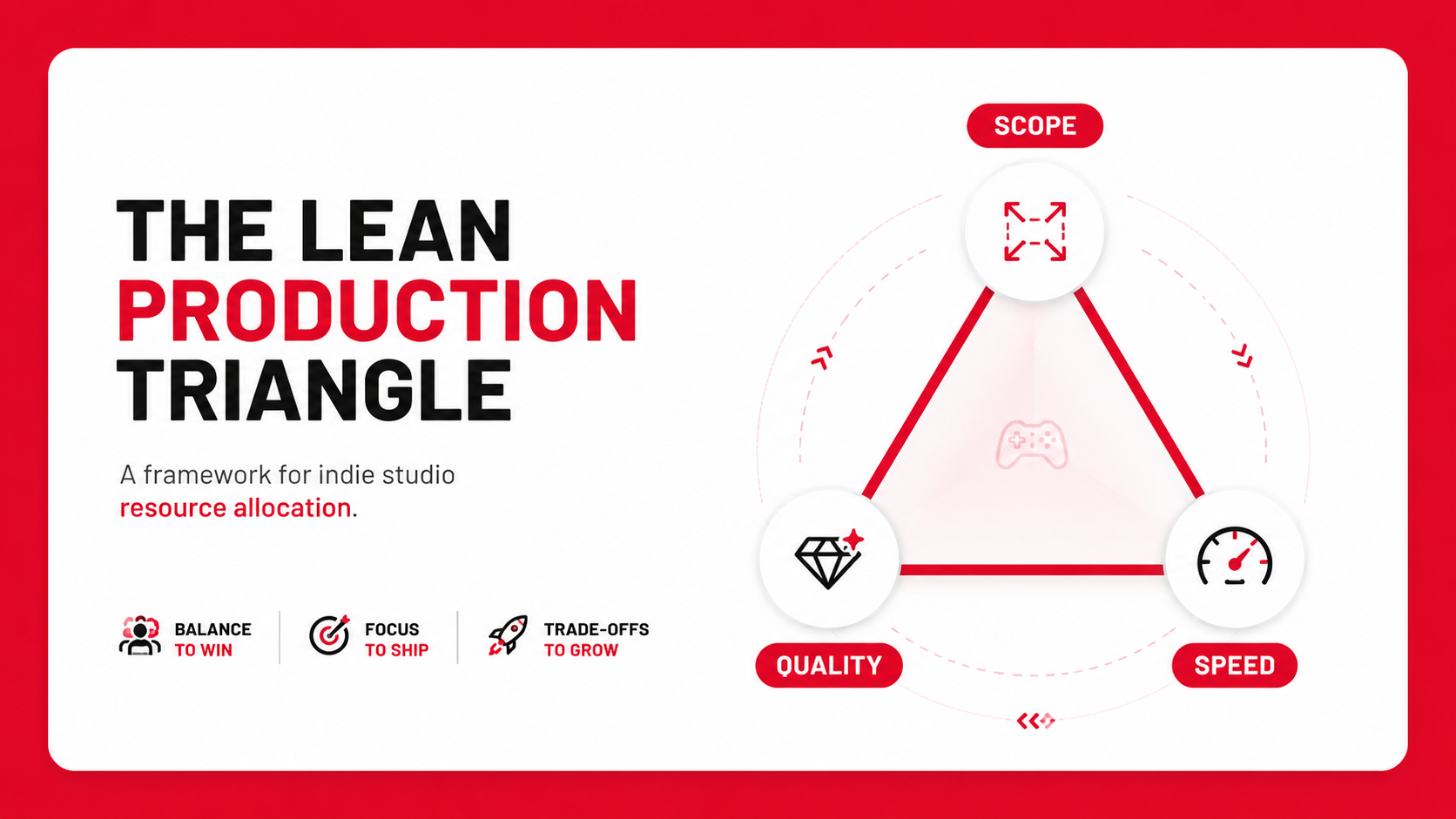
It identifies the three variables that every lean game development team must balance:
Scope is what the game contains — features, content volume, platform targets. Quality is the production standard — art fidelity, animation smoothness, bug tolerance, UX polish. Speed is the velocity at which the team can produce.
In a large studio, you can add headcount to move all three variables favorably. In a lean indie studio, improving two of these almost always creates pressure on the third.
The studios that succeed in 2026 have internalized this triangle. They scope aggressively, protect quality on the elements players will engage with most, and use outsourcing and tooling to extend speed without compromising the other two.
Production pipelines often break when studios try to expand scope mid-production without adjusting quality expectations or timeline. We’ve observed this pattern repeatedly: a team ships an Early Access build, player feedback asks for more content, and the team attempts to deliver scope expansion at the same quality level on the same schedule. The result is usually a delayed full release, team burnout, or visible quality degradation in the expanded content.
Production Challenges For Indie Studios That Still Exist
Lower barriers to entry have not eliminated production difficulty. They’ve shifted where difficulty concentrates.
- Art consistency across a full production. This is the challenge most studios underestimate entering full production. A 2D game art might require thousands of assets like environments, UI elements, character animations, VFX, cutscene art. Maintaining visual consistency across all of these, especially when working with multiple artists or external partners, requires rigorous style guides, reference packs, and QA checkpoints that small teams rarely plan for early enough.
- Art consistency usually becomes a crisis around alpha — when the full content set is in-engine for the first time and visual inconsistencies become visible at game speed. By that point, rework is expensive.
- Animation pipeline bottlenecks. Sprite animation is deceptively time-intensive. A single character with a complete animation set (idle, walk, run, attack, hit, death, plus special moves) can represent two to four weeks of work for an experienced animator. Studios frequently underestimate animation scope, leading to cuts or quality compromises late in production.
- QA at scale. A 2D game with procedural elements, branching narrative, or significant content volume presents QA challenges that a two-person team cannot adequately address. Many indie studios ship with preventable regression bugs because QA was treated as a final-stage activity rather than an ongoing pipeline function.
- Communication in distributed teams. Remote game development is viable — but it requires explicit communication infrastructure. Async handoffs between time zones, ambiguous art briefs, and undocumented design decisions create compounding friction. One lesson we’ve seen repeatedly: studios that invest in documentation early — style guides, technical specs, asset naming conventions — recover from setbacks faster than studios that don’t.
2D vs 3D Development: A Practical Comparison
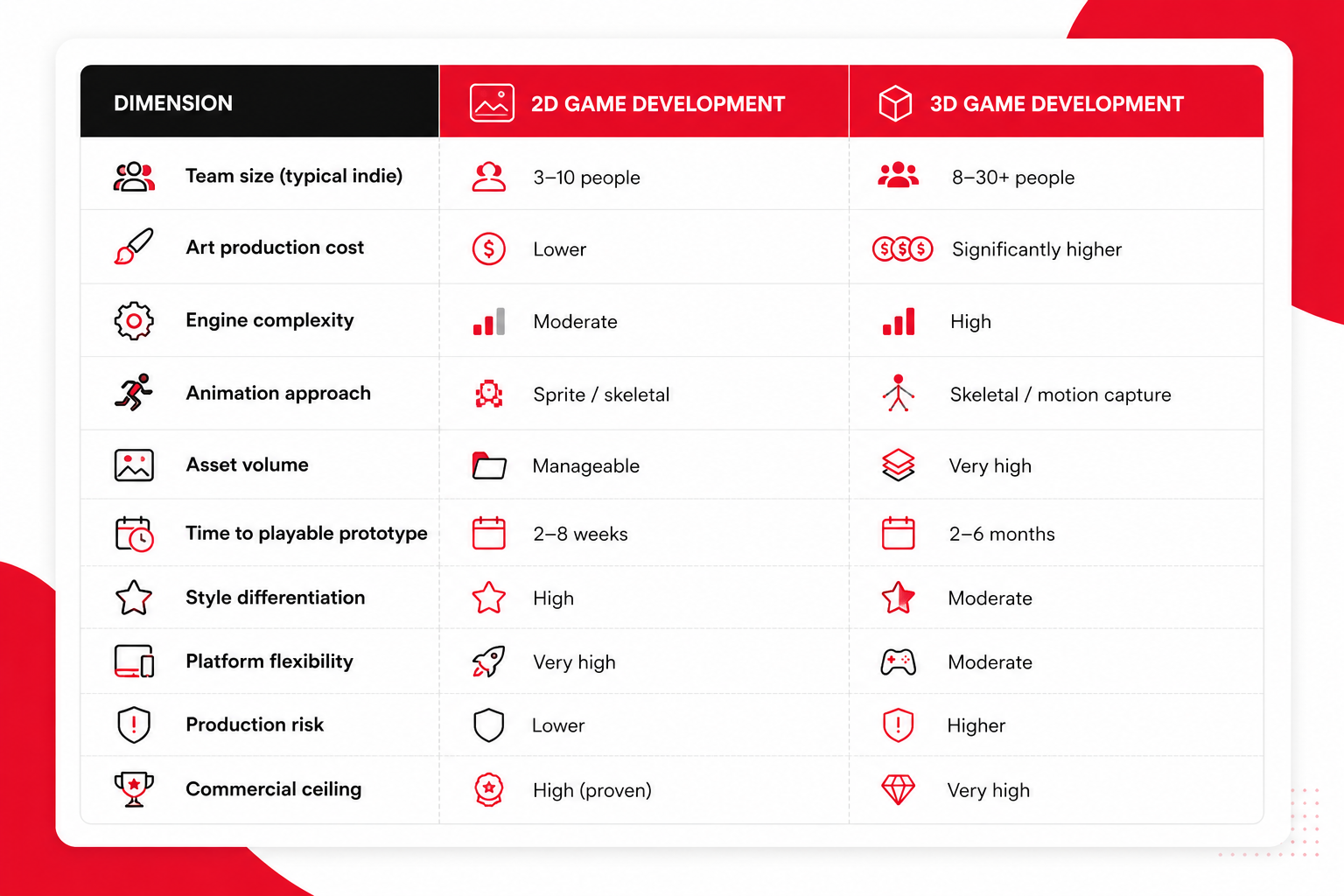
For a lean indie studio, 2D development offers a fundamentally better risk-adjusted profile. The commercial ceiling is real — it has been proven across multiple platforms and genres. And the production risk is substantially lower, which matters enormously for a small team where a failed production can end the studio.
Lean Indie Studio Team vs Large Studio: Where the Advantage Lies
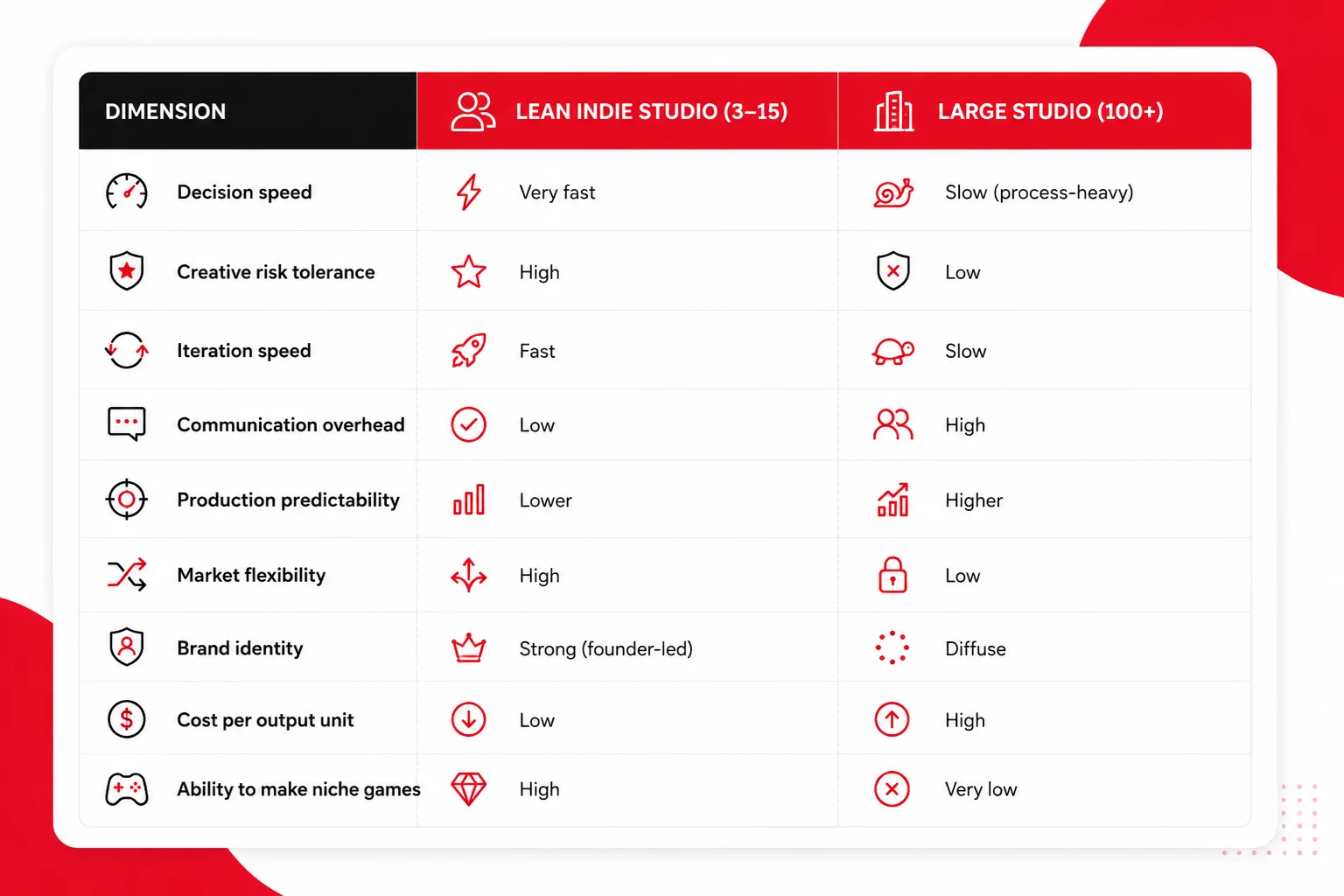
The lean indie studio’s structural advantages — speed, creative freedom, and low communication overhead — are most powerful in the early and middle stages of production. The risks concentrate in production at scale: content volume, QA coverage, and consistent output pace over 18–24 months.
This is precisely the gap where outsourcing partnerships become strategically valuable.
When Should an Indie Studio Outsource?
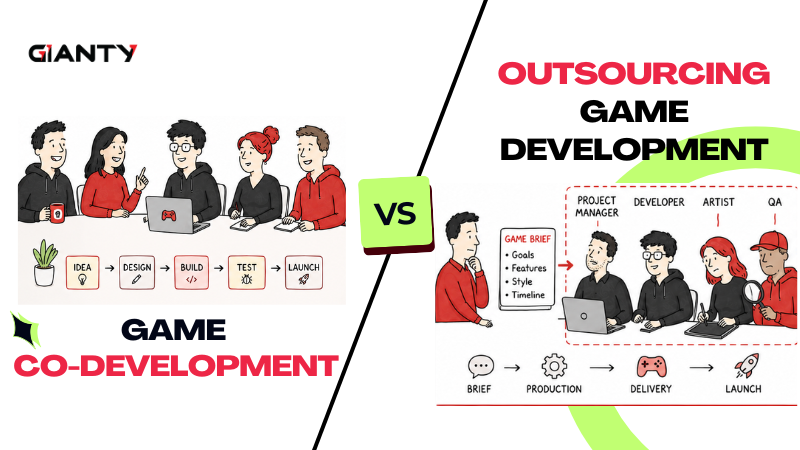
Game outsourcing is not a sign of a team’s limitations — it’s a production tool. Used correctly, it extends a studio’s effective output without increasing fixed headcount, which is critical for a small team managing cash flow across a multi-year development cycle.
The right time to consider outsourcing is when:
- Production volume outpaces in-house capacity. If your art backlog is growing faster than your team can process it, outsourcing is often more efficient than hiring.
- A specific skill is needed on a time-limited basis. Bringing in a specialist animator for a final boss sequence, or a UI/UX artist for the menus, is more cost-effective than hiring full-time.
- QA coverage is insufficient. A dedicated QA partner can provide test coverage that a small development team cannot maintain while shipping.
- The team is approaching a milestone and needs surge capacity. External production capacity can be scaled up for a sprint and reduced afterward — something headcount cannot do.
The biggest mistake isn’t outsourcing too early. It’s outsourcing without adequate documentation. An external partner cannot match your style without a detailed style guide. They cannot meet your technical requirements without clear specs. The cost of a poor brief is almost always higher than the time saved by skipping it.
7 Signs Your Indie Studio Is Ready to Outsource
Use this checklist to evaluate readiness before engaging an external partner:
- You have a finalized and documented art style — with references, color palettes, and character sheets that an external artist can follow without constant guidance.
- Your asset pipeline is defined — you know your resolution standards, naming conventions, export formats, and engine import workflows.
- You have a clear art backlog — at least 3–4 weeks of structured work that can be handed off without requiring real-time design decisions.
- You have dedicated bandwidth for partner management — someone on the team who can review deliverables, give structured feedback, and maintain communication rhythm.
- You have milestone clarity — external partners work best when they understand what they’re delivering toward, not just the next task.
- Your budget includes outsourcing costs as a line item — not as a contingency.
- You’ve defined quality acceptance criteria — you can describe what “good” looks like in measurable terms (asset count, style match, technical spec adherence).
In-House vs Outsourcing: A Decision Framework
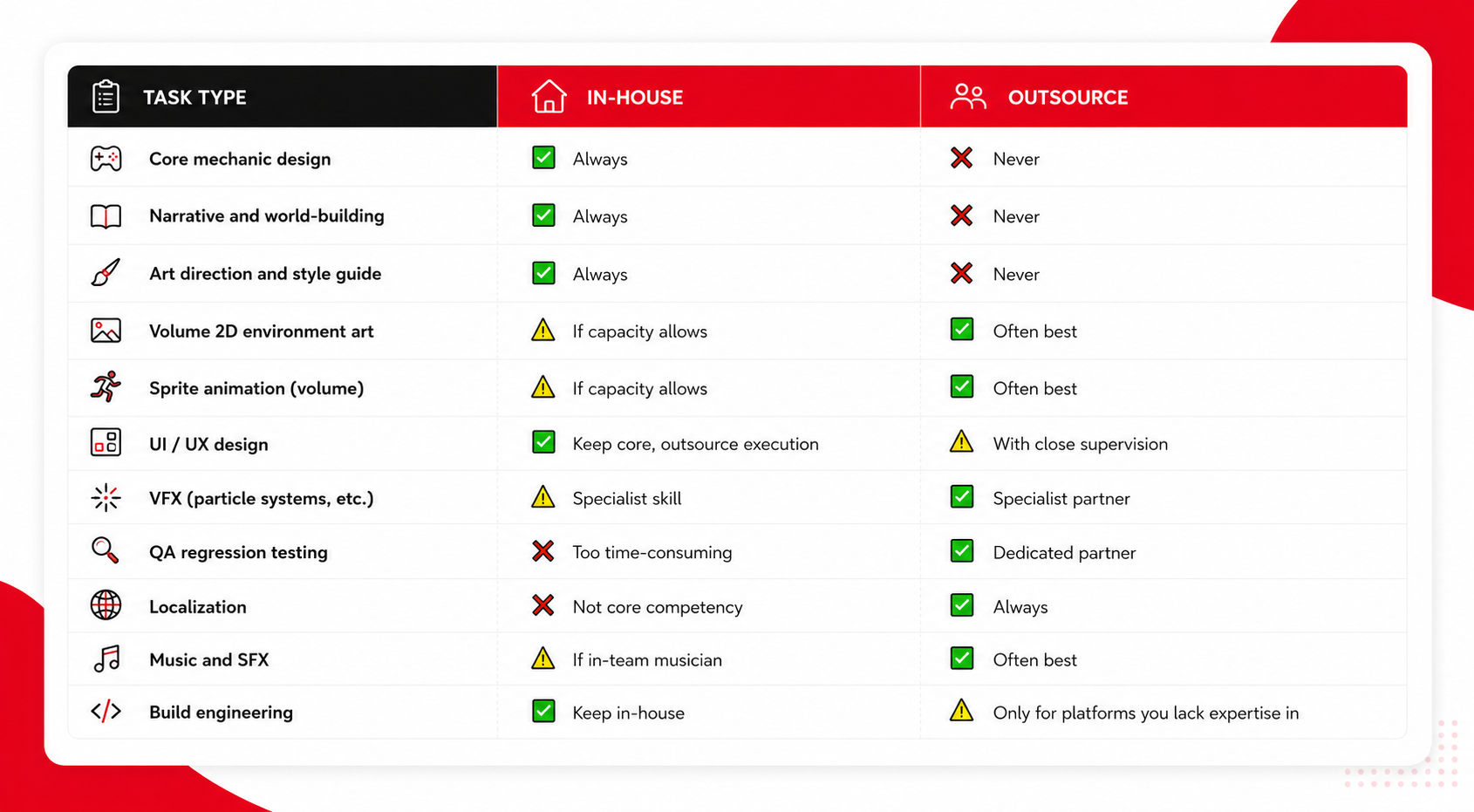
When we ask about “In-house or outsourcing?” – The answer is consistent: keep creative direction and systems design in-house; extend production volume, QA, and specialist skills externally.
How to Build a Scalable Production Pipeline for Indie Studios
A scalable production pipeline is one that maintains quality and velocity as content volume increases. For a 2D indie game, this means structuring your workflow around these stages:
Stage 1 — Pre-Production (Months 1–3)
- Finalize game design document (core loop, feature set, content scope)
- Define art style and produce style guide with reference sheet
- Build technical specifications (resolution, export formats, naming convention)
- Prototype core mechanics to validated fun
- Identify which content categories will require external production support
Stage 2 — Vertical Slice (Months 3–5)
- Produce one complete level or chapter at full quality
- Stress-test the art pipeline, including any external partner workflows
- Resolve technical dependencies (shader setup, animation rig standards, UI framework)
- Use this stage to validate your quality bar before scaling content production
Stage 3 — Alpha (Months 5–14)
- Full content production phase — environments, characters, animations, UI
- Weekly asset review checkpoints to catch style drift early
- Begin QA regression testing at the end of each sprint, not at the end of Alpha
- Maintain a living backlog with scope explicitly managed against timeline
Stage 4 — Beta (Months 14–18)
- Content complete; focus shifts to polish, bug fixing, and balance
- QA coverage expands — including external QA partners for platform certification
- Localization, accessibility pass, store page preparation
- Press and content creator outreach
Stage 5 — Launch and Post-Launch (Month 18+)
- Day-one patch preparation
- Community management
- DLC or update roadmap scoped to actual team capacity — not wishlist
Production Cost Comparison
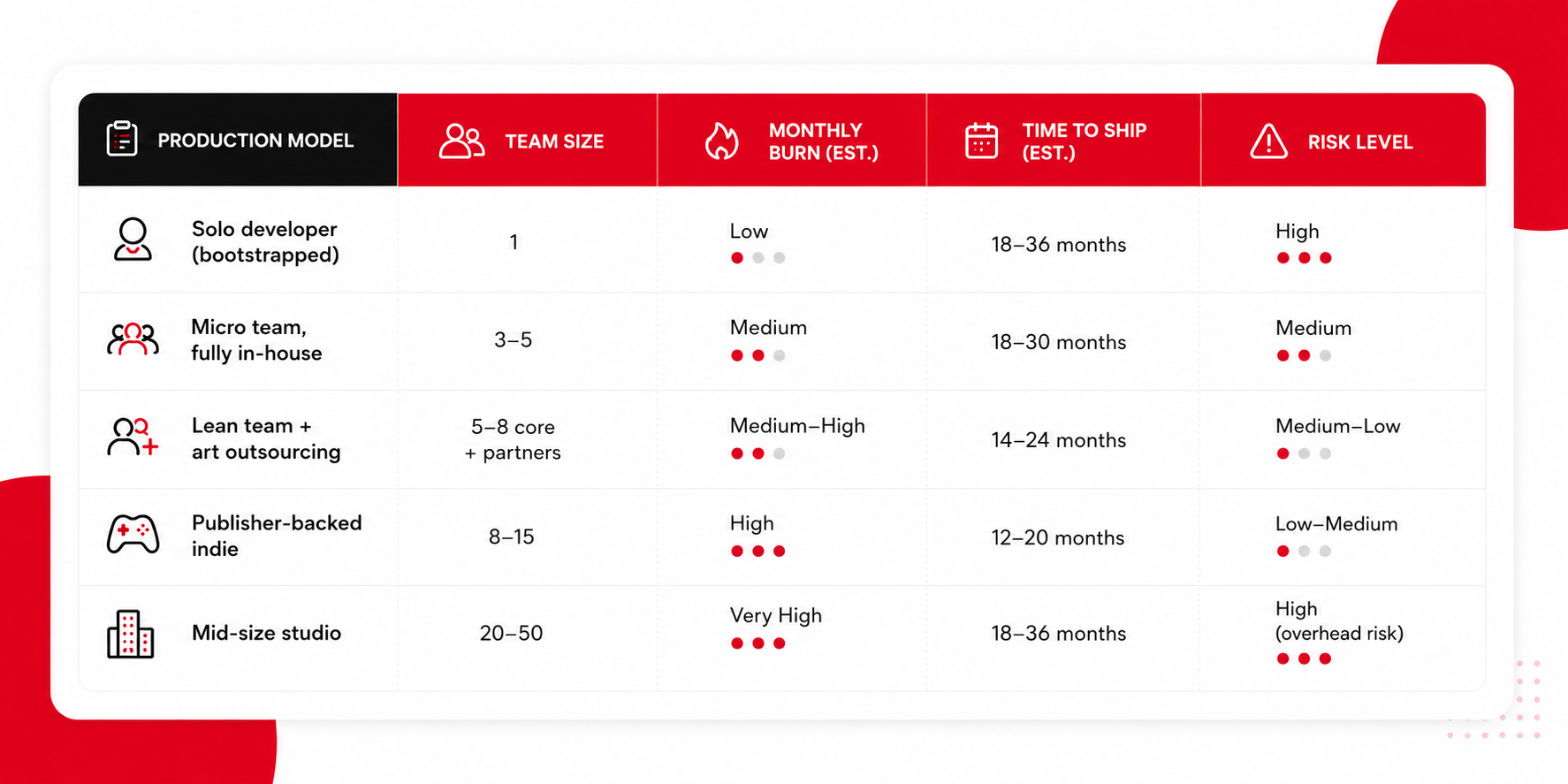
The sweet spot for risk-adjusted production in 2026 is the lean indie studio with targeted outsourcing model. It keeps fixed overhead low while giving access to production capacity that scales with project needs.
Common Mistakes New Indie Studios Make
What mistakes do new indie studios most commonly make in game production?
We’ve worked alongside enough game teams to see the patterns repeat.
1. Scoping to ambition, not capacity. Most first-time studios build a game design document that reflects what they want to make, not what they can make in the time and budget available. The result is a production that never finishes — or finishes at dramatically reduced quality.
2. Skipping the style guide. Art direction without documentation is art direction that only lives in the art director’s head. The moment a second artist joins — or an external partner is engaged — without a style guide, visual inconsistency begins accumulating.
3. Treating QA as a final-stage activity. QA integrated throughout development catches regressions early. QA as a final check before launch creates a bug backlog that delays shipping and increases launch risk.
4. Underestimating animation scope. Studios consistently budget for the number of characters, not the number of animation states per character. A game with five characters and twenty animation states each is one hundred distinct animations. At even one week per animation (a fast pace for quality work), that’s two years of one animator’s time.
5. Hiring generalists when specialists are needed. A 2D game artist and a 2D animator are different skills. A programmer and a technical artist are different roles. Small teams try to find unicorns; experienced teams hire for the specific bottleneck.
6. Starting external partner conversations too late. Finding, evaluating, onboarding, and aligning with an outsourcing partner takes time. Studios that wait until they’re in production crisis before reaching out are always negotiating from a weak position.
Summary: Why is 2026 the Golden Age for Lean Indie Studios?
Because the conditions that once required publisher infrastructure — distribution, discoverability, production tooling, and outsourcing partnerships — are now accessible to small teams operating independently.
2D game development specifically offers a risk-adjusted production profile that is uniquely favorable for lean studios. The commercial ceiling is proven. The tooling is mature. The audience is large and growing. And the cost asymmetry versus 3D means that commercially viable returns are achievable at a production budget that a small team can actually reach.
The production challenges are real — art consistency, animation scope, QA coverage, distributed team communication — but they are solvable. Studios that invest in documentation, build structured external partnerships, and apply disciplined milestone planning to lean production are building the capabilities that compound across projects.
From more than two decades of working alongside game teams — from small indie studios to major Japanese publishers — the pattern is consistent: the studios that succeed long-term are not the ones with the biggest budgets. They’re the ones with the clearest production thinking.
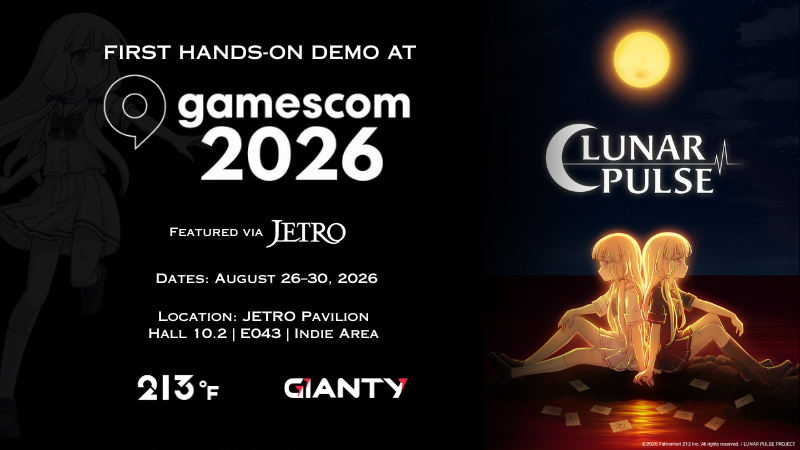
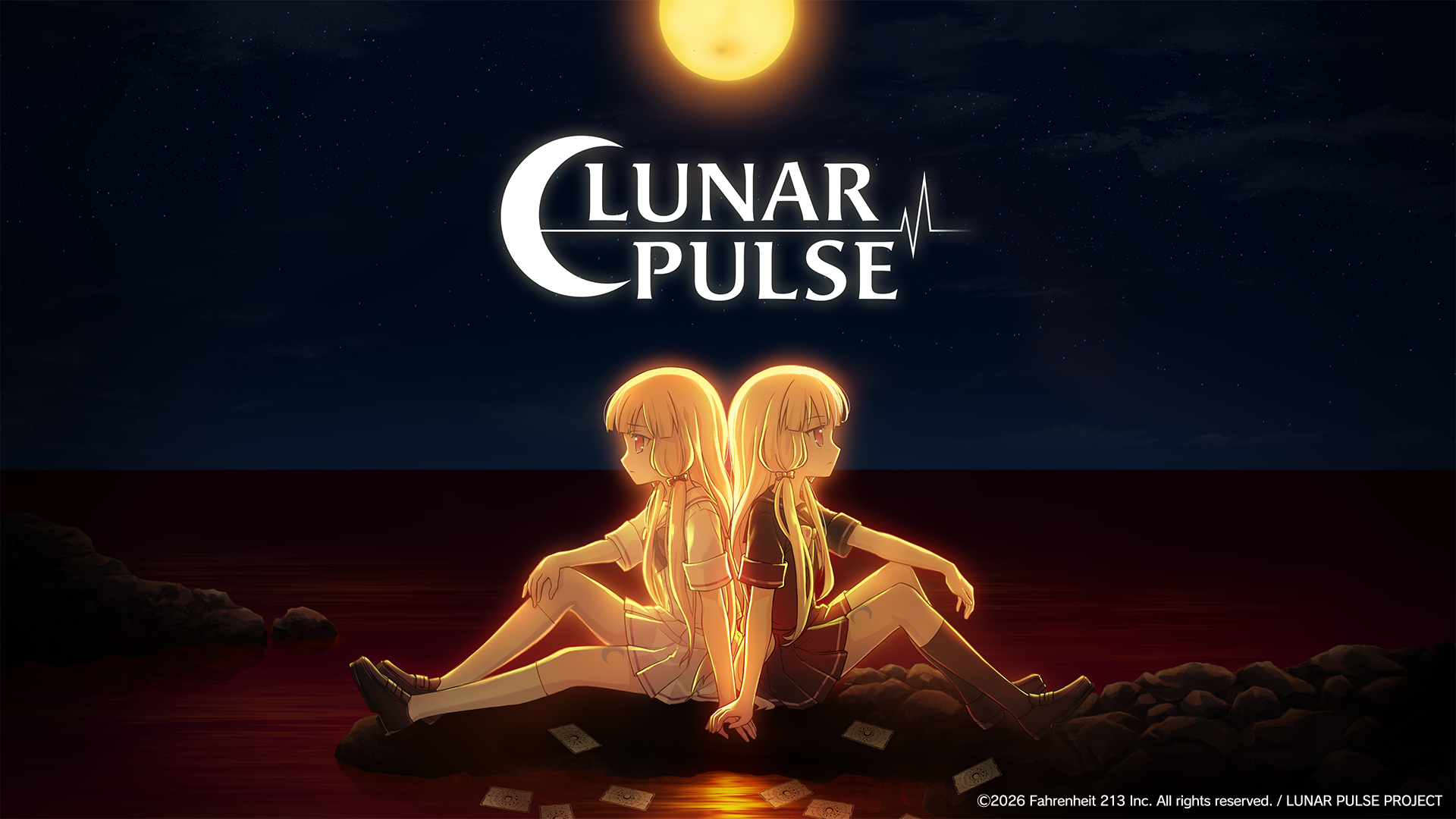
LUNAR PULSE is the product of a creative co-dev between two Japan-based studios in 2026: Fahrenheit 213 (213℉), the studio behind acclaimed works such as Fate/Grand Order, Kingdom Hearts, and Dissidia Final Fantasy, and GIANTY, a company specializing in game development, AI development and also known as the developer of GOKEN title.
For GIANTY, LUNAR PULSE represents more than a development project – it reflects our continued dedication to partnering with world-class creators to bring original, emotionally resonant games to players around the world. We are honored to co-develop this title alongside 213℉, and we look forward to sharing more updates as LUNAR PULSE moves toward its 2027 Steam release.
FAQ
- What is an indie studio? An indie studio is a game development team that operates without publisher financial control, typically 1–30 people, self-funded or independently backed, with full creative ownership of their titles.
- Why are 2D games popular again in 2026? Three reasons: players actively choose 2D as a preference (not a compromise), discovery platforms like Steam make small titles visible globally, and 2D production costs are low enough that commercial returns are achievable without publisher scale.
- How much does it cost to develop a 2D indie game? A lean team of 5–8 people with targeted outsourcing can ship a competitive 2D title in 18–24 months. Exact costs depend on team size, outsourcing scope, and location — but the cost-to-revenue ratio is significantly better for 2D than 3D at indie scale.
- When should an indie studio outsource art production? When your art backlog grows faster than your team can clear it, when you need a specialist skill temporarily, or when you’re approaching a milestone and need surge capacity. Prerequisite: a documented style guide and clear asset specs before the first handoff.
- What is the best engine for 2D indie game development? Unity for cross-platform and mobile reach; Godot for open-source workflows and smaller builds. Choose based on your team’s existing expertise — switching engines mid-production is almost always more costly than staying with a familiar tool.
- What are the biggest production mistakes indie studios make? Scoping to ambition rather than capacity, skipping the art style guide, treating QA as a final-stage activity, underestimating animation volume, and waiting until production crisis to contact outsourcing partners.
- How does GIANTY help indie studios? GIANTY provides 2D art production, animation, Unity development, and QA services — acting as a production partner embedded in the team’s pipeline, not a vendor processing orders. With 20+ years working alongside game studios worldwide, the focus is on Japanese-standard quality delivered at accessible pricing for teams that need to scale output without scaling headcount.
Ready to Build Faster?
If your studio is approaching production scale and you’re evaluating how to extend your team’s output without adding permanent headcount, we’re happy to talk through your pipeline.
GIANTY works with indie studios and game publishers worldwide from early 2D prototypes through full production support and QA. [Talk to our team →]